
Traditional vs Modern Industrial Instrumentation and Control Systems: Differences and Upgrade Paths
On this page
Most plants are not either traditional or modern; they are layers of both. A refinery may run a current DCS connected to 1980s transmitters, and a food factory may have new packaging lines next to relay-controlled utilities. Understanding what each generation does well, and where the real risks are, helps decide what to upgrade first.
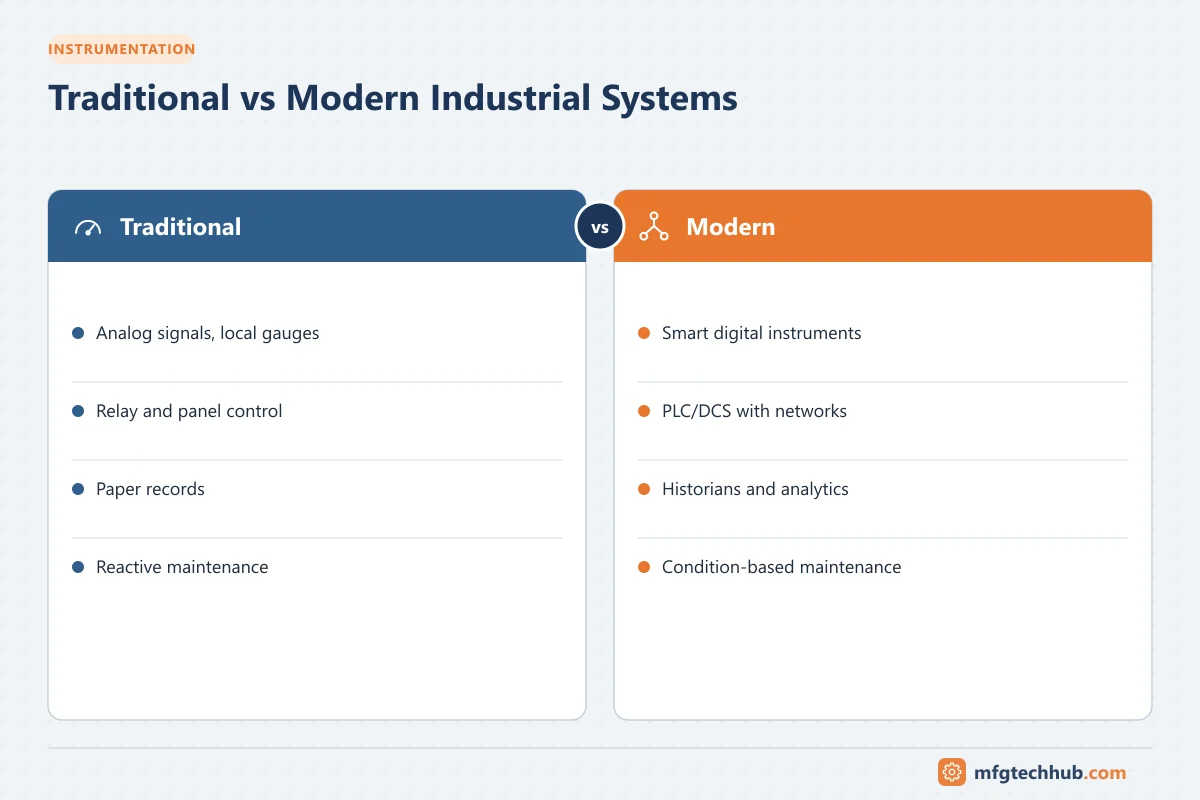
Side by side
| Aspect | Traditional | Modern |
|---|---|---|
| Field instruments | Pneumatic (3–15 psi) or analog 4–20 mA; local gauges | Smart transmitters with HART, fieldbus, wireless or Ethernet-APL; diagnostics |
| Control | Panel controllers, relay logic, hard-wired interlocks | PLC and DCS with software logic and redundancy |
| Operator interface | Mimic panels, indicators, chart recorders | HMI and SCADA displays, alarm management |
| Records | Paper charts and logbooks | Historians, electronic records, MES |
| Maintenance | Time-based, run to failure | Condition-based, predictive, asset management systems |
| Changes | Rewiring and re-piping | Configuration changes under change control |
| Security | Isolated by design | Networked; requires cybersecurity management |
What traditional systems do well
- Simplicity: a relay circuit or pneumatic loop can be understood and repaired with basic tools.
- Isolation: no network means no remote cyberattack path.
- Longevity: many pneumatic and analog devices run for decades.
- Independence: hard-wired protective circuits do not depend on software.
Some of these strengths are deliberately kept in modern plants: hard-wired emergency stops and independent safety functions are good practice. See Functional Safety.
What modern systems add
- Diagnostics: smart devices report their own health (NAMUR NE 107). See Industry 4.0 and Smart Instrumentation.
- Data: historians and MES keep complete, searchable records.
- Flexibility: logic and recipes change without rewiring.
- Remote support and analytics: condition monitoring and remote expertise.
- Integration: production, quality and maintenance systems share data.
The real risks of old systems
| Risk | Why it matters | Typical sign |
|---|---|---|
| Obsolescence | Spare parts and support disappear | Parts bought from surplus dealers |
| Knowledge loss | Few people understand the system | Undocumented changes, one “expert” |
| Hidden drift | Analog devices drift without warning | Frequent disagreement with lab results |
| No diagnostics | Failures found only when something goes wrong | Surprise trips |
| Documentation gaps | Drawings no longer match the plant | Loop checks reveal differences |
Modern systems have their own risks: cybersecurity, software lifecycles, complexity and dependence on networks and power. Neither generation is risk-free.
Upgrade paths for brownfield plants
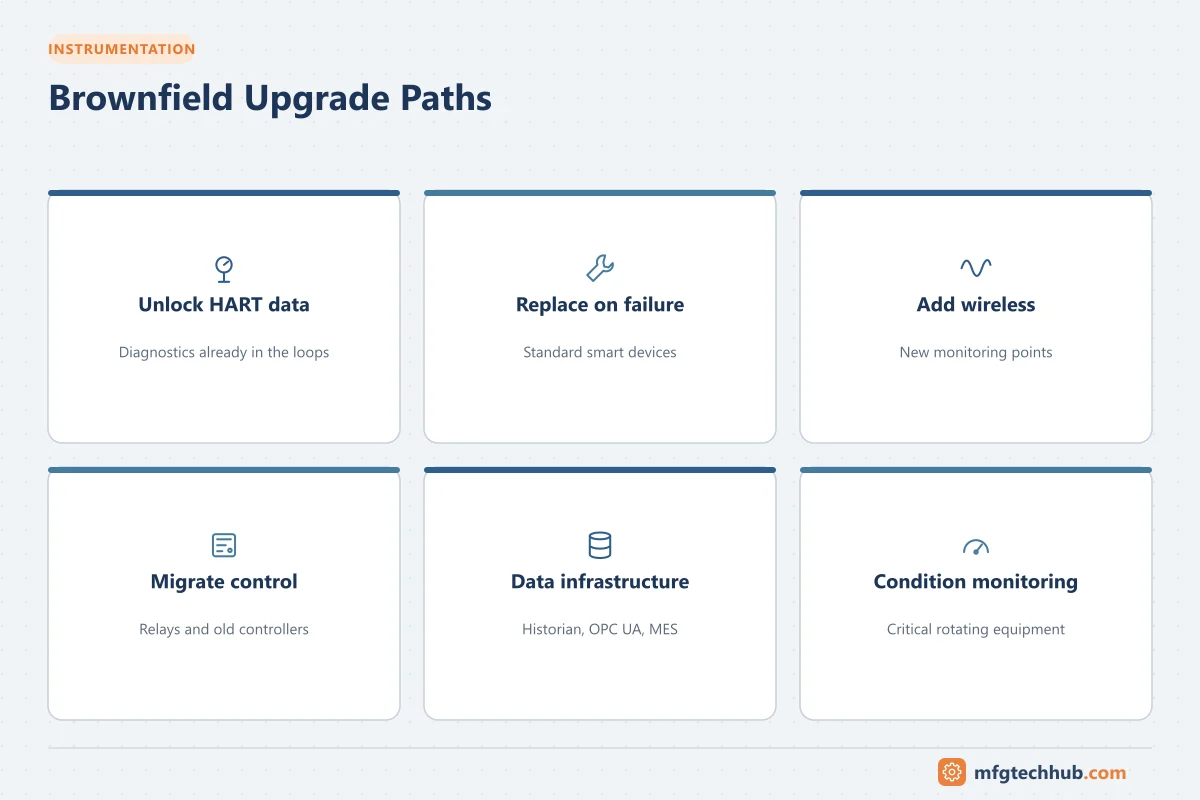
| Approach | What it involves | When it fits |
|---|---|---|
| Unlock existing data | Use HART data already in 4–20 mA loops through HART-capable I/O or multiplexers | Many smart devices installed, no diagnostics used |
| Replace on failure with smart devices | Standard smart device types as old ones fail | Steady modernisation without big projects |
| Add wireless monitoring | WirelessHART or other wireless sensors for new measurements | Monitoring points too expensive to cable |
| Control system migration | Replace relay logic or old controllers with PLC/DCS, often in phases | Obsolete control hardware |
| Add data infrastructure | Historian, OPC UA, MES connectivity | Data needed for quality, energy or maintenance |
| Condition monitoring | Vibration, thermography, motor analysis | Critical rotating equipment |
See PLC Migration and DCS Migration Challenges.
How to prioritise
- Safety first: protective functions that are obsolete or undocumented.
- Production risk: equipment whose failure stops the plant and cannot be repaired quickly.
- Value: measurements that affect quality, energy or throughput.
- Opportunity: combine upgrades with planned shutdowns.
Keep documentation current during every change; a modern system with wrong drawings is not an improvement. See Management of Change in Best Practices.
Frequently asked questions
Are pneumatic instruments still used?
Yes. Pneumatic control valves and actuators remain standard, and some pneumatic transmitters and controllers are still in service, especially in older plants and in areas where electrical equipment is difficult to install.
Should a plant replace all old instruments at once?
Rarely. Most plants upgrade by risk and value: safety-related and obsolete items first, then measurements that affect quality, energy or throughput, often during planned shutdowns.
Are modern systems always more reliable?
Not automatically. They add diagnostics and redundancy, but also software, networks and cybersecurity risks that must be managed.
Key takeaways
- Most plants are a mix of traditional and modern systems.
- Traditional systems are simple and isolated; modern systems add diagnostics, data and flexibility.
- The real risks of old systems are obsolescence, knowledge loss and hidden drift.
- Upgrade in steps, prioritised by safety, production risk and value.
Related tutorials
Before you apply this in a plant: this article is for education. Always check the current edition of the relevant standards, the manufacturer's documentation for your exact product and version, and your site's procedures. Safety-related work needs qualified personnel. See our editorial policy.