
Power Quality Analyzers and Harmonic Measurement
On this page
Power quality describes how close the electrical supply is to an ideal, steady sine wave at the correct voltage and frequency. Modern plants are full of electronics, variable frequency drives, PLCs and computers that are sensitive to poor power quality, and many of them also create it. Power quality analyzers measure disturbances and harmonics so engineers can find the causes of unexplained trips, overheating and equipment failures.
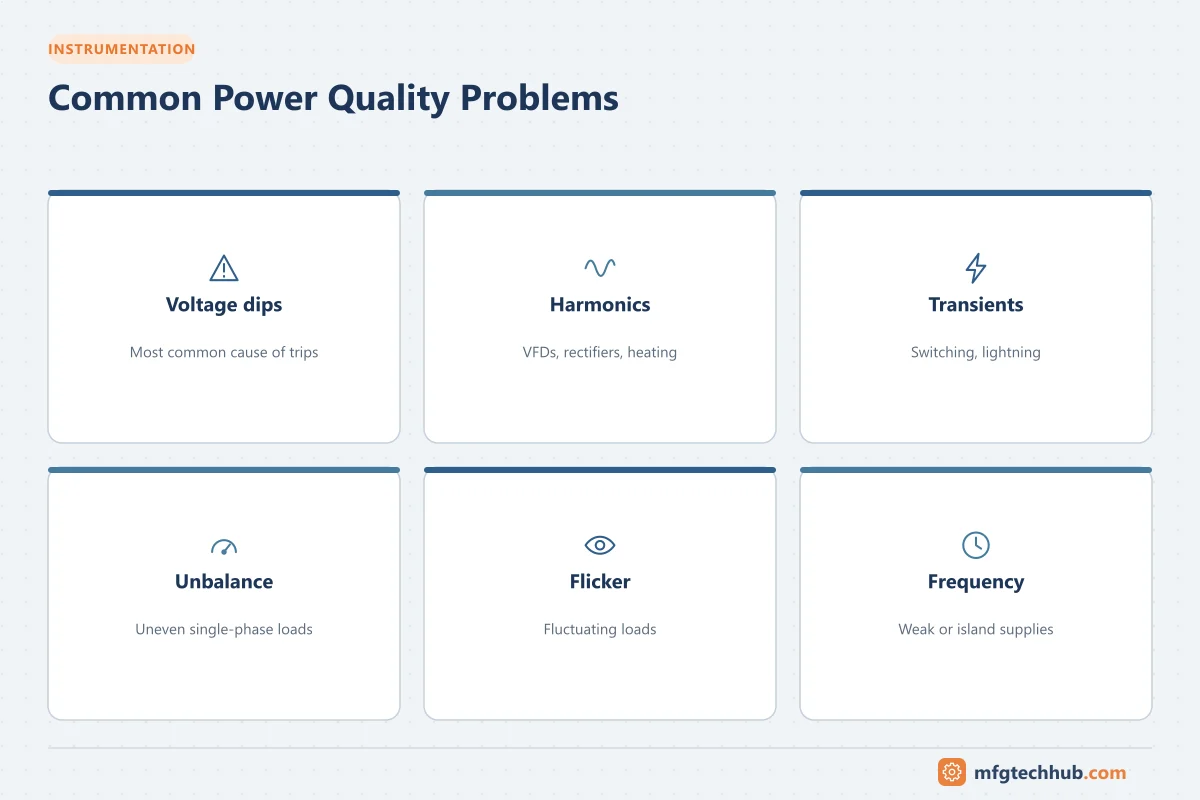
Common power quality problems
| Disturbance | Description | Typical causes | Typical effects |
|---|---|---|---|
| Voltage sag (dip) | Short reduction in voltage, typically lasting from half a cycle to about a minute | Faults on the network, large motor starts | Drive trips, contactor dropout, PLC resets |
| Voltage swell | Short increase in voltage | Switching off large loads, faults on other phases | Stress on electronics |
| Interruption | Loss of voltage | Faults, protection operation | Production stoppage |
| Transient | Very fast spike | Lightning, capacitor switching, inductive load switching | Damage to electronics, insulation stress |
| Harmonics | Waveform distortion at multiples of the fundamental frequency | VFDs, rectifiers, UPS, LED lighting, computers | Overheating of transformers, cables and motors; nuisance tripping |
| Flicker | Rapid voltage fluctuation visible in lighting | Arc furnaces, welders, fluctuating loads | Lighting flicker, operator discomfort |
| Unbalance | Unequal voltages on three phases | Uneven single-phase loads | Motor heating and derating |
| Frequency variation | Deviation from 50/60 Hz | Weak or islanded supplies, generators | Timing and speed errors |
Voltage sags are the most common power quality problem in industry and a frequent cause of unexplained process trips.
Harmonics explained
A harmonic is a voltage or current at an integer multiple of the fundamental frequency. On a 50 Hz system, the 5th harmonic is 250 Hz and the 7th is 350 Hz.
Nonlinear loads draw current in pulses rather than smooth sine waves. A standard six-pulse VFD rectifier, for example, produces characteristic harmonics of order 5, 7, 11, 13 and so on.
Total Harmonic Distortion (THD)
THD (%) = √(H2² + H3² + H4² + ... ) ÷ H1 × 100where H1 is the fundamental and H2, H3… are harmonic magnitudes. Engineers distinguish:
- Current THD (THDi): how distorted the load current is
- Voltage THD (THDv): how distorted the supply voltage is, which affects every load on the network
Current distortion from one load becomes voltage distortion for everyone when it flows through the impedance of transformers and cables.
Effects of harmonics
- Extra heating in transformers, motors and cables
- Triplen harmonics (3rd, 9th, 15th) adding in the neutral conductor of three-phase four-wire systems, which can overload neutrals
- Resonance with power factor correction capacitors, causing capacitor failures
- Nuisance tripping of breakers and malfunction of sensitive electronics
- Metering and protection errors
What a power quality analyzer does
A power quality analyzer is an advanced meter that records waveforms and events over time. Typical capabilities:
- Voltage and current on all phases and neutral
- Harmonics up to the 50th order or higher, and interharmonics
- Event capture: sags, swells, interruptions and transients with waveform snapshots
- Flicker measurement
- Unbalance, frequency and power factor
- Long-term logging with time synchronization
Portable vs permanent analyzers
- Portable analyzers are connected temporarily, typically for a week or more, to troubleshoot a problem or survey a site.
- Permanently installed analyzers on main incomers and critical feeders provide continuous monitoring and evidence when disputes arise with the utility.
Key standards
| Standard | Purpose |
|---|---|
| IEC 61000-4-30 | Measurement methods for power quality parameters; Class A instruments give comparable, repeatable results |
| IEC 61000-4-7 | Harmonic and interharmonic measurement techniques |
| IEC 61000-4-15 | Flicker measurement |
| EN 50160 | Voltage characteristics of public supply networks in Europe |
| IEEE 519 | Recommended limits for harmonic voltage and current at the point of common coupling |
| IEEE 1159 | Recommended practice for monitoring electric power quality |
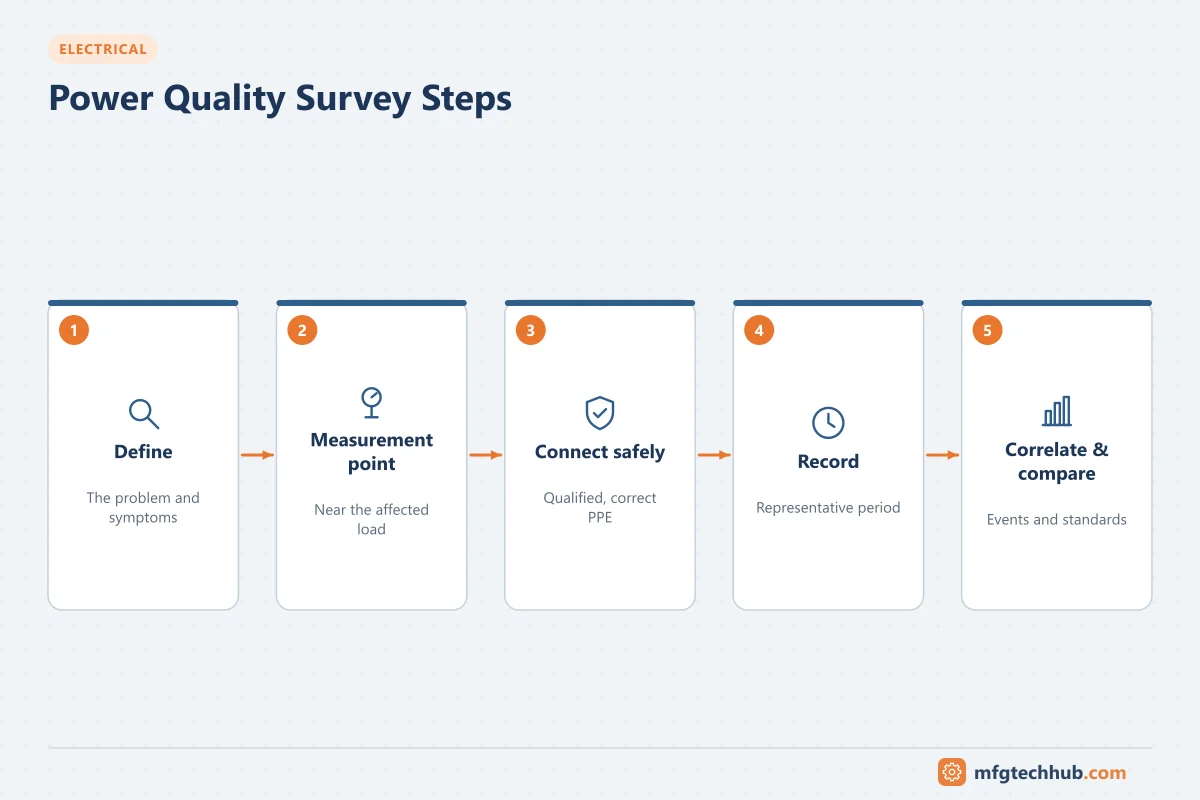
How to perform a power quality survey
- Define the problem: equipment failures, trips, overheating, capacitor failures, or a compliance check.
- Choose the measurement point: start at the main incomer, then move closer to affected equipment.
- Connect safely using appropriate PPE and CAT-rated equipment, and verify CT orientation.
- Record for a representative period, typically at least a full production week.
- Correlate events with equipment trips, production logs and utility events.
- Compare results with standards and equipment tolerances.
Common solutions
| Problem | Possible solutions |
|---|---|
| Harmonics from drives | Line reactors or DC chokes, passive harmonic filters, 12- or 18-pulse drives, active front-end drives, active harmonic filters |
| Capacitor resonance | Detuned (reactor-protected) capacitor banks |
| Voltage sags | Ride-through settings on drives, UPS for control power, dynamic voltage restorers, relay and contactor selection |
| Transients | Surge protective devices; see Surge Protection and Lightning Arresters |
| Neutral overheating | Oversized neutrals, K-rated transformers, harmonic mitigation |
| Unbalance | Redistribution of single-phase loads |
Key takeaways
- Voltage sags and harmonics are the most common industrial power quality problems.
- THD measures waveform distortion; current harmonics cause voltage distortion across the network.
- Power quality analyzers record events and harmonics according to IEC 61000-4-30 and related standards.
- Solutions range from simple ride-through settings to active harmonic filters.
Related tutorials
Before you apply this in a plant: this article is for education. Always check the current edition of the relevant standards, the manufacturer's documentation for your exact product and version, and your site's procedures. Safety-related work needs qualified personnel. See our editorial policy.