
Earth Leakage Protection: ELCB, RCCB, RCBO and RCD Types
On this page
A short circuit is detected by overcurrent protection, but many dangerous faults draw only a small current: a damaged cable touching a metal enclosure, moisture in a junction box, or a person touching a live conductor. Earth leakage protection detects these small currents flowing to earth and disconnects the circuit before they cause electric shock or fire.
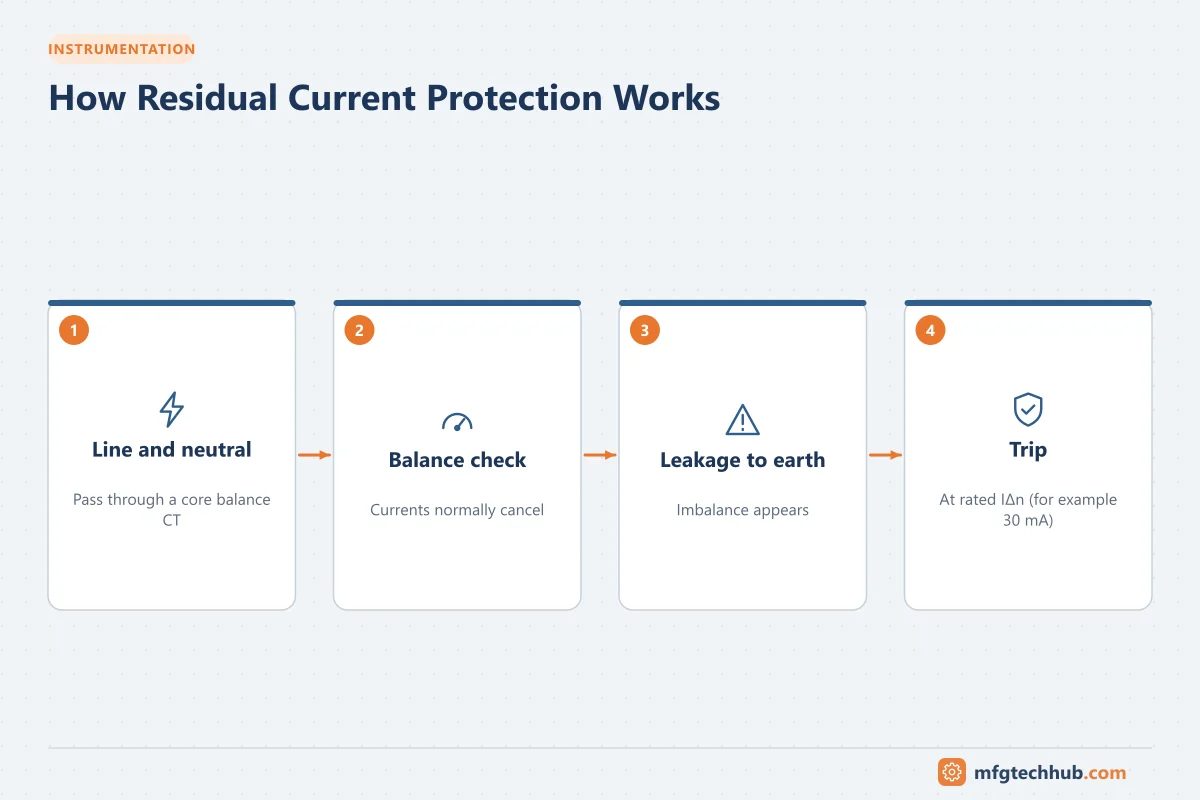
How residual current protection works
A residual current device (RCD) passes all live conductors (phases and neutral) through a toroidal current transformer. In a healthy circuit, the currents going out and coming back cancel, so the net (residual) current is zero. If some current leaks to earth, for example through a person or damaged insulation, the currents no longer balance. When the residual current exceeds the device’s rated sensitivity (IΔn), it trips.
Healthy: I(L1) + I(L2) + I(L3) + I(N) = 0
Fault:   residual current = current leaking to earth → trip if above IΔn
ELCB, RCCB, RCBO: the terminology
| Term | Meaning |
|---|---|
| ELCB (voltage-operated) | An older device that detected voltage on the earth conductor; largely obsolete because it fails to detect some faults |
| ELCB (colloquial) | Often used loosely to mean any earth leakage breaker, including current-operated RCDs |
| RCD | General term for residual current devices |
| RCCB | Residual current circuit breaker without overcurrent protection (IEC 61008) |
| RCBO | Residual current breaker with integral overcurrent protection (IEC 61009) |
| Earth leakage relay + core-balance CT | Separate relay and sensor, used with MCCBs or contactors on larger or industrial circuits, with adjustable sensitivity and time delay |
An RCCB must always be protected by an upstream MCB or fuse, because it does not protect against overloads or short circuits.
Sensitivity ratings
| Rated residual current (IΔn) | Main purpose |
|---|---|
| 10 mA / 30 mA | Additional protection of people against electric shock (sockets, portable equipment, wet areas) |
| 100 mA | Protection of circuits and some equipment |
| 300 mA / 500 mA | Fire protection and equipment protection |
| Adjustable (for example 30 mA to 30 A) with time delay | Earth leakage relays on industrial feeders, allowing selectivity |
A 30 mA RCD must trip within about 300 ms at IΔn and much faster at higher residual currents (around 40 ms at 5 × IΔn), limiting the energy of an electric shock.
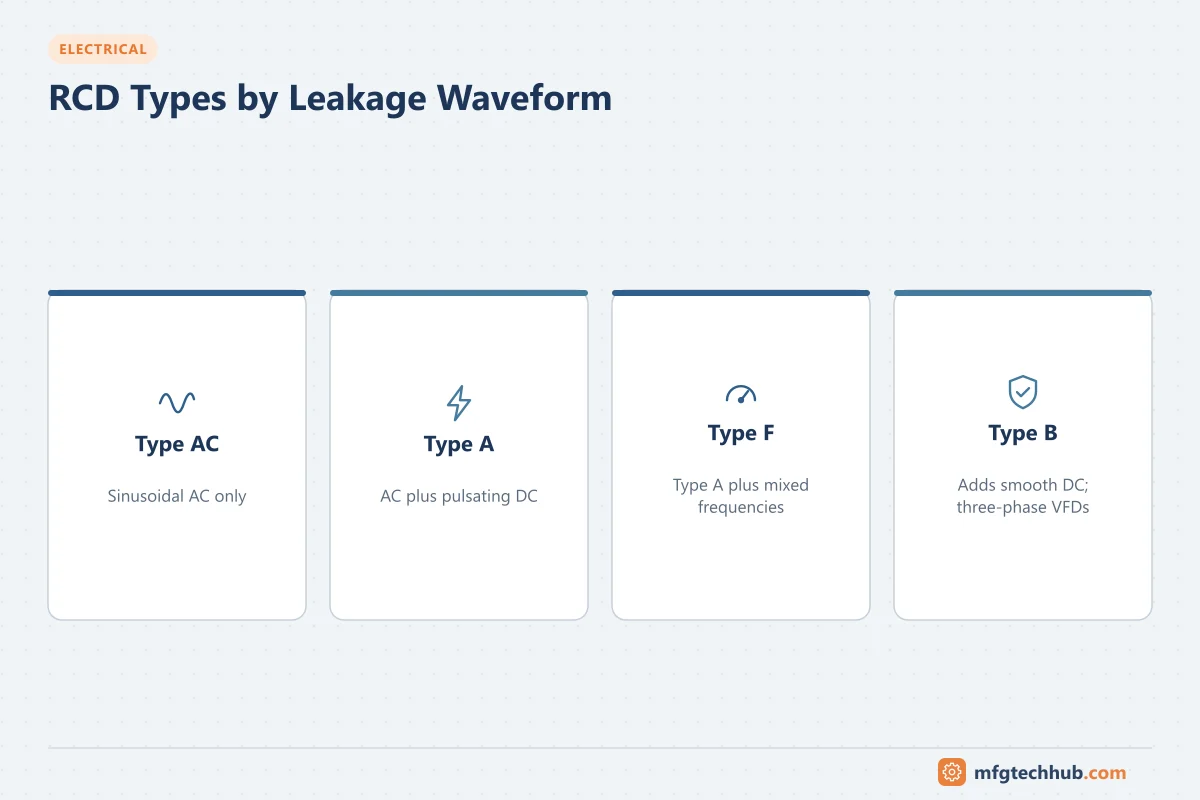
RCD types: matching the leakage waveform
Modern loads, especially electronics and drives, can produce leakage currents that are not pure AC sine waves. The RCD type must match:
| Type | Detects | Typical loads |
|---|---|---|
| AC | Sinusoidal AC residual current | Simple resistive and inductive loads (restricted or not permitted in some countries) |
| A | AC plus pulsating DC | Single-phase electronics, many appliances |
| F | Type A plus mixed-frequency currents | Single-phase VFDs, heat pumps, washing machines |
| B | Type F plus smooth DC and high-frequency currents | Three-phase VFDs, EV chargers, solar inverters, medical equipment |
Using a Type AC or A device on a circuit with three-phase drives can blind the RCD to DC leakage, so it may fail to trip. Always check the drive or equipment manual for the required type.
Nuisance tripping
Earth leakage devices sometimes trip without a dangerous fault. Common causes:
- VFD EMC filters and long screened motor cables that create high-frequency capacitive leakage to earth
- Many loads on one RCD, whose normal leakages add up
- Moisture in outdoor junction boxes and cable glands
- Switching transients and lightning surges
- Neutral-to-earth connections downstream of the RCD
Solutions include splitting circuits across several RCDs, choosing RCDs designed for drive circuits, using time-delayed (S-type) devices upstream for selectivity, and fixing moisture and insulation problems. Never bypass an RCD to stop nuisance trips.
Selectivity between RCDs
When RCDs are installed in series, the upstream device should be time-delayed (type S) and have a higher sensitivity rating, so that a fault on a final circuit trips only the local device.
Relationship to earthing systems
The need for and behavior of RCDs depends on the system earthing arrangement:
- In TT systems, where fault loop impedance is high, RCDs are often essential for automatic disconnection.
- In TN systems, overcurrent devices usually provide fault protection, and RCDs add protection for sockets and specific locations.
- In IT systems, insulation monitoring devices alarm on the first fault.
See Grounding and Earthing Techniques.
Testing and maintenance
- Press the test button regularly (commonly recommended quarterly or as local regulations require). It checks the mechanism.
- Perform periodic trip time and trip current tests with an RCD tester during electrical inspections.
- Record test results and replace devices that fail or trip slowly.
- Measure insulation resistance on circuits with frequent trips.
Key takeaways
- RCDs detect imbalance between outgoing and returning currents and trip on earth leakage.
- 30 mA devices protect people; higher ratings protect equipment and against fire.
- RCD type (AC, A, F, B) must match the load’s leakage waveform, especially with drives.
- Nuisance tripping has causes that can be fixed; RCDs must never be bypassed.
Related tutorials
Before you apply this in a plant: this article is for education. Always check the current edition of the relevant standards, the manufacturer's documentation for your exact product and version, and your site's procedures. Safety-related work needs qualified personnel. See our editorial policy.