
What Is a DCS? Distributed Control Systems Explained, from Field Signal to Operator
On this page
A distributed control system (DCS) is a control system for a whole process plant in which control is distributed across many controllers, each responsible for part of the plant, while operators supervise and run everything from a central control room. All parts share one engineering database and are supplied as one integrated system by one vendor. Refineries, chemical plants, power stations, pharmaceutical plants and large water treatment works run on a DCS.
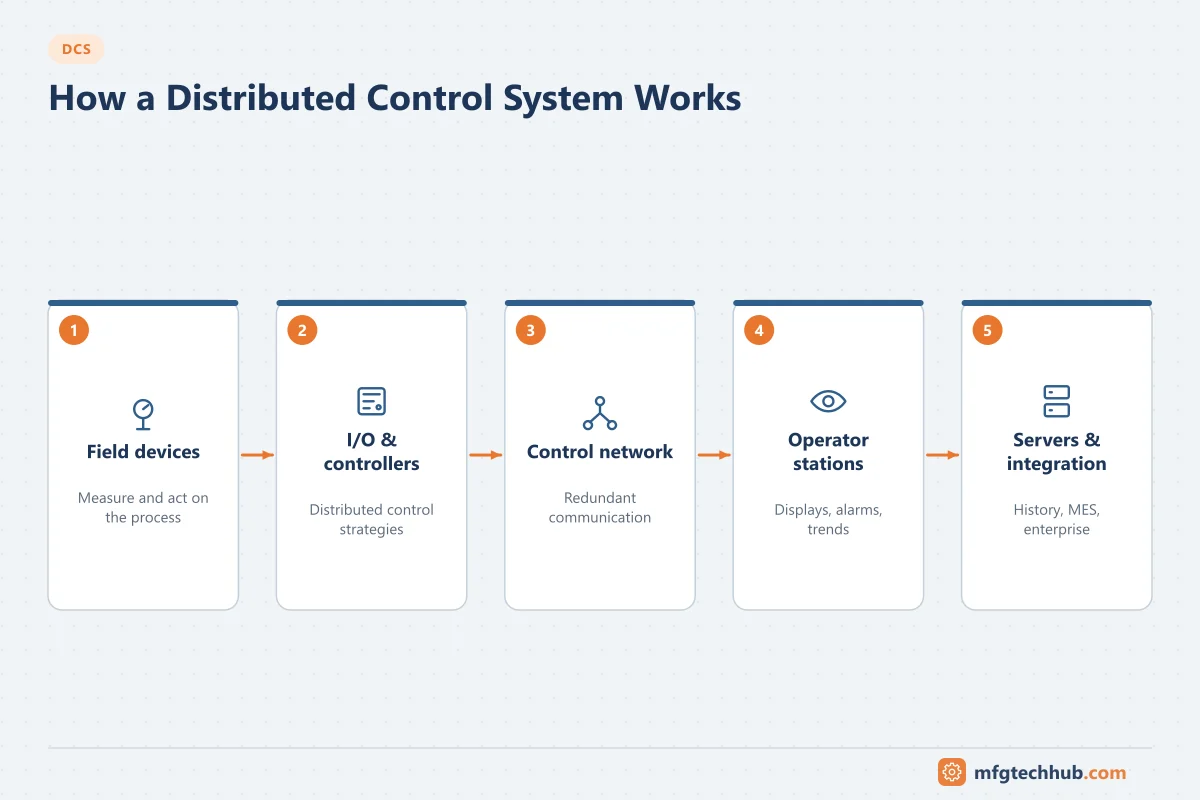
What is “distributed” in a DCS?
Before DCS, plants were controlled either by individual panel instruments (one controller per loop) or, in some plants from the 1960s, by one central computer. A central computer was a single point of failure for the whole plant. A DCS distributes the control processing over many controllers, so the failure of one affects only its part of the plant, and controllers are usually redundant as well. What stays central is the operator interface, the engineering database and the history. See History and Evolution of DCS.
The main parts of a DCS
| Part | Role | Detail page |
|---|---|---|
| Field devices | Transmitters, analysers, valves, motors measure and act on the process | Field Devices |
| I/O modules | Convert field signals to digital values and back | Controllers and I/O |
| Controllers | Execute control strategies for their part of the plant, usually redundant | Controllers and I/O |
| Control network | Redundant network linking controllers, stations and servers | Network Topologies and Protocols |
| Operator stations | Displays, alarms, trends and commands for operators | Operator and Engineering Stations |
| Engineering stations | Configure strategies and displays, download changes | Operator and Engineering Stations |
| Servers | Configuration database, historian, alarm journal, interfaces | DCS Servers |
How these parts are arranged in levels is explained in DCS Hierarchy and Layers.
How a DCS works: one control cycle
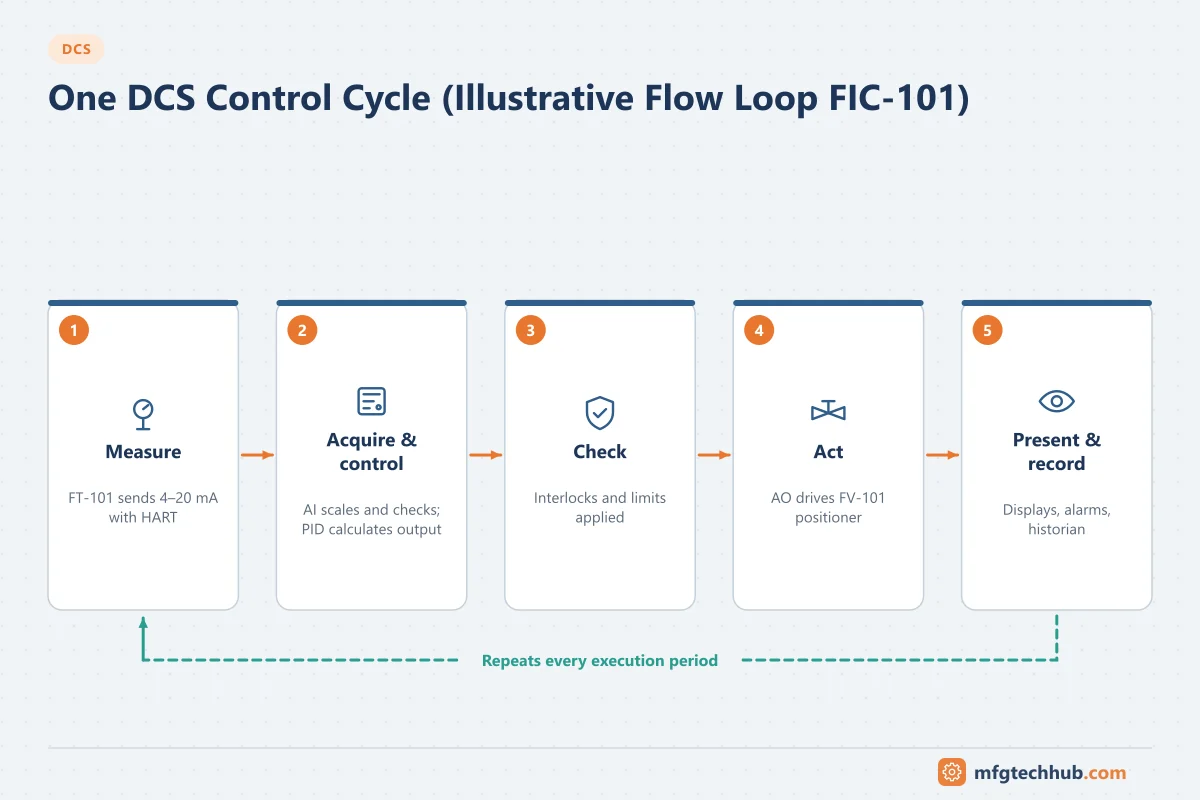
Every control module in a controller repeats the same cycle at its configured execution period, often between 100 ms and a few seconds depending on the loop. Taking a flow loop FIC-101 as an illustrative example:
| Step | What happens | Where |
|---|---|---|
| 1. Measure | Flow transmitter FT-101 sends 4–20 mA (with HART) | Field |
| 2. Acquire | The AI channel converts the current to a value, checks for failure signals, and scales to engineering units | I/O module and controller |
| 3. Control | The PID block compares the flow with the setpoint and calculates a new output | Controller |
| 4. Check | Interlocks and limits are applied (for example output forced closed if the pump is stopped) | Controller |
| 5. Act | The AO channel sends 4–20 mA to the valve positioner of FV-101 | I/O module and field |
| 6. Present | New values and any alarms are sent to operator stations | Control network and stations |
| 7. Record | Values and events are stored in the historian and alarm journal | Servers |
The operator can change the setpoint or switch the loop to manual on the faceplate. The command goes to the controller, which checks it and applies it in the next cycle. For the details of this loop in function blocks, see Setting Up Control Loops.
Beyond single loops, a DCS runs advanced strategies (cascade, ratio, feedforward, override; see DCS Control Strategies), sequences and batch phases (ISA-88), and motor and valve logic with interlocks.
What makes a DCS different
- One integrated database. A tag is configured once; its alarm limits, faceplate, history and security follow automatically.
- Redundancy as standard. Controllers, networks, power supplies and servers are designed to fail over without upsetting the process.
- Online changes. Strategies can be changed and downloaded while the plant runs.
- Built for continuous and batch processes. Large numbers of PID loops, advanced control and batch management are part of the product.
- Plant-wide operation. Operators can see and control the whole plant from the control room, with areas assigned to consoles.
DCS, PLC and SCADA
| DCS | PLC | SCADA | |
|---|---|---|---|
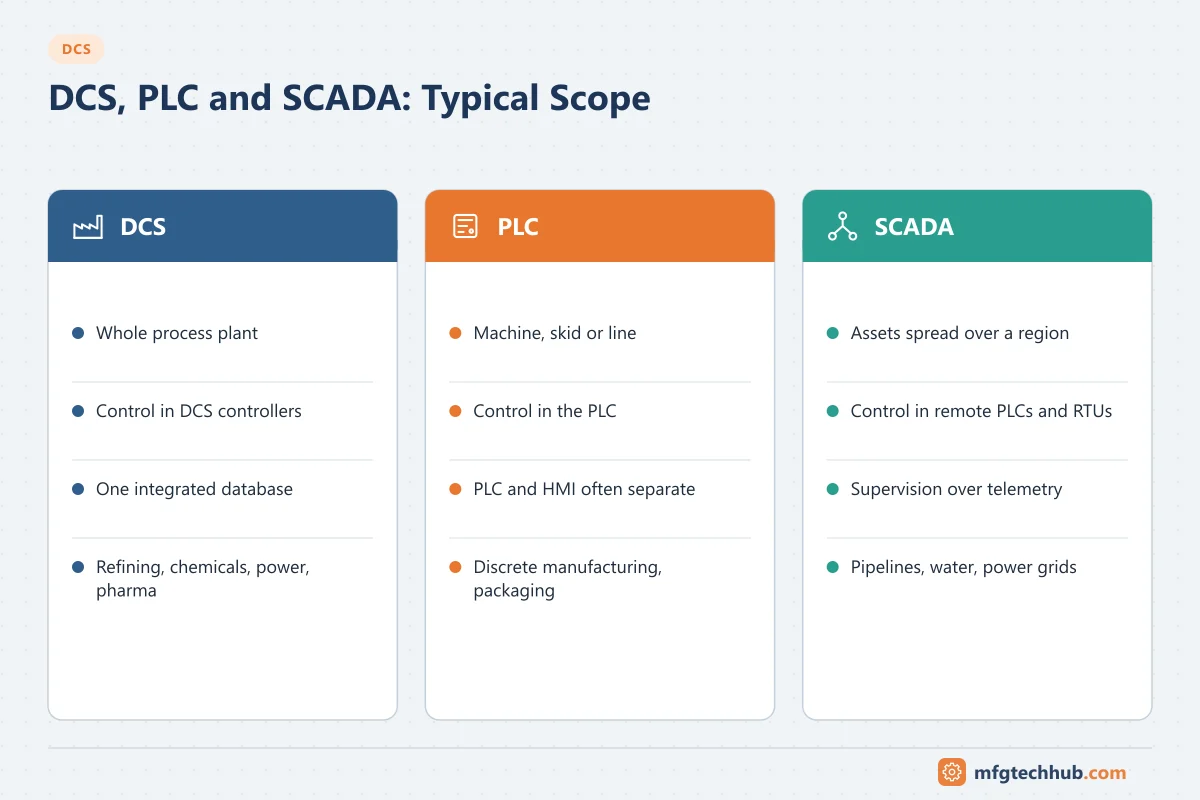
| Typical scope | Whole process plant | Machine, skid or production line | Geographically spread assets |
| Control located in | DCS controllers | The PLC | PLCs and RTUs at remote sites; SCADA supervises |
| Engineering | One integrated system | PLC and HMI often configured separately | SCADA plus separate controller programming |
| Typical industries | Refining, chemicals, power, pharma | Discrete manufacturing, packaging, machines | Pipelines, water networks, power grids |
The boundaries have blurred: modern PLCs handle process control, and DCS platforms integrate PLCs. See DCS vs PLC and What Is SCADA?.
Where DCS is used
DCS fits plants where a process runs continuously or in batches, stoppages are costly or dangerous, and many loops interact: oil and gas processing and refining, chemicals and petrochemicals, power generation, pharmaceuticals and biotech, pulp and paper, mining and minerals, and large water and wastewater plants. See DCS Applications Across Industries and Why Process Plants Use a DCS.
Main DCS platforms include ABB Ability System 800xA, Emerson DeltaV, Honeywell Experion PKS, Siemens SIMATIC PCS 7 and PCS neo, Yokogawa CENTUM VP and Schneider Electric Foxboro DCS. See DCS Vendors and Products.
Key terms
| Term | Meaning |
|---|---|
| Tag | A named point or module, for example FIC-101 |
| Function block | A reusable element (AI, PID, AO, calculation) used to build strategies |
| Control module | The group of blocks for one loop or device |
| Faceplate | The pop-up display for operating a single loop or device |
| Mode | Manual, automatic or cascade operation of a loop |
| Execution period | How often a module runs in the controller |
| Download | Transferring configuration from the engineering database to controllers or stations |
| SIS | Safety instrumented system, separate from the DCS; see Functional Safety |
Frequently asked questions
What does DCS stand for?
Distributed control system: a control system in which control processing is spread over many controllers, each controlling part of the plant, with central operation and engineering.
Is a DCS hardware or software?
Both. It consists of controllers, I/O and networks (hardware) plus configuration, operator, engineering and historian software, supplied and supported as one system.
Does the plant stop if the DCS control room fails?
No. Control runs in the distributed controllers, which continue at their last settings. Operators, however, lose visibility and control, so stations, servers and networks are normally redundant.
Key takeaways
- A DCS distributes control across controllers and centralises operation, engineering and history.
- Its parts are field devices, I/O, controllers, networks, operator and engineering stations and servers.
- Every control cycle measures, acquires, controls, checks, acts, presents and records.
- It is designed for large continuous and batch plants, with redundancy and online changes as standard.
Related tutorials
Before you apply this in a plant: this article is for education. Always check the current edition of the relevant standards, the manufacturer's documentation for your exact product and version, and your site's procedures. Safety-related work needs qualified personnel. See our editorial policy.