
ISA-88 Explained: Batch Process Control, Recipe Management, MES Integration and Industry 4.0 Guide
On this page
Modern manufacturing industries such as pharmaceuticals, food and beverage, biotechnology, and specialty chemicals often produce products in batches rather than continuous or discrete processes.
Managing batch production efficiently requires standardized procedures, consistent recipes, reusable equipment models, and reliable automation systems. Without a structured framework, manufacturers often face challenges related to product consistency, recipe management, validation, and production flexibility.
ISA-88, also known as ANSI/ISA-88 and internationally recognized as IEC 61512, provides a proven standard for designing, implementing, and managing batch manufacturing operations.
Today, ISA-88 serves as the foundation for modern batch automation systems, Manufacturing Execution Systems (MES), Electronic Batch Records (EBR), and Industry 4.0 initiatives.
What is ISA-88?
ISA-88 is an international standard developed by the International Society of Automation (ISA) for batch process control.
The standard provides a structured methodology for:
- Batch production management
- Recipe management
- Equipment modeling
- Process automation
- Batch execution
- Manufacturing flexibility
ISA-88 promotes a key principle:
Separate process recipes from equipment control logic.
This separation allows manufacturers to reuse equipment, standardize production processes, and reduce engineering effort when introducing new products.
ISA-88 is widely used across industries including:
- Pharmaceuticals
- Biotechnology
- Food and Beverage
- Chemical Manufacturing
- Personal Care Products
- Specialty Materials
- Consumer Goods
Why ISA-88 Matters
Many manufacturing facilities still rely on customized automation logic where process instructions are tightly integrated with equipment control.
This approach often creates several challenges:
- Difficult recipe management
- Complex automation modifications
- High validation costs
- Limited equipment reuse
- Increased engineering effort
- Poor scalability
ISA-88 addresses these issues by introducing standardized models that separate manufacturing procedures from equipment capabilities.
As a result, organizations gain:
- Greater production flexibility
- Faster product introduction
- Better batch consistency
- Reduced automation development costs
- Easier regulatory compliance
ISA-88 at a Glance
ISA-88 is built around several core models:
| ISA-88 Model | Purpose |
|---|---|
| Physical Model | Defines manufacturing equipment hierarchy |
| Procedural Model | Defines production process execution |
| Recipe Model | Defines how products are manufactured |
| Equipment Model | Defines equipment capabilities |
| Batch Control Model | Defines execution and coordination of batch operations |
Together, these models create a standardized framework for batch manufacturing.
ISA-88 Physical Model
The Physical Model describes how manufacturing equipment is organized within a facility.
Enterprise
The highest organizational level representing the overall business organization.
Site
A manufacturing location or production facility.
Area
A specific production area within a site.
Examples:
- Tablet Manufacturing Area
- Fermentation Area
- Packaging Area
- Blending Area
Process Cell
A collection of equipment used to manufacture a batch product.
Examples:
- Fermentation Process Cell
- Blending Process Cell
- Reaction Process Cell
Unit
Major processing equipment capable of performing production activities.
Examples:
- Reactor
- Mixer
- Dryer
- Fermenter
- Blender
Equipment Module
Groups of equipment that perform a specific process function.
Examples:
- Heating System
- Cooling System
- Agitation System
- Dosing System
Control Module
The lowest level of equipment control.
Examples:
- Valves
- Pumps
- Motors
- Sensors
- Actuators
This hierarchy creates a standardized structure for organizing manufacturing equipment.
ISA-88 Equipment Hierarchy Diagram
The ISA-88 Physical Model organizes manufacturing equipment into a clear hierarchy from enterprise level down to control modules.
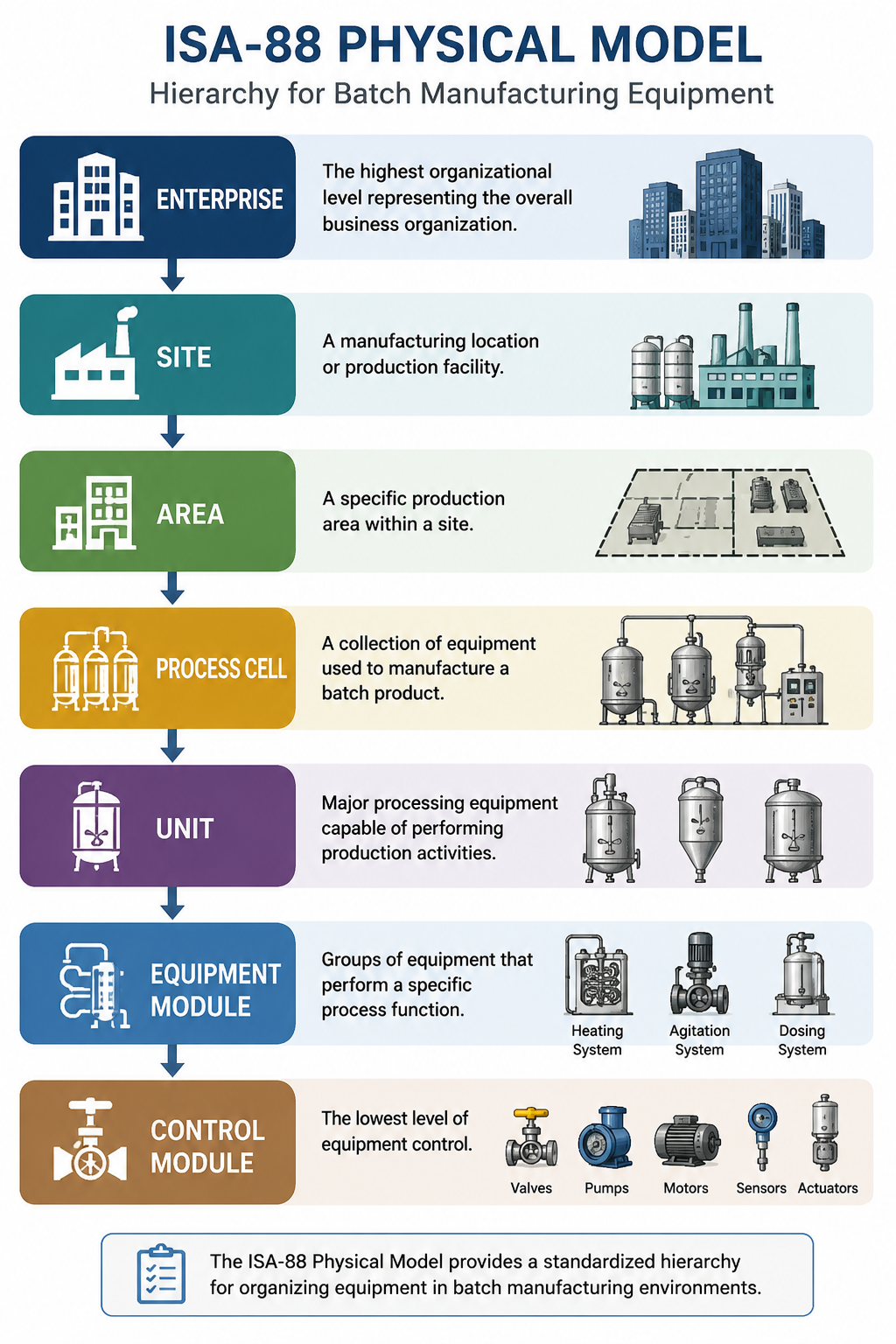
This hierarchical structure helps manufacturers standardize automation design, improve equipment reuse, and simplify system maintenance.
ISA-88 Procedural Model
The Procedural Model defines how manufacturing activities are executed.
It breaks production into logical levels of process execution.
Procedure
The complete manufacturing process required to produce a product.
Example:
Manufacture a pharmaceutical tablet batch.
Unit Procedure
A major segment of the manufacturing process performed within a unit.
Example:
Mixing operation.
Operation
A specific production activity within a unit procedure.
Example:
Add ingredients.
Phase
The smallest executable step within the process.
Examples:
- Open Valve
- Start Pump
- Heat Reactor
- Transfer Material
- Stop Mixer
Phases are typically implemented within PLCs, DCS systems, or batch controllers.
This structure allows complex manufacturing procedures to be organized into reusable components.
ISA-88 Procedural Hierarchy Diagram
The ISA-88 Procedural Model defines how batch production activities are structured and executed.
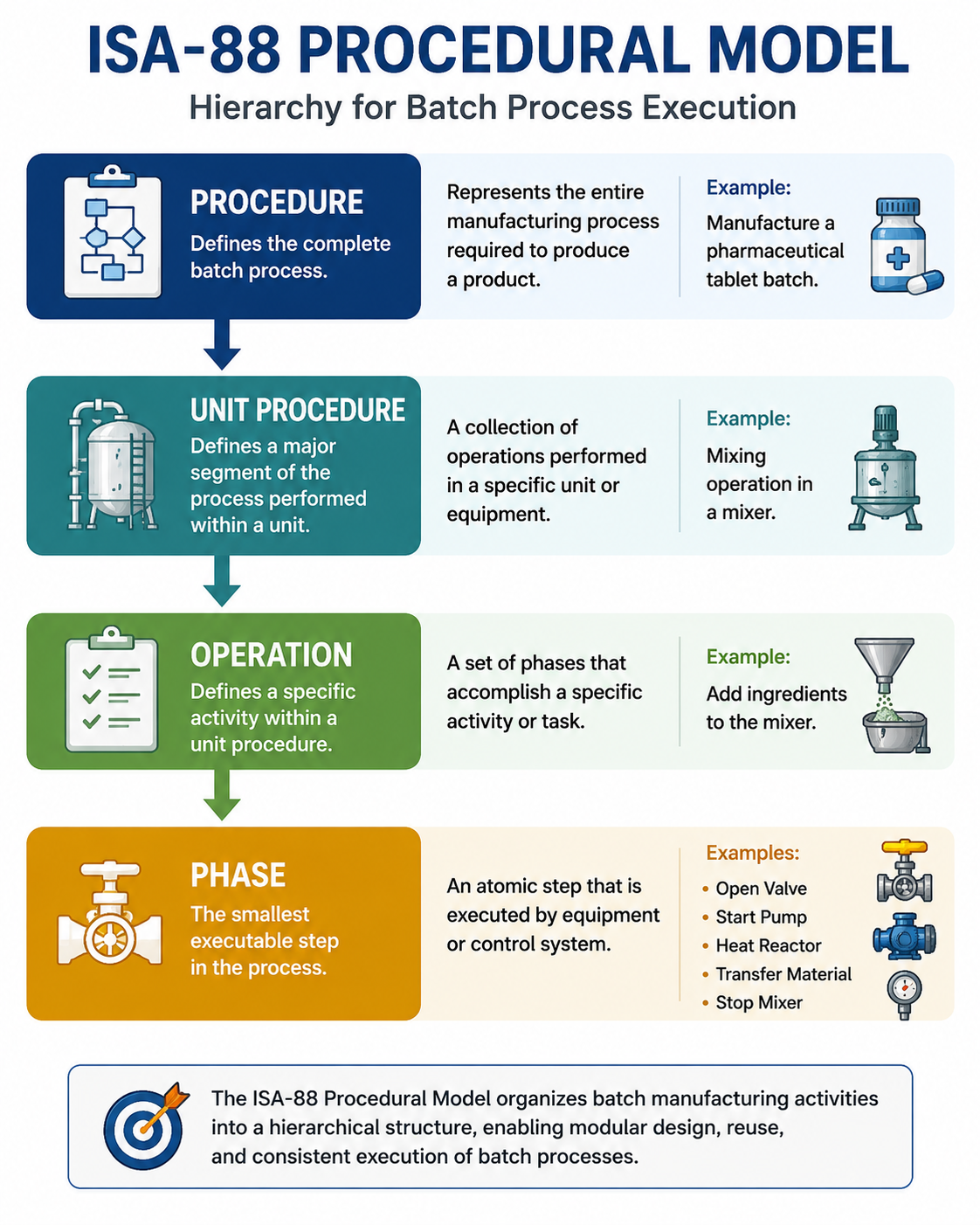
The procedural model enables modular and reusable production workflows. It also makes recipe execution easier to understand, validate, maintain, and scale.
ISA-88 Recipe Model
The Recipe Model defines how products are manufactured.
A recipe contains the information necessary to produce a product consistently.
ISA-88 defines four recipe types.
General Recipe
Defines product requirements at a business level without site-specific details.
Site Recipe
Adapts the general recipe to a particular manufacturing site.
Master Recipe
An approved production recipe ready for manufacturing use.
Includes:
- Equipment requirements
- Process parameters
- Production instructions
- Quality specifications
Control Recipe
A specific batch instance executed during production.
Typically contains:
- Batch ID
- Material information
- Process parameters
- Equipment assignments
- Operator instructions
- Batch records
The Control Recipe becomes the actual batch execution record.
ISA-88 Recipe Types Explained
ISA-88 defines four distinct recipe types that support product lifecycle management from product definition to actual batch execution.
| Recipe Type | Purpose | Typical Owner |
|---|---|---|
| General Recipe | Defines product requirements independent of site or equipment | Corporate Engineering or Product Development |
| Site Recipe | Adapts the general recipe for a specific manufacturing site | Site Engineering |
| Master Recipe | Approved production recipe used for manufacturing | Manufacturing Operations |
| Control Recipe | Actual executed batch instance | Batch Control System or MES |
This layered approach ensures consistency while allowing site-specific flexibility.
Equipment Model
One of the most important concepts in ISA-88 is equipment modularization.
Equipment capabilities are defined independently from product recipes.
This means:
- Equipment can be reused for multiple products.
- Recipes can change without modifying automation logic.
- Engineering effort is reduced.
- Validation becomes easier.
Benefits include:
- Reusable automation code
- Faster implementation
- Easier maintenance
- Improved scalability
- Lower lifecycle costs
Real-World Example: Pharmaceutical Tablet Manufacturing
Consider a pharmaceutical tablet production process.
Unit
Mixer
Unit Procedure
Material Preparation
Operation
Ingredient Mixing
Phases
- Load Raw Materials
- Verify Weight
- Start Mixer
- Mix for Defined Duration
- Stop Mixer
- Transfer Product
If a new product is introduced, the recipe can be modified without redesigning the equipment control logic.
This significantly improves manufacturing flexibility and reduces engineering effort.
ISA-88 Batch Control Architecture
ISA-88 supports a modular batch control architecture where:
- Recipes define what should be produced.
- Equipment models define available capabilities.
- Procedures define how production is executed.
- Control systems execute phases and equipment operations.
This architecture enables standardized batch execution while maintaining flexibility.
Industries Using ISA-88
ISA-88 is widely implemented across batch manufacturing industries.
Pharmaceutical Manufacturing
- Electronic Batch Records
- Recipe Management
- Validation Compliance
- Batch Genealogy
- GMP documentation
Food and Beverage
- Mixing operations
- Blending processes
- Packaging recipes
- Production traceability
- Quality checks
Biotechnology
- Fermentation control
- Bioreactor management
- Batch execution
- Process monitoring
- Critical process parameter tracking
Chemical Manufacturing
- Reactor control
- Formula management
- Batch scheduling
- Material traceability
- Process safety
Personal Care and Cosmetics
- Product formulations
- Mixing operations
- Batch documentation
- Quality management
- Packaging control
ISA-88 and Electronic Batch Records
One of the most common modern applications of ISA-88 is Electronic Batch Record implementation.
An Electronic Batch Record system captures:
- Batch parameters
- Operator actions
- Equipment status
- Material consumption
- Quality results
- Process deviations
- Audit trail information
- Approval history
Combining ISA-88 with MES enables digital batch execution, improved traceability, faster review by exception, and better regulatory compliance.
ISA-88 Integration with MES Architecture
A typical ISA-88 architecture integrates with MES and ERP systems as follows:
| System | Primary Function |
|---|---|
| ERP | Production planning, inventory, costing and business management |
| MES | Production execution, work instructions, quality and batch records |
| ISA-88 Batch System | Recipe and batch control |
| SCADA / DCS | Process monitoring and supervisory control |
| PLC | Equipment control and phase execution |
This architecture provides visibility from enterprise planning through shop-floor execution.
ISA-88 and MES Integration
Many MES platforms use ISA-88 concepts for managing production workflows.
Typical ISA-88 and MES integration includes:
- Recipe Management
- Batch Scheduling
- Electronic Batch Records
- Work Instructions
- Genealogy Tracking
- Material Traceability
- Quality Management
- Production Reporting
ISA-88 provides the operational structure while MES provides production execution and management capabilities.
ISA-88 and Industry 4.0
ISA-88 remains highly relevant in Industry 4.0 environments.
It supports:
- Smart Manufacturing
- Digital Batch Records
- Manufacturing Analytics
- Industrial IoT
- Predictive Maintenance
- Artificial Intelligence
- Cloud Manufacturing Platforms
- Real-Time Production Intelligence
Many modern digital manufacturing platforms use ISA-88 principles as the foundation for batch execution.
ISA-88 vs ISA-95
ISA-88 and ISA-95 serve different but complementary purposes.
ISA-88 Focuses On
- Batch Process Control
- Recipe Management
- Equipment Models
- Procedural Models
- Batch Execution
ISA-95 Focuses On
- Enterprise Integration
- MES Integration
- Production Management
- ERP Connectivity
- IT-OT Integration
Together, ISA-88 and ISA-95 form the foundation of many modern manufacturing architectures.
Common ISA-88 Implementation Challenges
Legacy Automation Systems
Older PLC and DCS platforms may not support modern batch management functionality.
Inconsistent Recipe Structures
Organizations often maintain multiple recipe formats that complicate standardization.
Validation Requirements
Highly regulated industries require extensive validation and documentation.
Change Management
Transitioning from custom automation logic to ISA-88 standards requires organizational commitment and training.
Integration Complexity
Connecting ISA-88 environments with MES, ERP, historians, and quality systems requires careful planning.
Benefits of ISA-88
Improved Batch Consistency
Standardized procedures help ensure repeatable production results.
Faster Product Introduction
New products can be deployed using existing equipment.
Reduced Engineering Costs
Reusable modules minimize development and maintenance effort.
Easier Validation
Structured designs simplify compliance with regulatory requirements.
Better Production Flexibility
Recipes can be updated without redesigning automation logic.
Improved Equipment Utilization
Manufacturing assets can be reused across multiple products.
Enhanced Operational Efficiency
Batch execution becomes more predictable and manageable.
Best Practices for ISA-88 Implementation
- Standardize recipe structures.
- Modularize equipment design.
- Reuse phases and operations whenever possible.
- Define clear equipment capabilities.
- Integrate batch records with MES systems.
- Implement consistent naming conventions.
- Establish governance for recipe changes.
- Design for future scalability.
- Align automation, manufacturing, quality and IT teams early.
- Validate master recipes and control recipe execution workflows.
Related Standards and Topics
Key Takeaways
- ISA-88 is the global standard for batch process control.
- It separates process recipes from equipment control logic.
- It defines Physical, Procedural, Equipment, and Recipe Models.
- It improves flexibility, consistency, and scalability.
- It is widely used in pharmaceutical, biotechnology, food, chemical and personal care industries.
- It supports MES integration, Electronic Batch Records and Industry 4.0 initiatives.
- It complements ISA-95 for enterprise integration and ISA-99 for industrial cybersecurity.
Conclusion
ISA-88 provides a proven framework for designing, executing and managing batch manufacturing processes.
By separating process procedures from equipment control, manufacturers can improve flexibility, reduce engineering effort, simplify validation and maintain consistent product quality.
Whether implementing a new batch automation system, deploying MES, creating Electronic Batch Records or pursuing Industry 4.0 initiatives, ISA-88 remains one of the most important standards in modern manufacturing.
For organizations operating batch processes, ISA-88 provides the foundation for scalable, compliant, efficient and future-ready manufacturing operations.