
Automation Engineer Roadmap: What to Learn, in Order
On this page
Industrial automation covers a huge range of technologies, and it is easy to get lost. This roadmap sets out a practical learning order, from the fundamentals every automation engineer needs to the specialist skills that open senior and Industry 4.0 roles. Each stage links to the relevant tutorials on MFG Tech Hub.
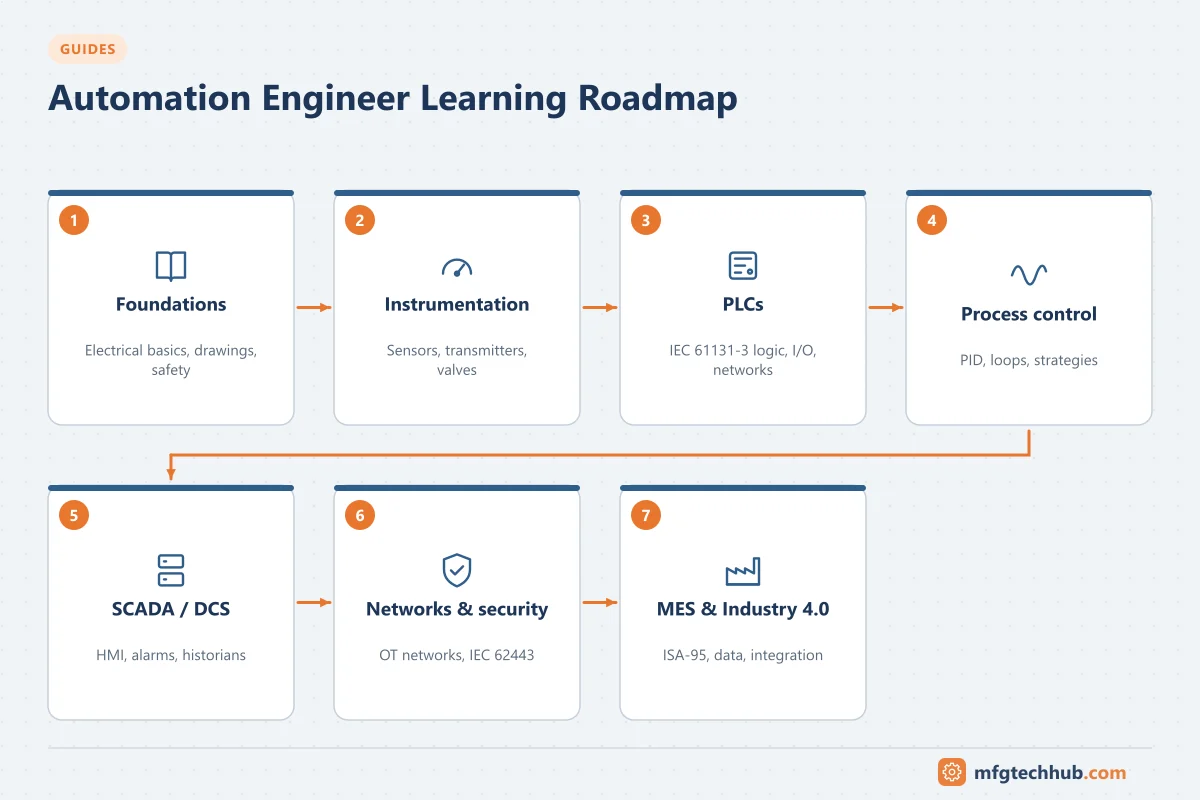
You do not need to master everything. Most engineers build deep skills in one or two areas, such as PLC and machine control, DCS and process control, or MES and manufacturing IT, while understanding how the rest of the system fits together.
Stage 1: Foundations
Before touching a controller, make sure you are comfortable with:
- Basic electrical engineering: voltage, current, Ohm’s law, AC and DC circuits, relays, contactors and motor starters.
- Reading drawings: electrical schematics, loop diagrams and P&IDs (Piping and Instrumentation Diagrams).
- Process basics: pressure, flow, level and temperature, and how pumps, valves, tanks and heat exchangers behave.
- Electrical safety: lockout/tagout, safe isolation, and working in hazardous areas.
Useful tutorials:
- Role of Measurement, Control and Automation in Industry
- Safety in Industrial Instrumentation and Electrical Systems
Stage 2: Instrumentation
Every control decision depends on measurements. Learn:
- How pressure, temperature, level and flow are measured
- Transmitters, 4-20 mA signals and HART
- Calibration, accuracy and uncertainty
- Control valves and actuators
Start with the Instrumentation learning path and practice with the 4-20 mA calculator and RTD calculator.
Stage 3: PLCs and control logic
PLCs are the most common entry point into automation jobs. Learn:
- PLC hardware and the scan cycle
- Ladder logic first, then function block diagram and structured text
- Timers, counters, comparisons, math and data handling
- Analog scaling and simple sequences
- Troubleshooting with online monitoring
Follow the PLC learning path, and test yourself with our PLC interview questions.
Practice tip: most major vendors offer free or low-cost software with a built-in simulator. Build small projects: a motor start/stop with interlocks, a tank fill sequence, a traffic light.
Stage 4: Process control
Learn how feedback control works and how to make loops behave well:
- PID control and tuning
- Cascade, ratio, feedforward and split-range control
- Loop troubleshooting: valve problems, noise and interactions
Read PID Control Explained and experiment with the PID tuning calculator.
Stage 5: HMI, SCADA and DCS
Operators run the plant through these systems. Learn:
- HMI display design and navigation
- Alarm management principles (ISA-18.2)
- Historians and trends
- SCADA architecture and remote telemetry
- DCS architecture, control strategies and redundancy
Follow the SCADA and DCS learning paths.
Stage 6: Industrial networks and communication
Modern systems are networks of devices. Learn:
- Ethernet and TCP/IP basics, IP addressing and VLANs
- Industrial protocols: Modbus, PROFINET or EtherNet/IP, and OPC UA
- Network topologies and redundancy
- Troubleshooting with basic network tools
Start with Industrial Communication Protocols Explained.
Stage 7: Industrial cybersecurity
Connected systems must be protected. Learn:
- The IEC 62443 zones and conduits model
- Network segmentation and DMZs
- Secure remote access, patching and backup
- Security in PLC and SCADA configuration
Read ISA-99 / IEC 62443 and PLC Security Concerns.
Stage 8: Manufacturing systems and Industry 4.0
To progress into senior, architecture or digital transformation roles, learn how the plant floor connects to the business:
- The ISA-95 model and levels 0-4
- MES: production tracking, quality, genealogy and OEE
- ISA-88 batch control
- Industrial IoT, edge computing and MQTT
- Manufacturing data and analytics
- AI in manufacturing
Soft skills that matter
Technical skill is only part of the job. Successful automation engineers also:
- Document clearly: functional specifications, test procedures and as-built drawings
- Communicate with operators and maintenance teams, who know the process best
- Manage change safely: backups, approvals and testing before live changes
- Stay calm during troubleshooting, working logically from symptom to cause
- Keep learning, because technology and standards keep changing
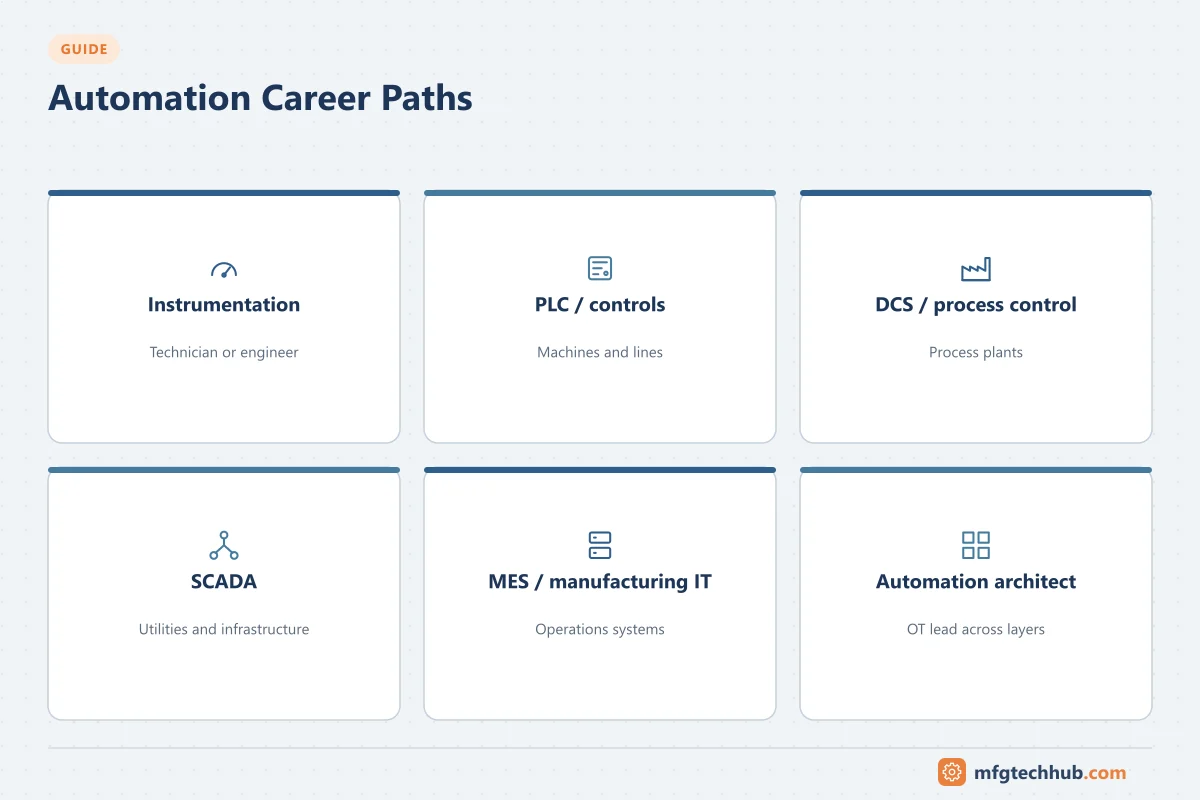
Typical career paths
| Role | Focus | Key skills |
|---|---|---|
| Instrumentation technician / engineer | Field devices, calibration, loop checks | Instrumentation, 4-20 mA, HART, hazardous areas |
| PLC / controls engineer | Machine and line control | PLC programming, HMI, drives, safety |
| DCS / process control engineer | Continuous and batch process plants | DCS configuration, PID and advanced control |
| SCADA engineer | Utilities, energy, remote assets | SCADA, telemetry protocols, networks |
| MES / manufacturing IT engineer | Production systems and data | MES, ISA-95, databases, integration |
| Automation architect / OT lead | Plant or company-wide systems | Architecture, cybersecurity, standards, project leadership |
Role-based learning paths
Each path goes from fundamentals to real project work. Read the articles in order, practise with the tools, then apply what you learned to a small project. Start with How a Factory Works whatever your role: it shows where each role fits.
Instrumentation engineer
- Beginner: Role of Measurement, Control and Automation → Accuracy, Precision and Repeatability → Pressure Measurement
- Intermediate: Pressure Transmitters → DP Flowmeters → Float, Displacer and DP Level → Thermocouples
- Advanced: Control Valves → Reading P&IDs → Calibration
- Troubleshooting: Instrument Troubleshooting → Common Instrument Failures
- Practise: 4–20 mA calculator, DP level calculator, RTD calculator
Electrical engineer (industrial)
- Beginner: Instrumentation and Electrical Systems Overview → Types of Industrial Motors
- Intermediate: VFDs and Soft Starters → Circuit Breakers and Fuses → Switchgear and Distribution
- Advanced: Motor Protection Relays → Grounding and Earthing → Power Quality and Harmonics
- Safety and maintenance: Electrical Hazard Prevention → Infrared Thermography
PLC engineer
- Beginner: What Is a PLC? → How PLCs Work → PLC Basic Components
- Intermediate: PLC Programming Languages → PLC Application Examples → PLC Programming Best Practices
- Projects: PLC Project Process → PLC Project Best Practices
- Troubleshooting and lifecycle: PLC Troubleshooting Guide → PLC Migration and Upgrades → PLC Security
- Interview preparation: PLC Interview Questions
SCADA engineer
- Beginner: What Is SCADA? → SCADA System Hierarchy
- Intermediate: RTUs → SCADA Data Acquisition → Industrial Communication Protocols
- Advanced: Customising HMI Displays → Setting Up Alarms → Traditional vs Modern SCADA Architecture
- Projects: SCADA Project Process → SCADA Examples by Industry
DCS / process control engineer
- Beginner: DCS Introduction → DCS vs PLC → PID Control Explained
- Intermediate: Setting Up Control Loops → Control Strategies → Boiler Drum Level Control
- Advanced: DCS Architecture → DCS Networks → ISA-88 Batch Control
- Projects: DCS Project Process
- Practise: PID tuning calculator
MES engineer
- Beginner: What Is MES? → ISA-95 Explained → MES Benefits and How to Measure Them
- Intermediate: MES Data Flow and Architecture → MES Quality Management → MES Production Scheduling
- Integration: MES Integration Guide → MES Real-Time Data Acquisition
- Implementation: Planning and Strategy → Selecting an MES → Implementation Challenges → Lessons Learned
- Practise: OEE calculator
IIoT and industrial data engineer
- Beginner: How a Factory Works → Industrial IoT
- Intermediate: Industrial Communication Protocols → Wireless Sensor Networks → 5G and Edge Computing
- Advanced: Manufacturing Data Analytics → AI in Manufacturing → AI in Process Control
OT cybersecurity engineer
- Beginner: How a Factory Works → ISA/IEC 62443
- Intermediate: PLC Security → DCS Networks → MES Data Management and Security
- Advanced: apply zones and conduits to a real plant network diagram, then review remote access, backups and incident response.
How to use MFG Tech Hub with this roadmap
- Work through the learning paths in order: Instrumentation, PLC, SCADA, DCS and MES.
- Use the glossary whenever you meet an unfamiliar term.
- Use the free engineering tools to practice calculations.
- Revisit the guides and standards as you move into more advanced roles.