
Boiler Drum Level Control: Shrink and Swell, Single-, Two- and Three-Element Control in a DCS
On this page
Boiler drum level control is a classic process control problem and a standard example of cascade and feedforward control in a DCS. The drum separates steam from water in a drum-type boiler. If the level is too low, boiler tubes can overheat and fail; if it is too high, water can be carried over with the steam and damage superheaters and turbines. The level must be held within a narrow band while steam demand changes, and the process behaves in a counter-intuitive way that simple level control handles badly.
Shrink and swell: why drum level is difficult
The water in a drum and its risers contains steam bubbles. Their volume depends on drum pressure:
- Swell: when steam demand increases suddenly, drum pressure falls, more water flashes to steam, bubbles expand, and the level rises temporarily, even though more mass is leaving the drum.
- Shrink: when steam demand falls (pressure rises) or a large amount of cooler feedwater enters, bubbles collapse and the level falls temporarily.
This is an inverse response. A simple level controller sees the level rise when load increases and reduces feedwater, exactly when more water is needed. The real level then falls sharply after the swell ends.
Control structures
| Structure | Measurements | How it works | Suitable for |
|---|---|---|---|
| Single-element | Drum level | Level controller moves the feedwater valve directly | Small boilers, steady loads, and low-load operation of larger boilers |
| Two-element | Drum level + steam flow | Steam flow feedforward added to the level controller output | Moderate load changes, stable feedwater pressure |
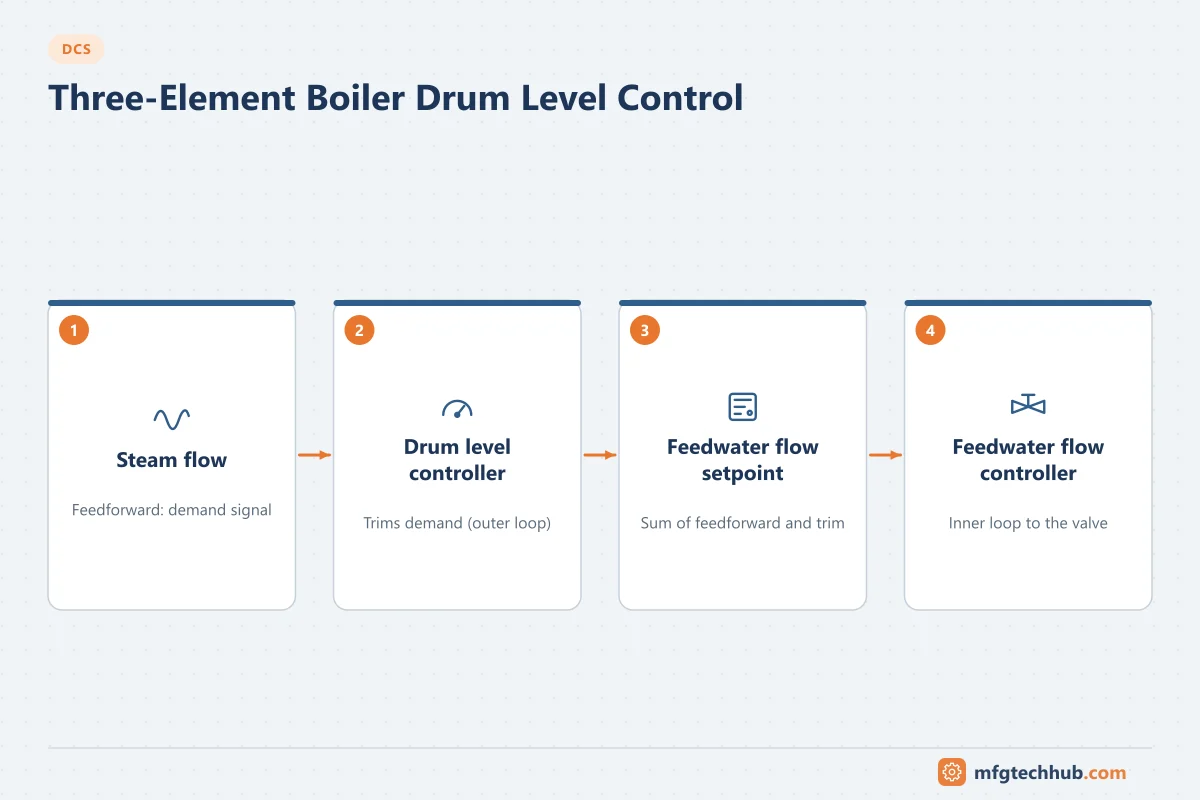
| Three-element | Drum level + steam flow + feedwater flow | Level controller output plus steam flow feedforward set the setpoint of a feedwater flow controller | Larger boilers, rapid load changes, variable feedwater supply pressure |
How three-element control works
- Steam flow (feedforward): feedwater demand should match steam flow. When steam flow increases, the feedwater flow setpoint increases immediately, instead of waiting for (and being misled by) the level.
- Drum level controller (outer loop): trims the feedwater demand to correct level errors, blowdown and measurement mismatch between steam and feedwater flow.
- Feedwater flow controller (inner loop): controls the actual feedwater flow to the combined setpoint, correcting disturbances such as changes in feedwater pump pressure before they affect the level.
In DCS terms this is cascade (level → feedwater flow) plus feedforward (steam flow). See DCS Control Strategies.
Measuring drum level
- DP transmitters are common. The water leg density and the steam density depend on drum pressure, so the level calculation needs pressure (density) compensation to be accurate across the operating range. Many DCS function libraries include a drum level compensation calculation.
- With a wet reference leg (filled with condensate) on the upper tap, the DP falls as the level rises. The range and direction must be configured correctly, and the reference leg must stay filled.
- Redundant transmitters (often three, with median selection) improve availability of the control measurement.
- Protection (low-low and high-high level trips) uses separate, independent measurements in the burner management or safety system, not the control transmitters. See Functional Safety.
- Boiler codes and standards also require independent direct level indication (such as gauge glasses or other approved indicators); follow the applicable code for your boiler.
Steam and feedwater flow measurements also need correct compensation (temperature and pressure for steam) so that feedforward matches. See DP Flowmeters and Level Measurement Selection.
Switching between single- and three-element
At low loads, steam flow measurements may be inaccurate (flow below the meter’s useful range), so many systems:
- run single-element control at low load and during start-up,
- switch to three-element automatically above a load threshold, with hysteresis,
- ensure bumpless transfer in both directions by initialising the inactive controller.
Loss of a flow measurement (bad quality) should also switch to single-element control and alert the operator.
Tuning guidance
- Tune the feedwater flow loop first (fast, similar to any flow loop), then the level controller.
- The level controller in three-element control usually needs moderate gain with integral action. Too much gain reacts to swell and fights the feedforward.
- Derivative action is generally avoided on drum level because the measurement is noisy and shows inverse response.
- The feedforward gain should make feedwater flow match steam flow in steady state; allow for blowdown and measurement differences through the level controller’s integral action.
- Test with load changes typical of operation, and record the level deviation during swell.
Specific values depend on the boiler, drum size, valves and instruments, so avoid copying tuning values from other plants. See PID Control Explained.
Troubleshooting
| Symptom | Likely cause | Check |
|---|---|---|
| Level drops sharply after load increases | Single-element control or feedforward disabled; feedforward gain too low | Control mode; feedforward configuration |
| Level oscillates slowly | Level controller gain too high, interaction with feedwater loop | Tune inner loop first; reduce outer gain |
| Steady offset between steam and feedwater flow | Flow compensation errors, blowdown, meter calibration | Compensation inputs; meter checks |
| Level reading wrong at some pressures | Missing or wrong density compensation; reference leg not full | Compensation calculation; reference leg condition |
| Bump when switching single ↔ three element | Initialisation not configured | Tracking of the inactive controller |
| Level trips without control problem | Protection transmitters disagree with control transmitters | Compare all level measurements and direct indication |
Frequently asked questions
What is three-element drum level control?
A control scheme that uses drum level, steam flow and feedwater flow. Steam flow acts as feedforward, the level controller trims the demand, and a feedwater flow controller controls the actual flow to the combined setpoint.
What is shrink and swell in a boiler drum?
A temporary level change caused by pressure changes in the drum. When load increases, pressure falls and bubbles expand, so level rises briefly (swell); when load falls, bubbles collapse and level drops briefly (shrink).
Why not use single-element control on large boilers?
Because single-element control reacts to swell by reducing feedwater when load increases, which leads to large level deviations and possible trips during rapid load changes.
Key takeaways
- Drum level must be held within tight limits to protect tubes, superheaters and turbines.
- Shrink and swell cause inverse response that misleads single-element control.
- Three-element control combines steam flow feedforward with a level-to-feedwater-flow cascade.
- Use density-compensated, redundant level measurement for control and independent measurements for protection.
Related tutorials
Before you apply this in a plant: this article is for education. Always check the current edition of the relevant standards, the manufacturer's documentation for your exact product and version, and your site's procedures. Safety-related work needs qualified personnel. See our editorial policy.