
Industrial Automation Glossary
On this page
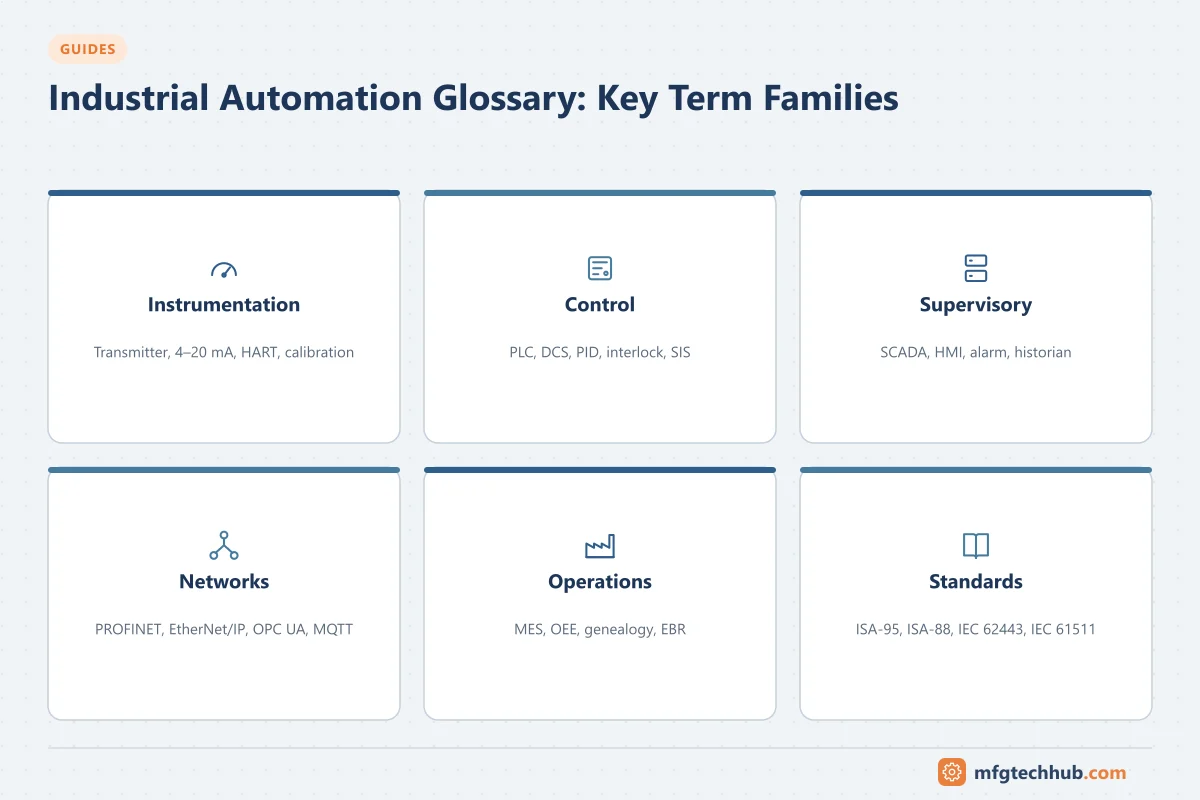
Plain-English definitions of common terms in instrumentation, control systems and manufacturing IT. Terms link to our full tutorials where you can learn more. Use your browser’s find function (Ctrl+F) to jump to a term.
Numbers
4-20 mA — The most common analog signal for process instruments. The measured range maps to 4-20 mA; the “live zero” at 4 mA makes it possible to detect a broken wire. Try the 4-20 mA calculator.
A
Actuator — A device that moves or controls a mechanism, such as a pneumatic valve actuator or an electric motor.
Alarm — A notification to the operator that a condition requires a response. Good alarm systems follow ISA-18.2 and avoid nuisance alarms. See setting up SCADA alarms.
Alarm flooding — When so many alarms occur in a short period that operators cannot respond to them effectively, often during a plant upset.
Analog input (AI) / analog output (AO) — Controller I/O channels for continuous signals such as 4-20 mA or 0-10 V.
Asset management — Tracking the condition, configuration and maintenance history of plant equipment and instruments.
Availability (OEE) — The share of planned production time that equipment is actually running. See the OEE calculator.
B
Batch process — Production in discrete quantities following a recipe, common in pharmaceuticals, food and specialty chemicals. Governed by ISA-88.
Bumpless transfer — Switching a controller between manual and automatic without a sudden jump in output.
Bus topology — A network layout where devices share one communication line. See SCADA network topologies.
C
Calibration — Comparing an instrument against a reference standard and adjusting it so its readings are correct. See calibration and standardization.
Cascade control — Two nested control loops where the output of the primary (outer) controller sets the setpoint of the secondary (inner) controller.
CMMS — Computerized Maintenance Management System, used to plan and record maintenance work.
Commissioning — Testing and bringing a new or modified system into operation, including loop checks and functional tests.
Control loop — The combination of a measurement, a controller and a final control element working to hold a process variable at its setpoint. See PID control.
Control valve — A valve positioned by a controller to regulate flow, pressure, temperature or level.
Coriolis flowmeter — A meter that measures mass flow directly from the twisting of vibrating tubes. See mass flowmeters.
CPU — The processor module of a PLC that executes the control program. See PLC components.
D
Data historian — A database optimized for storing and retrieving time-series process data. See DCS database servers.
Dead time — The delay between a change in controller output and the first measurable response of the process.
Derivative action (D) — The part of a PID controller that responds to the rate of change of the error.
Differential pressure (DP) — The difference between two pressures; used to infer flow and level. See the DP level calculator.
Digital input (DI) / digital output (DO) — On/off I/O channels, such as limit switches and motor start commands.
Digital twin — A virtual model of a physical asset or process, updated with real data, used for simulation, optimization and training.
Displacer — A level instrument that measures the change in buoyant force on a partially submerged body. See float, displacer and DP level.
DCS — Distributed Control System, a plant-wide control system with controllers distributed across the process, common in continuous process industries. See what is a DCS.
DMZ (industrial) — A buffer network between plant (OT) and business (IT) networks that controls data flows between them.
E
Edge computing — Processing data close to the equipment rather than in a central data center or cloud. See IIoT.
Electromagnetic flowmeter (magmeter) — A flowmeter that measures the voltage induced when a conductive liquid flows through a magnetic field. See magnetic and ultrasonic flowmeters.
Electronic batch record (EBR) — A digital record of how a batch was produced, used in regulated industries such as pharmaceuticals instead of paper batch records.
ERP — Enterprise Resource Planning, business software for finance, orders, purchasing and planning (ISA-95 Level 4).
Ethernet/IP — An industrial Ethernet protocol based on the Common Industrial Protocol (CIP). See industrial protocols.
F
Fail-safe — A design in which a failure leads to a safe state, such as a valve that closes on loss of air.
FAT / SAT — Factory Acceptance Test and Site Acceptance Test: formal tests of a system at the supplier’s facility and again after installation on site.
Feedforward control — Adjusting the controller output based on a measured disturbance before it affects the process variable.
Field device — An instrument or actuator installed in the process, such as a transmitter or control valve. See DCS field devices.
Fieldbus — A digital network connecting field devices to controllers, such as PROFIBUS or Foundation Fieldbus.
Function Block Diagram (FBD) — A graphical IEC 61131-3 PLC language built from connected function blocks. See PLC programming languages.
G
Gateway — A device that translates between two communication protocols, for example Modbus RTU to OPC UA.
Gauge pressure — Pressure measured relative to atmospheric pressure. See absolute vs gauge vs differential pressure.
Genealogy — The record of which materials, lots and process steps went into a finished product; a core MES function.
H
HART — A protocol that adds digital communication on top of a 4-20 mA signal for configuration and diagnostics.
HMI — Human-Machine Interface, the screens operators use to monitor and control the process. See SCADA HMI.
Hysteresis — The difference in an instrument’s output depending on whether the input is increasing or decreasing.
I
I/O module — Controller hardware that connects field signals to the controller. See DCS controllers and I/O.
IEC 61131-3 — The international standard defining PLC programming languages.
IEC 62443 — The international series of standards for industrial automation cybersecurity. See ISA-99.
IIoT — Industrial Internet of Things, connecting industrial devices and systems to share data. See IIoT explained.
Integral action (I) — The part of a PID controller that accumulates error over time to eliminate offset.
Integral windup — Excessive build-up of the integral term while the controller output is saturated, causing overshoot.
Interlock — Logic that prevents or forces an action to protect people, equipment or product, such as stopping a pump on low suction pressure.
Intrinsic safety (IS) — A protection technique that limits electrical energy so it cannot ignite a hazardous atmosphere.
ISA-88 — The standard for batch control, defining physical, procedural and recipe models. See ISA-88.
ISA-95 — The standard for integrating enterprise and control systems, defining levels 0-4. See ISA-95.
L
Ladder Diagram (LD) — A PLC programming language resembling relay wiring diagrams.
Level transmitter — An instrument that measures the level of liquid or solids in a vessel. See radar vs ultrasonic level sensors.
Loop check — Verifying during commissioning that each instrument signal reaches the correct controller input with the correct scaling.
LRV / URV — Lower and upper range values of a transmitter, corresponding to 4 mA and 20 mA.
M
MES — Manufacturing Execution System, software that manages and tracks production on the shop floor (ISA-95 Level 3). See what is MES.
Modbus — A simple, widely used open protocol for industrial communication, available as RTU (serial) and TCP (Ethernet).
MQTT — A lightweight publish/subscribe messaging protocol widely used in IIoT.
MTBF / MTTR — Mean Time Between Failures and Mean Time To Repair, key reliability metrics.
O
OEE — Overall Equipment Effectiveness = Availability × Performance × Quality. See the OEE calculator.
OPC UA — A secure, platform-independent standard for industrial data exchange with a rich information model.
OT — Operational Technology: the hardware and software that monitor and control physical processes.
Offset — A steady-state difference between setpoint and process variable, typical of proportional-only control.
P
P&ID — Piping and Instrumentation Diagram, showing process equipment, piping, instruments and control loops.
Performance (OEE) — Actual production speed compared with the ideal speed while running.
PID — Proportional-Integral-Derivative, the most common feedback control algorithm. See PID control explained.
PLC — Programmable Logic Controller, an industrial computer for real-time control of machines and processes. See what is a PLC.
Pressure transmitter — An instrument that converts pressure into an electrical signal. See pressure transmitters.
Process variable (PV) — The measured quantity being controlled, such as temperature or flow.
PROFIBUS / PROFINET — Fieldbus and industrial Ethernet protocols from PROFIBUS & PROFINET International.
Proportional band (PB) — An alternative way of expressing controller gain: PB % = 100 ÷ gain.
R
Redundancy — Duplicating critical components, such as controllers, networks or power supplies, so the system keeps running if one fails.
Repeatability — The ability of an instrument to give the same reading for the same input under the same conditions. See accuracy, precision and repeatability.
RTD — Resistance Temperature Detector, usually platinum (Pt100 or Pt1000). See the RTD calculator.
RTU — Remote Terminal Unit, a field device that collects data and communicates with SCADA over long distances. See RTUs in SCADA.
S
Safety Instrumented System (SIS) — An independent system that takes the process to a safe state when dangerous conditions are detected (IEC 61511).
Scan cycle — The repeating cycle in which a PLC reads inputs, executes its program and updates outputs. See how PLCs work.
SCADA — Supervisory Control and Data Acquisition, systems for monitoring and controlling distributed processes. See what is SCADA.
Sequential Function Chart (SFC) — An IEC 61131-3 language for describing sequences of steps and transitions.
Setpoint (SP) — The target value for a controlled variable.
SIL — Safety Integrity Level (1-4), a measure of the risk reduction provided by a safety function.
Signal conditioning — Processing a sensor signal (amplifying, filtering, isolating, linearizing) so it can be measured accurately. See signal conditioning.
Smart transmitter — A microprocessor-based transmitter with digital communication and diagnostics.
SPC — Statistical Process Control, using control charts to monitor process variation. See manufacturing analytics.
Split-range control — One controller output driving two or more final elements over different parts of its range.
Stiction — Static friction in a control valve that makes it stick and then jump, often causing oscillation.
Structured Text (ST) — A high-level, text-based IEC 61131-3 PLC language similar to Pascal.
T
Tag — A named data point in a control system, such as a process value, setpoint or alarm.
Thermocouple — A temperature sensor made of two dissimilar metals that produces a voltage proportional to temperature difference. See thermocouple types.
Time constant — For a first-order process, the time to reach 63.2% of the final change after the dead time.
Traceability — The ability to trace a product’s history, materials and process conditions. See MES traceability.
Transmitter — An instrument that converts a measurement into a standard signal for transmission to a controller.
U
Unified Namespace (UNS) — An architecture where all systems publish their current state to a central, hierarchical data hub, often built on MQTT.
V
VFD — Variable Frequency Drive, which controls motor speed by varying supply frequency.
Vortex flowmeter — A flowmeter that counts vortices shed by a bluff body placed in the flow.
W
Wet leg — A liquid-filled reference line on a DP level transmitter, used when vapors would condense in the line.
Watchdog timer — A timer in a PLC or controller that faults the CPU if the program scan takes too long, protecting against runaway or stuck programs.
Work order — An instruction to produce a quantity of product (production) or perform a task (maintenance).
Z
Zero suppression / elevation — Calibration adjustments to a DP transmitter’s range to account for liquid in impulse lines or wet legs.
Zones and conduits — The IEC 62443 approach to segmenting industrial networks into security zones connected by controlled conduits.