
Radar vs Ultrasonic Level Sensors for Tanks and Silos: Principles, Comparison and Installation
On this page
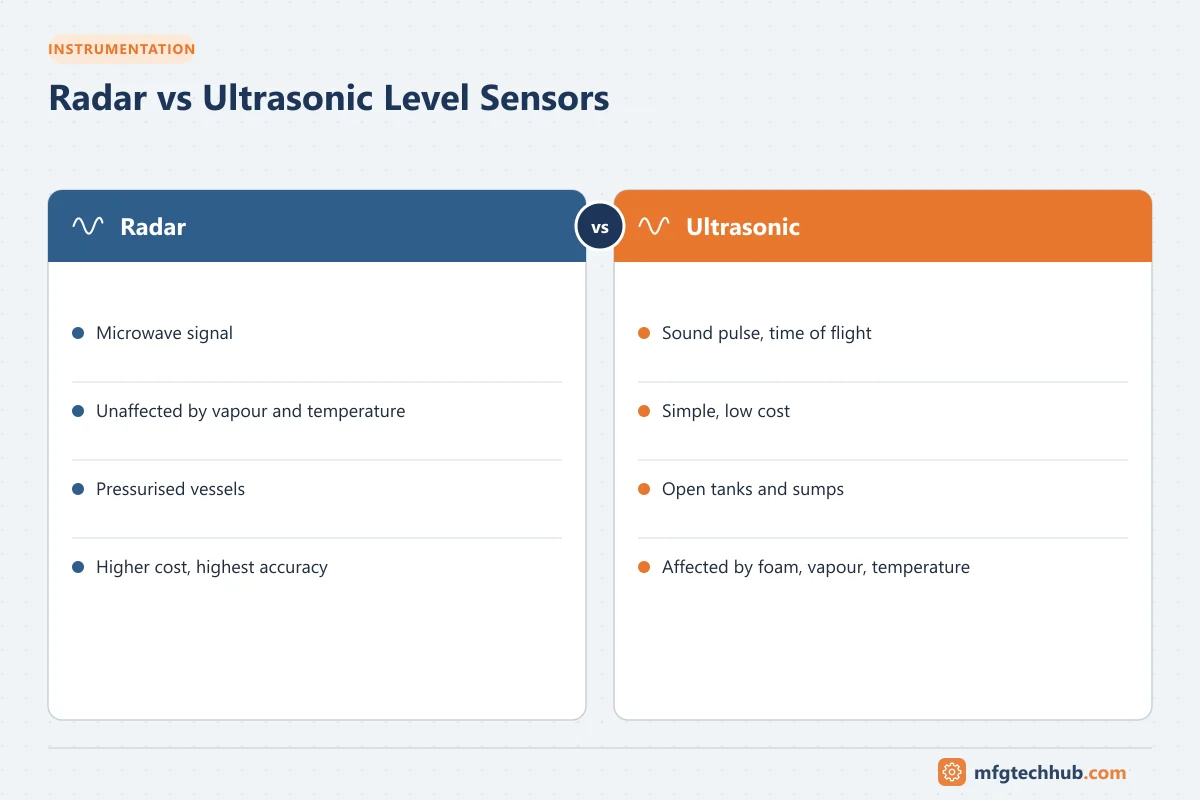
Ultrasonic and radar level sensors both measure the distance from the top of a tank to the product surface by timing a reflected signal, and both avoid contact with the product. The difference is the signal: sound for ultrasonic, microwaves for radar. That difference decides how each copes with temperature, vapour, dust, foam and pressure, and why radar has become the default for many process tanks while ultrasonic remains a cost-effective choice for water and simple storage.
How they measure
| Aspect | Ultrasonic | Radar |
|---|---|---|
| Signal | Sound pulse | Microwave (pulse or FMCW) |
| Measured | Echo travel time | Echo time (pulse) or frequency difference (FMCW) |
| Speed of signal | Speed of sound: changes with gas temperature and composition | Speed of light: practically unaffected by the atmosphere in the tank |
| Level | Tank height minus measured distance | Tank height minus measured distance |
Ultrasonic sensors compensate for air temperature with a built-in sensor, but temperature layers and vapours still cause errors. Radar is largely immune to temperature, pressure and vapour in the tank.
Radar variants
| Type | Notes |
|---|---|
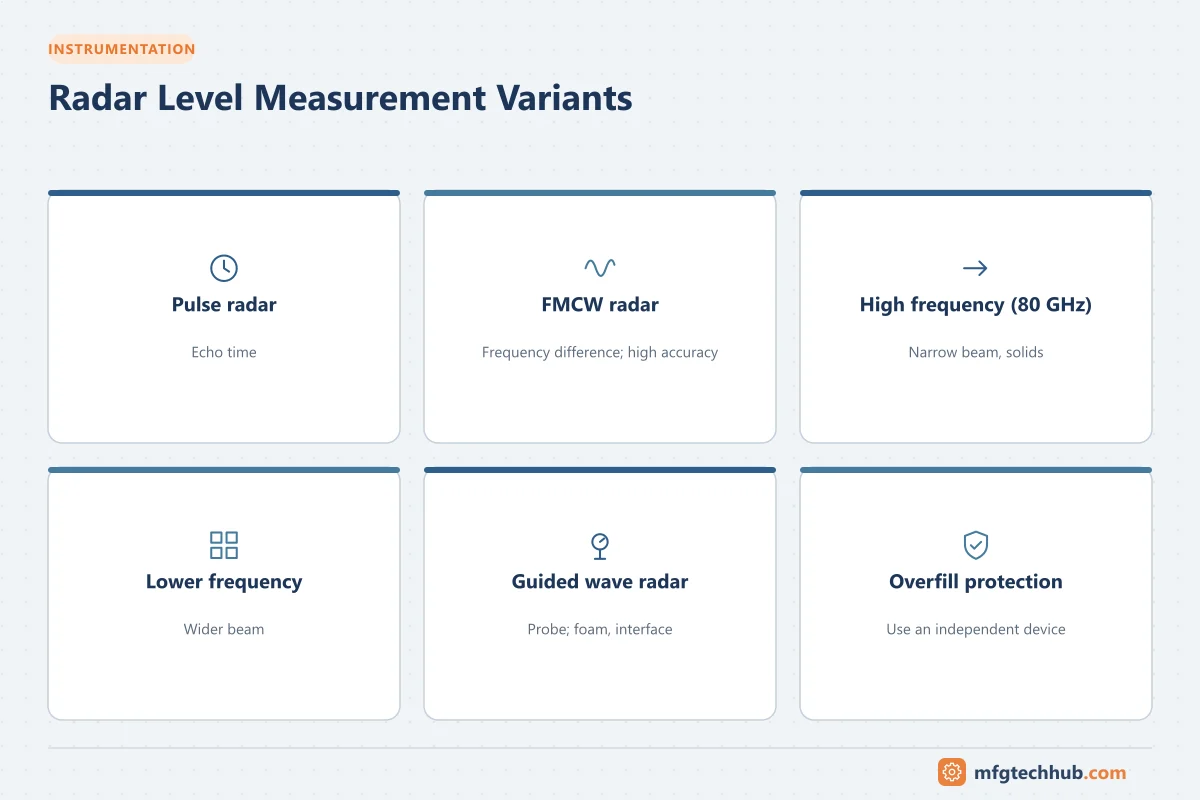
| Pulse radar | Measures echo time of short microwave pulses |
| FMCW radar | Sweeps frequency; distance from frequency difference; high accuracy |
| High-frequency (for example 80 GHz) | Narrow beam from a small antenna; avoids internal obstructions, good in narrow tanks and for bulk solids |
| Lower frequency (for example 26 GHz and below) | Wider beam; can cope better with some condensation and build-up |
| Guided wave radar (GWR) | Signal travels along a probe; excellent in foam, vapour, turbulence and for interfaces, but it is a contact method |
Comparison for storage applications
| Condition | Ultrasonic | Radar |
|---|---|---|
| Clean water tanks, open channels | Good, low cost | Good |
| Vapour, steam, high temperature | Poor | Good |
| Pressure or vacuum | Poor (sound needs a medium; pressure limits) | Good |
| Heavy dust (bulk solids) | Poor | Good with high-frequency radar |
| Foam | Poor (absorbs sound) | Variable; GWR often better |
| Agitated surface | Poor to fair | Fair to good with signal processing, still pipe or GWR |
| Low-dielectric liquids (oils, solvents) | Unaffected by dielectric | Weaker echo; check suitability |
| Cost | Lower | Higher, falling |
See Level Measurement Selection Guide for all technologies.
Installation
| Topic | Good practice |
|---|---|
| Position | Away from the inlet stream, agitator blades and internal structures |
| Beam | Clear path to the surface over the full range; narrow-beam radar for crowded tanks |
| Nozzles | Antenna or transducer should extend beyond the nozzle, or follow the manufacturer’s nozzle limits |
| Blocking distance | Keep the maximum level below the sensor’s dead zone near the face |
| Still pipes / bypass chambers | Calm the surface for radar in agitated or foaming liquids |
| Solids | Aim the sensor towards the outlet to follow the cone; consider aiming devices |
| Reference | Enter tank height, zero point and units correctly; verify with a manual dip |
Configuration and verification
- Set tank geometry, measurement range and damping.
- Record an empty-tank or false-echo map so the sensor ignores fixed reflections from internals.
- Verify with a manual dip or independent level gauge at two levels.
- For overfill protection, use an independent high-level device, not the same sensor. See Level Measurement Selection and Functional Safety.
Troubleshooting
| Symptom | Likely cause | First check |
|---|---|---|
| Level jumps to a fixed value | False echo from internal structure or nozzle | Echo curve; false-echo mapping |
| Level lost when tank is full | Level in blocking distance | Mounting height, range settings |
| Ultrasonic reading unstable in warm tanks | Temperature layers, vapour | Consider radar |
| Radar echo weak | Low dielectric, foam, build-up on antenna | Echo curve, antenna cleaning, GWR alternative |
| Reading lags during filling | Excessive damping | Damping setting |
| Bulk solids reading wrong | Angle of repose, dust, sensor aimed at wall | Aim sensor; high-frequency radar |
Frequently asked questions
What is the main difference between radar and ultrasonic level sensors?
Ultrasonic sensors use sound, which is affected by temperature, vapour, pressure and dust. Radar uses microwaves, which are practically unaffected by the tank atmosphere, making radar suitable for more demanding applications.
When is ultrasonic level measurement a good choice?
For water and wastewater tanks, open channels and simple storage at ambient conditions, where it is accurate enough and costs less than radar.
What is guided wave radar?
A radar method in which the microwave pulse travels along a rod or cable probe into the product. It handles foam, vapour, turbulence and interface measurement well, but it is in contact with the product.
Key takeaways
- Both time a reflected signal; ultrasonic uses sound, radar uses microwaves.
- Radar suits vapour, pressure, temperature, dust and solids; ultrasonic suits simple water storage.
- Install with a clear beam, respect blocking distance and map false echoes.
- Use an independent device for overfill protection.
Related tutorials
Before you apply this in a plant: this article is for education. Always check the current edition of the relevant standards, the manufacturer's documentation for your exact product and version, and your site's procedures. Safety-related work needs qualified personnel. See our editorial policy.