
How Water and Wastewater Treatment Plants Work: Processes, Instruments, SCADA and Energy
On this page
Water utilities run some of the most widely distributed automation systems in the world: treatment plants plus hundreds of remote pumping stations, reservoirs and valves, often supervised from one control room. Priorities are public health, continuous service, regulatory compliance, energy efficiency and cybersecurity.
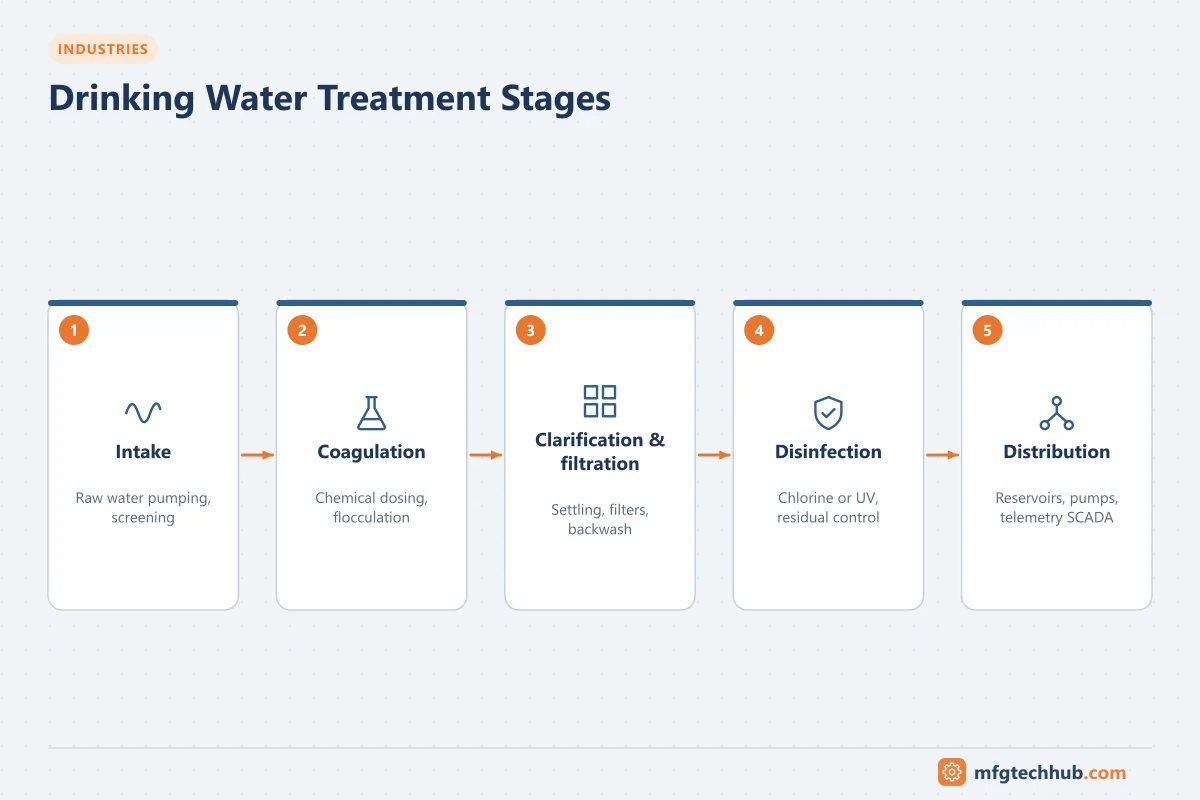
Drinking water treatment
| Stage | Purpose | Key measurements and controls |
|---|---|---|
| Intake and screening | Take raw water from rivers, reservoirs or wells | Flow, level, raw water quality (turbidity, pH) |
| Coagulation and flocculation | Chemicals bind particles into flocs | Chemical dosing proportional to flow and raw water quality; mixer control |
| Clarification / sedimentation | Flocs settle out | Sludge blanket level, sludge removal control |
| Filtration | Sand, multimedia or membrane filters remove remaining particles | Filter differential pressure (headloss), turbidity after filters, backwash sequences |
| Disinfection | Chlorine, chloramine, UV or ozone inactivates pathogens | Chlorine residual, contact time, UV intensity |
| pH adjustment and stabilisation | Reduce corrosion in pipes | pH, alkalinity dosing |
| Storage and distribution | Clear water tanks, pumping to the network | Level, pressure, flow, pump control |
Filter backwash is a classic PLC sequence: when headloss, turbidity or run time reaches a limit, the filter is taken out of service and cleaned with a controlled sequence of air and water.
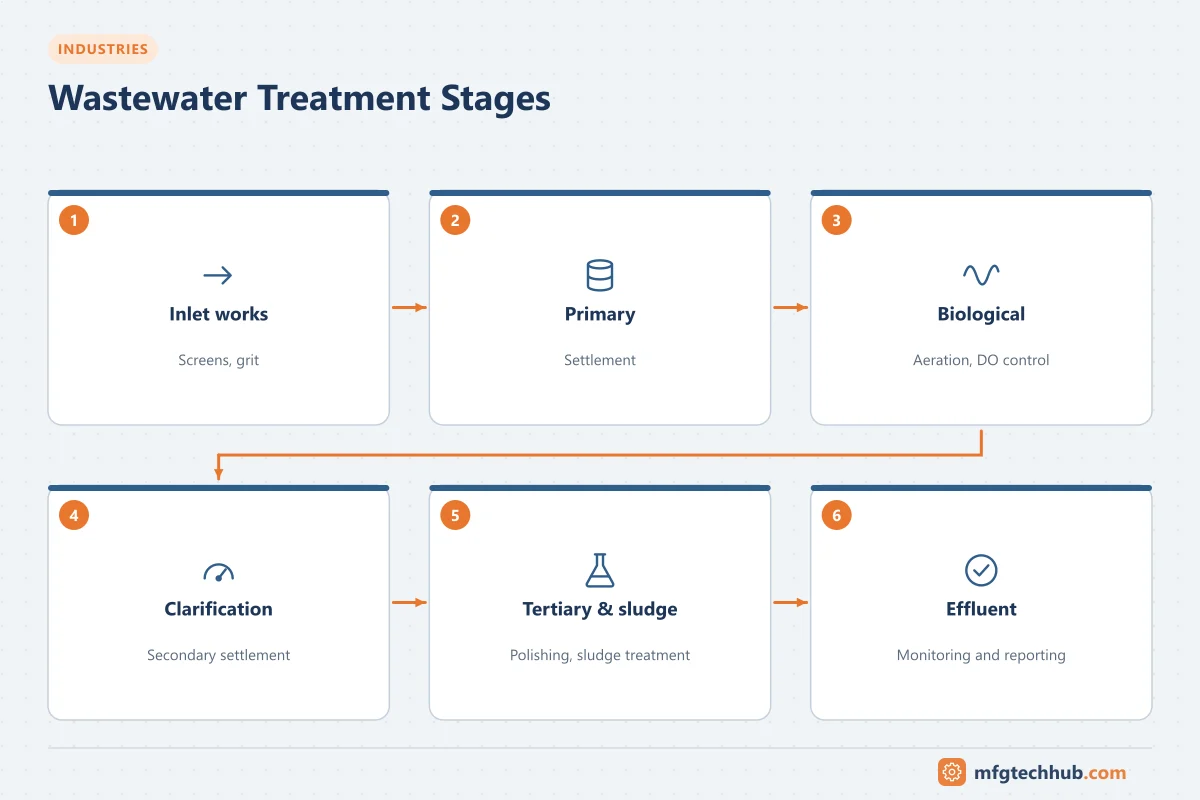
Wastewater treatment
| Stage | Purpose | Key measurements and controls |
|---|---|---|
| Inlet works | Screening and grit removal | Screen differential level, flow measurement (often open-channel flow with flumes) |
| Primary treatment | Settling of solids | Sludge pumping control |
| Secondary (biological) treatment | Activated sludge or similar processes remove organic matter and nutrients | Dissolved oxygen (DO) control with blowers, ammonia/nitrate monitoring, return and waste sludge flows |
| Secondary clarification | Separates biomass from treated water | Sludge blanket, return activated sludge flow |
| Tertiary treatment (where required) | Further removal of phosphorus, solids, pathogens | Chemical dosing, filtration, UV |
| Sludge treatment | Thickening, digestion (producing biogas), dewatering | Temperatures, gas production, polymer dosing, centrifuge control |
| Effluent monitoring | Compliance with discharge permits | Flow, TSS, ammonia, phosphorus, other permit parameters |
Aeration: the biggest energy opportunity
Aeration blowers are commonly among the largest energy consumers at an activated sludge plant. Good practice:
- DO control with VFD-driven blowers and a pressure or most-open-valve control strategy
- Ammonia-based aeration control that adjusts DO setpoints according to load
- Accurate, well-maintained DO sensors (fouling causes over-aeration)
See VFDs and Soft Starters and Energy Management with PLCs.
Instruments specific to water
| Instrument | Use | Maintenance notes |
|---|---|---|
| Turbidity | Filter performance, raw and treated water quality | Cleaning, calibration with standards, bubble effects |
| Chlorine residual | Disinfection control and compliance | Reagent or membrane maintenance, sample flow |
| pH and ORP | Chemical treatment control | Regular calibration, electrode fouling |
| Dissolved oxygen | Aeration control | Optical sensors reduce maintenance, but cleaning is still needed |
| Ammonia, nitrate, phosphate analysers | Nutrient removal control and reporting | Sample conditioning, reagent management |
| Electromagnetic flowmeters | Most water flows | Full pipe and grounding. See How to Select a Flowmeter |
| Ultrasonic/radar level | Tanks, wet wells, channels | Foam and turbulence in wastewater. See How to Select a Level Transmitter |
Distribution and collection networks
- Pumping stations controlled by local PLCs/RTUs, running duty/standby pumps on level or pressure. See PLC Application Examples.
- Reservoirs and tanks with level-based control of inflows.
- Pressure management zones and district metered areas for leakage control.
- Sewer pumping stations and overflows monitored to prevent spills.
Automation architecture
| Level | Typical systems |
|---|---|
| Remote sites | RTUs or small PLCs, local autonomy, battery backup |
| Communication | Radio, cellular, fibre; protocols such as DNP3, Modbus or IEC 60870-5-104 |
| Treatment plants | PLCs or DCS per process area; local HMIs |
| Control centre | SCADA with alarm management, historian, operator displays, on-call notification |
| Business and compliance | Laboratory systems, asset management (CMMS/EAM), regulatory reporting, GIS, billing |
See SCADA Applications by Industry and Remote Terminal Units.
Compliance and reporting
Utilities must demonstrate that drinking water meets quality standards and that wastewater discharges comply with permits. Automation supports this with continuous monitoring, validated data collection, alarm records and automated reports, with laboratory results added from LIMS.
Cybersecurity
Water systems have been targeted by attackers, including cases where internet-exposed controllers with default passwords were compromised. Key measures: no direct internet exposure of controllers or HMIs, secure remote access with MFA, segmentation between business and control networks, changed default credentials, and offline backups. See PLC Security and ISA/IEC 62443.
Frequently asked questions
What does SCADA do in a water utility?
It monitors and controls treatment plants and remote sites (pumping stations, reservoirs, valves) from a central control room, collects data for compliance and operations, raises alarms and notifies on-call staff.
Why is dissolved oxygen control important in wastewater treatment?
Microorganisms in activated sludge need oxygen to remove pollutants, but supplying too much wastes energy. Good DO control keeps treatment effective while minimising blower energy.
What instruments are critical for drinking water safety?
Turbidity after filtration and disinfectant residual (such as chlorine) are among the most important, together with pH, flow and contact time, because they indicate whether pathogens are effectively removed and inactivated.
Key takeaways
- Drinking water treatment removes particles and pathogens; wastewater treatment removes solids, organic matter and nutrients before discharge.
- Analysers (turbidity, chlorine, DO, ammonia) and their maintenance are central to control and compliance.
- SCADA with RTUs supervises distributed networks; aeration and pumping offer the largest energy savings.
- Cybersecurity is essential for utilities.
Related tutorials
Before you apply this in a plant: this article is for education. Always check the current edition of the relevant standards, the manufacturer's documentation for your exact product and version, and your site's procedures. Safety-related work needs qualified personnel. See our editorial policy.