
ISA-99 Explained: IEC 62443 Cybersecurity Framework for Industrial Control Systems
On this page
As industrial facilities become increasingly connected through digital technologies, Industrial IoT, cloud platforms, MES systems, and enterprise applications, cybersecurity has become one of the most critical concerns for manufacturers worldwide.
Industrial Automation and Control Systems (IACS) were traditionally designed for reliability and operational performance rather than cybersecurity. However, modern manufacturing environments now require secure communication between Operational Technology (OT) and Information Technology (IT) systems.
ISA-99, internationally recognized as IEC 62443, provides a comprehensive cybersecurity framework specifically designed to protect industrial control systems from cyber threats while maintaining operational reliability and safety.
What is ISA-99?
ISA-99 is a series of standards, technical reports, and recommended practices developed by the International Society of Automation (ISA) to address cybersecurity risks within Industrial Automation and Control Systems.
The ISA-99 standards were later adopted internationally as IEC 62443, which is now considered one of the most widely recognized cybersecurity standards for industrial environments.
The primary goal of ISA-99 is to help organizations:
- Protect critical industrial assets
- Reduce cybersecurity risks
- Improve operational resilience
- Secure IT and OT integration
- Establish cybersecurity governance
- Maintain safe and reliable plant operations
The framework is widely used across industries such as:
- Oil and Gas
- Pharmaceuticals
- Food and Beverage
- Chemical Manufacturing
- Water and Wastewater
- Power Generation
- Automotive Manufacturing
- Semiconductor Manufacturing
Why ISA-99 is Important
Modern industrial environments face increasing cybersecurity challenges due to:
- Remote connectivity
- Industrial IoT devices
- Cloud-based applications
- MES and ERP integration
- Third-party vendor access
- Legacy control systems
- Increasing ransomware attacks
Without a structured cybersecurity strategy, organizations may experience:
- Production downtime
- Data breaches
- Equipment damage
- Safety incidents
- Regulatory non-compliance
- Financial losses
- Supply chain disruptions
ISA-99 provides a proven framework for identifying, assessing, and mitigating cybersecurity risks across industrial operations.
ISA-99 Architecture
The ISA-99 architecture is commonly represented using the Purdue Enterprise Reference Architecture (PERA) model.
The model helps organizations define security boundaries between enterprise systems and operational technology environments.
Objectives of ISA-99
ISA-99 was developed to achieve several important cybersecurity objectives.
Identify Security Risks
Organizations must understand threats, vulnerabilities, and potential impacts affecting industrial systems.
Establish Security Controls
Security controls should be implemented to protect critical systems, networks, and operational assets.
Promote Best Practices
The framework provides guidance throughout the entire lifecycle of industrial automation systems.
Improve Communication
ISA-99 establishes common terminology and cybersecurity concepts for IT teams, OT teams, vendors, and system integrators.
Support Regulatory Compliance
Many cybersecurity regulations and industry standards align with IEC 62443 principles.
Structure of ISA-99 / IEC 62443
The ISA-99 standard is organized into multiple parts, each focusing on different cybersecurity requirements.
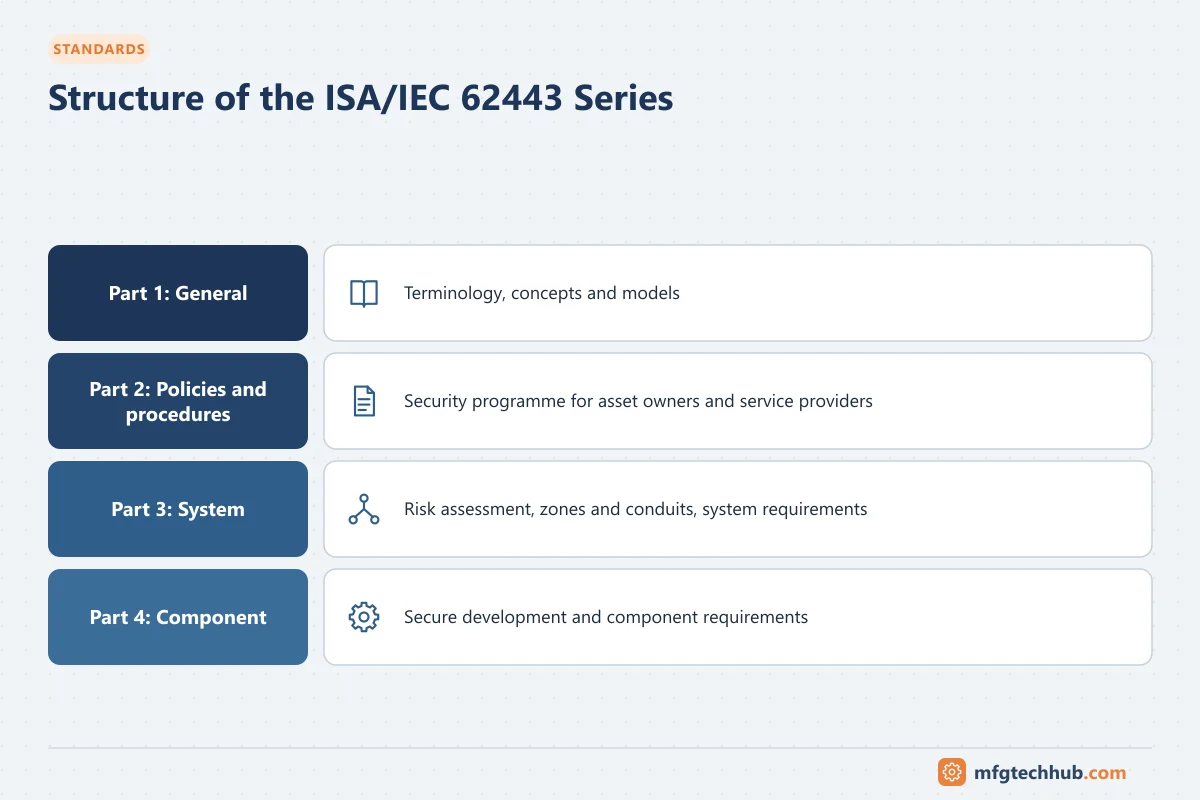
Part 1 – Terminology, Concepts, and Models
This section introduces:
- Fundamental cybersecurity concepts
- Security terminology
- Reference models
- Security architecture principles
It establishes the foundation for understanding industrial cybersecurity.
Part 2 – Cybersecurity Risk Assessment and Management
Focuses on:
- Risk identification
- Threat assessment
- Vulnerability analysis
- Risk mitigation planning
- Security program management
This section helps organizations prioritize cybersecurity investments.
Part 3 – System Security Requirements
Defines technical requirements for:
- Secure system design
- Network protection
- Authentication
- Access control
- Secure communications
Part 4 – Component Security Requirements
Provides security requirements for:
- PLCs
- HMIs
- SCADA servers
- Historians
- Network devices
- Industrial software products
Security Program Implementation
Provides guidance for implementing and maintaining cybersecurity programs within industrial organizations.
Security Lifecycle Management
Emphasizes continuous improvement through:
- Monitoring
- Auditing
- Risk reassessment
- Incident management
- Change control
Key Components of ISA-99
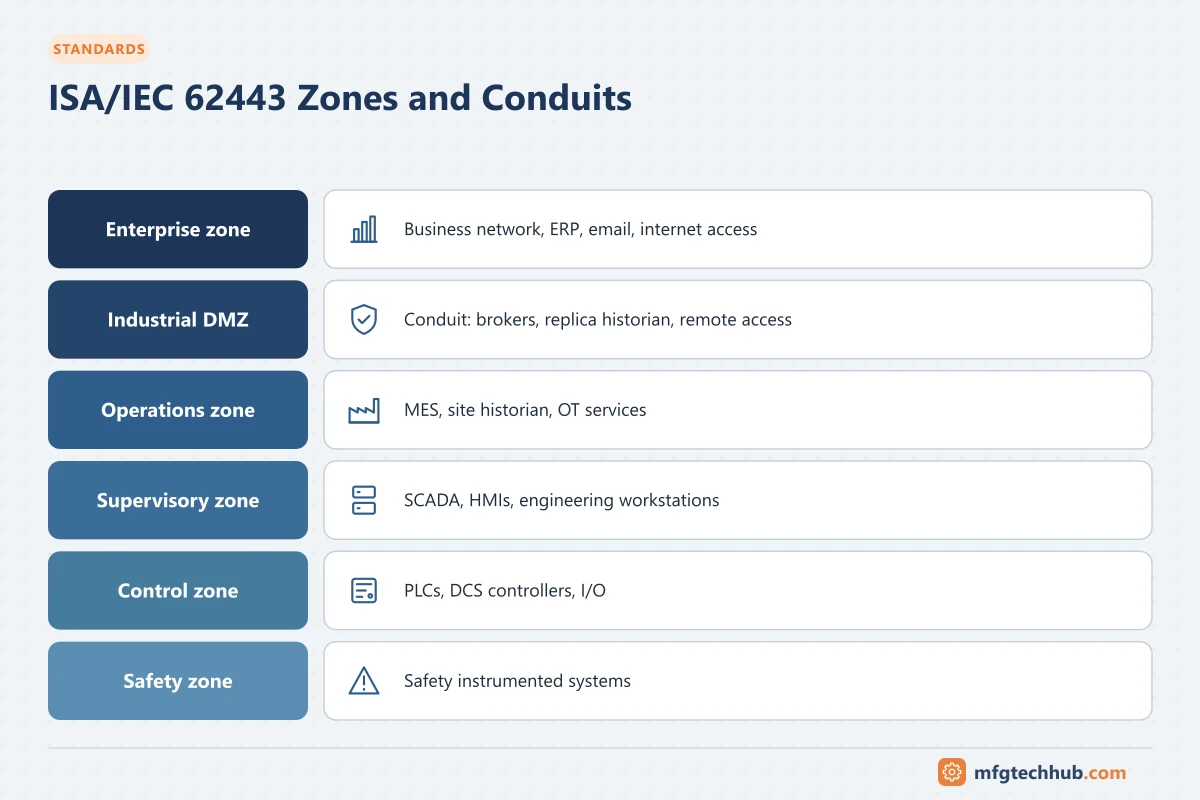
Security Zones and Conduits
One of the most important concepts in ISA-99 is the use of Zones and Conduits.
Security Zones
A security zone groups systems with similar security requirements.
Examples:
- Enterprise Zone
- Manufacturing Zone
- Control Zone
- Safety Zone
- DMZ Zone
Security Conduits
Conduits control communications between zones.
Examples:
- Firewalls
- Secure gateways
- VPN connections
- Data diodes
This approach limits the spread of cyber threats and improves network segmentation.
Risk Assessment and Management
ISA-99 promotes a risk-based approach to cybersecurity.
Organizations should identify:
- Threats
- Vulnerabilities
- Consequences
- Likelihood
- Risk levels
This allows resources to be focused on the most critical assets.
Defense-in-Depth Strategy
ISA-99 recommends multiple layers of protection.
Security layers typically include:
- Physical Security
- Network Security
- Application Security
- Endpoint Protection
- User Authentication
- Monitoring and Logging
- Backup and Recovery
No single control should be relied upon to provide complete protection.
Incident Response and Recovery
Organizations should establish procedures for:
- Incident detection
- Escalation
- Containment
- Recovery
- Post-incident analysis
Rapid response helps reduce operational disruption and business impact.
Continuous Monitoring and Improvement
Cybersecurity is not a one-time activity.
ISA-99 promotes:
- Continuous monitoring
- Security assessments
- Vulnerability management
- Patch management
- Security audits
- Performance measurement
This ensures that security controls remain effective as threats evolve.
ISA-99 and IT-OT Convergence
As manufacturing systems become more connected, IT and OT environments increasingly share data and infrastructure.
Benefits of IT-OT Integration
- Real-time visibility
- Improved analytics
- Better production planning
- Predictive maintenance
- Enhanced operational efficiency
Cybersecurity Challenges
- Increased attack surface
- Legacy equipment vulnerabilities
- Remote access risks
- Third-party connectivity
ISA-99 provides guidance for managing these risks while enabling digital transformation initiatives.
Real-World Example
Consider a pharmaceutical manufacturing facility:
Enterprise Level
ERP systems manage production planning, inventory, and business operations.
Manufacturing Operations
MES coordinates batch execution, electronic batch records, and production workflows.
Supervisory Systems
SCADA monitors process conditions and production equipment.
Control Systems
PLCs control reactors, pumps, valves, and packaging equipment.
Field Devices
Sensors and instruments collect process measurements.
Using ISA-99, security zones are established between these layers, and communication is controlled through secured conduits and firewalls.
Benefits of ISA-99
Organizations implementing ISA-99 can achieve several important benefits.
Improved Cybersecurity
Protects industrial systems against modern cyber threats.
Reduced Operational Risk
Minimizes the likelihood of production disruptions.
Better Regulatory Compliance
Supports compliance with industry regulations and cybersecurity requirements.
Stronger IT-OT Collaboration
Provides a common framework for both operational and business teams.
Enhanced System Availability
Improves reliability and resilience of industrial operations.
Scalable Security Architecture
Supports future growth and Industry 4.0 initiatives.
ISA-99 and Industry 4.0
Industry 4.0 technologies introduce significant cybersecurity challenges.
Examples include:
- Industrial IoT
- Cloud computing
- Artificial Intelligence
- Digital Twins
- Advanced Analytics
- Remote Operations
ISA-99 provides the cybersecurity foundation required to deploy these technologies safely and securely.
Without cybersecurity governance, digital transformation projects can introduce substantial operational risks.
Best Practices for ISA-99 Implementation
- Establish a cybersecurity governance program.
- Define security zones and conduits.
- Perform regular risk assessments.
- Implement defense-in-depth strategies.
- Enforce strong authentication and access control.
- Monitor networks continuously.
- Maintain asset inventories.
- Develop incident response plans.
- Conduct regular security audits.
- Train personnel on cybersecurity awareness.
Applying IEC 62443 in practice
- Network zones, conduits, VLANs, firewalls and the DMZ: Industrial Network Design for OT Engineers
- Controller hardening and real incident lessons: PLC Security
- Secure data exchange and certificates: OPC UA Explained and OPC UA Certificate Errors
- Secure brokers for IIoT: MQTT and Sparkplug B
Key Takeaways
- ISA-99 is the foundation of industrial cybersecurity standards.
- IEC 62443 is the international adoption of ISA-99.
- The framework focuses on protecting Industrial Automation and Control Systems.
- Security Zones and Conduits are core architectural concepts.
- Defense-in-depth is a critical security strategy.
- ISA-99 supports secure IT-OT integration and Industry 4.0 adoption.
Conclusion
ISA-99, now widely known as IEC 62443, provides a comprehensive framework for securing Industrial Automation and Control Systems.
By adopting ISA-99 principles, organizations can reduce cybersecurity risks, improve operational resilience, strengthen IT-OT collaboration, and build a secure foundation for Industry 4.0 and Smart Manufacturing initiatives.
As industrial environments become increasingly connected, ISA-99 remains one of the most important standards for protecting critical manufacturing and infrastructure systems.