
AI in Manufacturing: Practical Use Cases, Data Requirements and Implementation Guide
On this page
Artificial intelligence is changing how factories maintain equipment, inspect products and optimize processes. But successful industrial AI looks very different from the headlines. It is rarely a single “smart factory brain”. Instead, it is usually a focused model that solves one well-defined problem, built on reliable data and integrated into existing workflows.
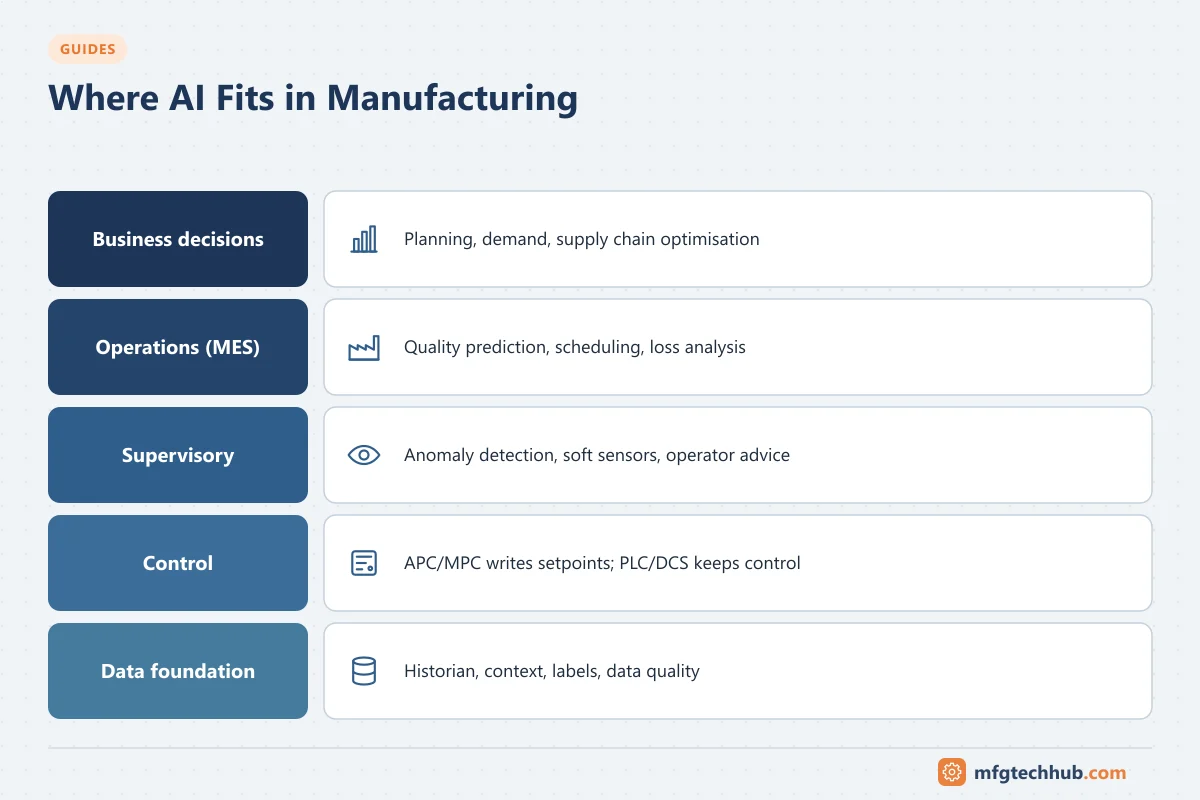
This guide explains where AI delivers real value in manufacturing, what data it needs, how it connects to automation and manufacturing systems, and how to avoid the most common pitfalls.
What Does AI Mean in a Manufacturing Context?
In manufacturing, “AI” usually refers to several related techniques:
- Machine learning (ML): algorithms that learn patterns from historical data, for example predicting a quality result from process conditions.
- Deep learning: neural networks that are particularly effective with images, audio and complex signals, such as detecting surface defects from camera images.
- Anomaly detection: methods that learn what “normal” looks like and flag unusual behavior without needing many examples of failures.
- Optimization: algorithms that search for the best combination of settings to meet goals such as throughput, quality or energy.
- Generative AI and large language models: tools that help people search documentation, summarize shift logs, draft reports or explain alarms in plain language.
Each technique fits different problems. Choosing the right one starts with a clear understanding of the business problem and the available data.
High-Value AI Use Cases
1. Predictive Maintenance
Predictive maintenance uses condition data such as vibration, temperature, motor current, pressure and runtime to estimate when equipment is likely to fail.
How it works:
- Sensors and controllers collect condition data, often through an IIoT architecture.
- Models learn the patterns that precede known failures, or detect deviations from normal behavior.
- Maintenance teams receive alerts early enough to plan repairs during scheduled downtime.
Typical assets: pumps, motors, fans, compressors, gearboxes, conveyors and spindles.
Practical tip: Many plants have few recorded failures for each asset type. In that case, anomaly detection is often more practical than trying to predict specific failure modes.
2. Visual Quality Inspection
Deep learning vision systems inspect products for scratches, cracks, missing components, incorrect labels, contamination or dimensional defects. Compared with traditional rule-based machine vision, AI-based inspection can handle natural variation in appearance, such as textures, reflections and irregular shapes.
Key success factors include consistent lighting, good camera positioning, and a well-labeled set of example images that represent both good and defective products.
3. Process Optimization
In continuous and batch processes, many variables interact in complex ways. Machine learning models can identify which conditions lead to the best yield, quality or energy efficiency, and recommend setpoints to operators. In some plants, these models work alongside advanced process control (APC) and model predictive control in the DCS.
4. Anomaly Detection in Process Data
Instead of relying only on fixed alarm limits, anomaly detection models learn normal multivariate behavior. They can flag subtle drifts, for example a heat exchanger slowly fouling or a valve beginning to stick, before they trigger alarms or affect product quality.
5. Quality Prediction (Soft Sensors)
A soft sensor estimates a quality variable that is expensive or slow to measure, such as a laboratory result, from process variables that are measured continuously. Operators get an estimate in minutes rather than waiting hours for lab results.
6. Demand Forecasting and Scheduling
AI models help forecast demand and optimize production schedules, considering changeover times, material availability and due dates. These capabilities often connect to MES production scheduling and ERP planning.
7. Energy Optimization
Models can predict energy consumption and identify opportunities to shift loads, optimize compressed air or HVAC systems, and reduce energy per unit of production.
8. Knowledge Assistants for Engineers and Operators
Generative AI tools can search standard operating procedures, manuals, maintenance history and alarm documentation, helping technicians find answers faster. Because these tools can produce incorrect answers, they should cite their sources, be restricted to approved documents, and never replace validated procedures for safety-critical work.
The Data Foundation for Industrial AI
AI models are only as good as the data behind them. Before starting an AI project, confirm that you have:
- Enough relevant history. Models need data that covers normal operation, different products and, where possible, the events you want to predict.
- Accurate timestamps. Process, quality and maintenance data must be aligned in time.
- Context. Values must be linked to assets, products, batches and operating modes. A pump running at low load behaves differently from one at full load.
- Labeled outcomes. For supervised learning, you need reliable labels: failure records, quality results or defect classifications.
- Consistent data quality. Frozen values, gaps, unit errors and sensor drift can mislead models.
The Manufacturing Data and Analytics guide covers data collection, historians and data quality in more detail.
Where AI Fits in the Automation Architecture
AI does not replace PLCs, DCS or safety systems. A typical and safe arrangement is:
| Layer | Role of AI |
|---|---|
| Safety instrumented systems | None. Safety functions remain deterministic and certified. |
| PLC and DCS control | Usually none directly; AI may provide recommended setpoints through controlled interfaces. |
| SCADA and HMI | Display AI insights, alerts and recommendations to operators. |
| Edge computing | Run models close to equipment for low-latency inference, such as vision inspection. |
| MES and historians | Supply training data and use predictions for quality, scheduling and maintenance. |
| Enterprise and cloud | Train models on large datasets and compare performance across sites. |
This layered approach, consistent with the ISA-95 model, keeps real-time control deterministic while allowing AI to improve decisions at higher levels.
Implementation Roadmap
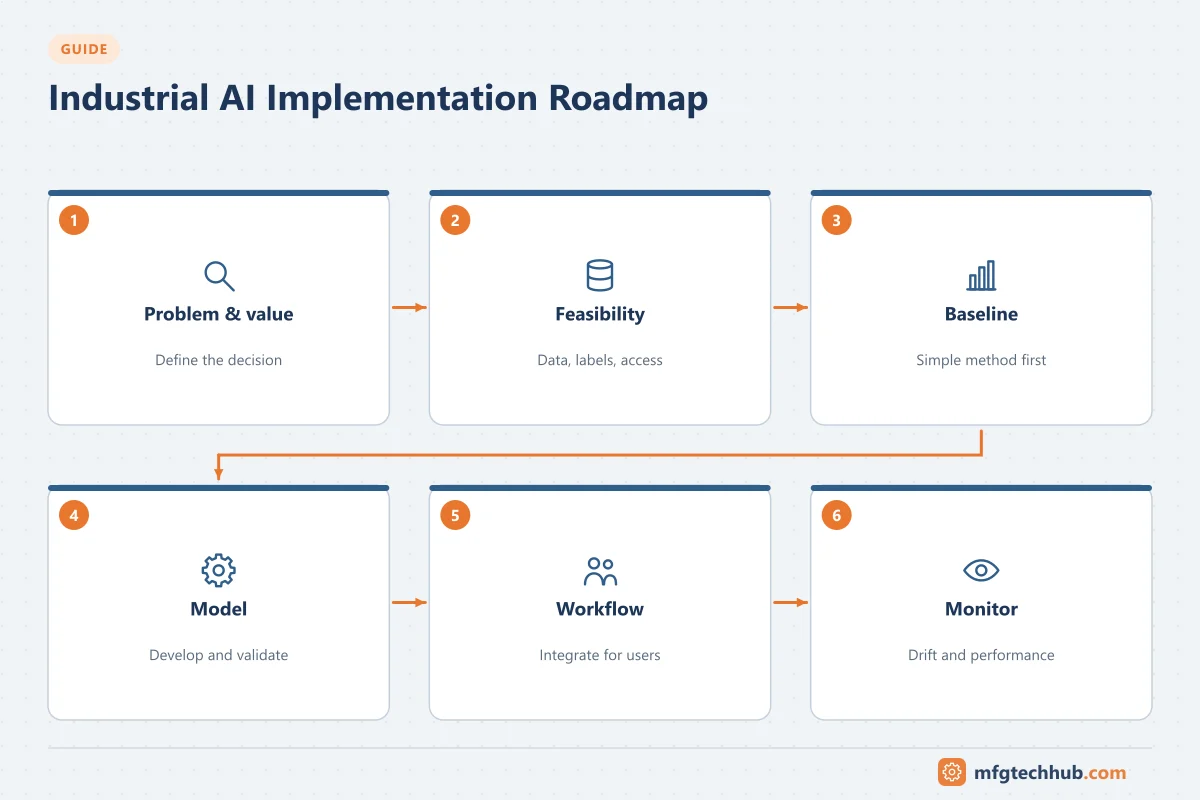
Step 1: Define the Problem and the Value
Write a clear problem statement with a measurable target, for example: “Reduce unplanned downtime of the main extruder by 25 percent within 12 months.”
Step 2: Check Feasibility
Confirm that the required data exists, is accessible, and contains the signal needed to solve the problem. A short data exploration phase often saves months of wasted effort.
Step 3: Build a Baseline
Start with simple methods, such as rules, statistical thresholds or basic regression. If a simple model solves the problem, it is easier to maintain and explain.
Step 4: Develop and Validate the Model
Train models on historical data and test them on data they have not seen, ideally from a later time period. Involve process experts to check whether results make physical sense.
Step 5: Integrate into Workflows
A model that produces predictions nobody sees is worthless. Decide who receives the output, how they act on it, and how the action is recorded, for example as a work order in the maintenance system.
Step 6: Monitor and Maintain
Processes, products and equipment change over time, so model accuracy can degrade. This is known as model drift. Monitor performance and retrain when needed.
Common Pitfalls
- Starting with the algorithm instead of the problem. Technology-led projects rarely deliver lasting value.
- Underestimating data preparation. Cleaning, aligning and contextualizing data often takes most of the project effort.
- Ignoring domain expertise. Operators and process engineers know which patterns matter and can spot unrealistic results.
- Lack of trust. If users do not understand why a model makes a recommendation, they may ignore it. Explainable outputs and a track record help build trust.
- Pilot purgatory. A successful pilot needs a plan, budget and ownership for scaling to other assets and sites.
- Security gaps. New data flows and edge devices must follow the plant’s OT security architecture, as described in ISA-99 / IEC 62443.
Responsible Use of AI in Industrial Operations
Because manufacturing decisions can affect safety, product quality and the environment, AI should be applied responsibly:
- Keep humans in the loop for decisions that affect safety or product release.
- Validate models appropriately in regulated industries such as pharmaceuticals, food and medical devices.
- Document data sources, model versions and performance.
- Provide a clear fallback when a model is unavailable or its inputs are out of range.
Continue Learning
- MES Data Analytics and AI
- MES Integration with Industry 4.0
- PLC Integration with Industry 4.0
- DCS Technology Future Trends
- SCADA Technology Future Trends
- Industrial IoT (IIoT)
Frequently Asked Questions
Can AI control a manufacturing process directly?
In most plants, AI provides recommendations or supervisory setpoints rather than directly controlling equipment. Real-time control stays in PLCs and DCS, and safety functions remain in certified safety systems.
How much data is needed for predictive maintenance?
It depends on the asset and the method. Anomaly detection can start with a few weeks of normal operating data. Predicting specific failure modes usually requires historical examples of those failures, which many plants do not have in large numbers.
Is AI only for large manufacturers?
No. Cloud services, pre-built vision tools and affordable wireless sensors have made focused AI projects accessible to small and medium-sized manufacturers. The key is choosing a narrow, valuable problem and having reliable data.