
DCS Future Trends: Ethernet-APL, Virtualisation, Modular Plants, Open Architectures and AI
On this page
DCS technology changes more slowly than IT, and for good reason: a plant expects its control system to run safely for decades. Still, several trends are changing how new systems are designed and how existing ones are extended. The useful question for each trend is not “is it exciting?” but “how mature is it, and what does it change for my plant?”
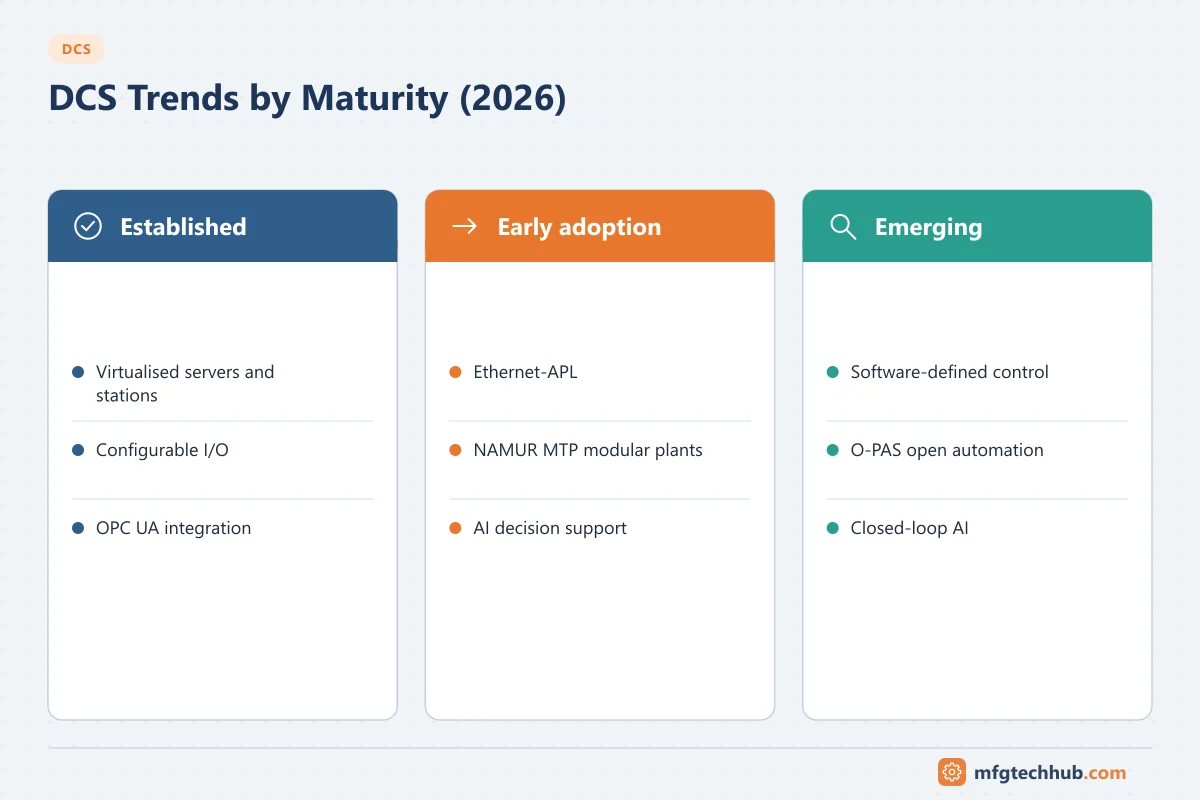
Trends at a glance
| Trend | Maturity (2026) | What it changes |
|---|---|---|
| Virtualised servers and stations | Established | Fewer PCs, faster recovery, easier refresh |
| Configurable I/O, electronic marshalling | Established | Less cabinet work, late I/O changes easier |
| OPC UA as the integration interface | Established | Standard, secure data exchange with MES and analytics |
| Ethernet-APL to field instruments | Early adoption | Ethernet speed and diagnostics at the instrument |
| Modular plants with NAMUR MTP | Early adoption | Package units integrated by configuration, not custom engineering |
| Software-defined / virtual controllers | Emerging | Control on server hardware; hardware and software lifecycles separated |
| Open process automation (O-PAS) | Emerging, pilots | Multi-vendor, portable control applications |
| Analytics and AI in operations | Growing, mostly advisory | Earlier detection of problems; decision support |
| Remote and centralised operations | Established in some sectors | Fewer control rooms; new security and staffing needs |
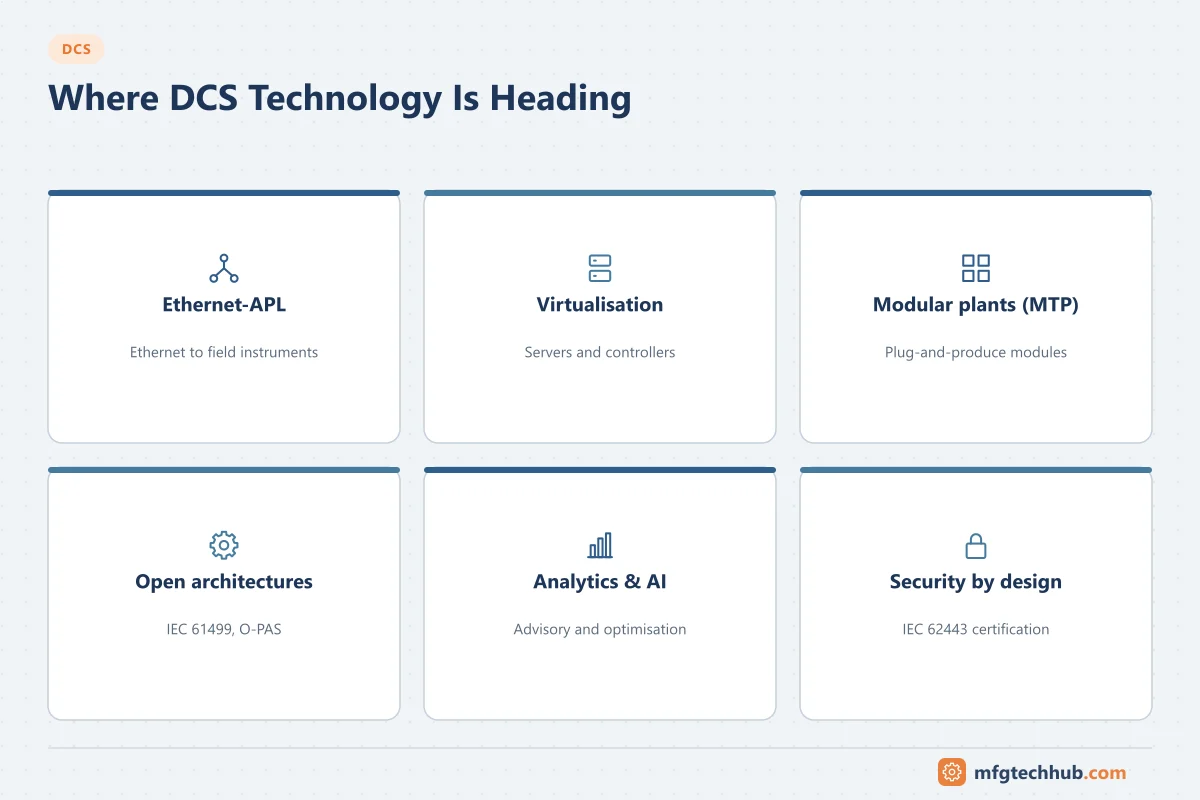
Ethernet-APL
Ethernet-APL (Advanced Physical Layer) brings Ethernet to field instruments over two-wire cable, with power and intrinsic safety options for hazardous areas. It is based on the IEEE 802.3cg 10BASE-T1L physical layer and carries protocols such as PROFINET, EtherNet/IP and HART-IP.
- Benefits: much higher bandwidth than HART or fieldbus, full device diagnostics, one network technology from field to control.
- Status: products from major instrument and DCS vendors are available; adoption is growing on new projects.
- Consider: network design and switch placement, device availability for all measurement types, and maintenance skills for Ethernet in the field.
Virtualisation and software-defined control
Servers and operator stations have been virtualised for years. The next step is software-defined control: controller functions running as software on industrial server hardware instead of in a dedicated controller. Several vendors now offer or are developing virtual controllers for some applications.
- Benefits: hardware can be refreshed independently of control applications; easier scaling; testing on identical virtual copies.
- Consider: deterministic performance, redundancy of the server platform, I/O connection, and which applications the vendor supports. Safety functions remain on certified safety controllers.
Modular plants and MTP
In modular plants, package units (skids) are delivered with their own automation. The Module Type Package (MTP), defined in VDI/VDE/NAMUR 2658, describes a module’s services, displays and interfaces so the DCS (the process orchestration layer) can integrate it by importing a file rather than by custom engineering.
- Benefits: faster integration of packages, reuse of modules across plants.
- Status: strongest adoption in chemicals and pharmaceuticals; requires both module suppliers and DCS vendors to support MTP.
Open process automation
The Open Process Automation Forum (The Open Group) is developing O-PAS, a standard for interoperable, multi-vendor process control systems, in which control applications can be moved between hardware from different suppliers. IEC 61499 provides a related model for portable, event-driven function-block applications.
- Status: test beds and pilot projects; most plants still buy integrated single-vendor DCS.
- Why it matters: it may change long-term lifecycle and migration economics if it achieves broad adoption.
Data, analytics and AI
DCS data is increasingly used beyond the control room:
- OPC UA and historians feed data platforms and analytics.
- Anomaly detection and predictive maintenance on equipment and instruments.
- Operator decision support: alarm analysis, procedure guidance, and assistants that search documentation.
- Advanced process control and optimisation, long established, now easier to maintain with better tools.
Most AI applications in process plants today are advisory: they suggest, operators and existing control decide. Closed-loop use needs the same validation, change control and fallback as any other control function. See AI and Machine Learning in Process Control.
Cloud and remote operations
Cloud platforms are used for analytics, fleet monitoring and vendor support, not for real-time control, which stays on site. Some sectors (for example offshore oil and gas, pipelines, utilities) operate multiple sites from remote operations centres. Both depend on secure, well-designed connections through the DMZ and clear rules on what can be commanded remotely.
Security by design
Cybersecurity is now a design requirement rather than an add-on. Vendors certify development processes and products to IEC 62443-4-1 and 4-2, and plant owners specify security levels for zones. Expect continued focus on secure remote access, patch management, backups and detection of abnormal network behaviour. See ISA/IEC 62443.
How to use these trends in your plant
- For a new plant, virtualisation, configurable I/O, OPC UA and a security-by-design architecture are normal expectations. Evaluate Ethernet-APL and MTP on their fit.
- For an existing plant, adopt trends at natural points: station refresh (virtualisation), I/O replacement (configurable I/O, APL), new package units (MTP).
- For everything, ask about the vendor’s lifecycle commitment, migration paths and support for open standards.
Frequently asked questions
Will the cloud replace the DCS?
Not for real-time control. Control must continue during network outages and meet safety requirements, so it stays on site. The cloud is used for analytics, fleet monitoring and support.
What is Ethernet-APL?
A two-wire Ethernet physical layer for field instruments, including intrinsically safe versions for hazardous areas. It brings Ethernet bandwidth and diagnostics to the field and carries protocols such as PROFINET, EtherNet/IP and HART-IP.
What is O-PAS?
The Open Process Automation Standard from the Open Process Automation Forum of The Open Group. It aims to let control applications run on interoperable hardware and software from different suppliers.
Key takeaways
- Judge each trend by maturity and its fit for your plant.
- Virtualisation, configurable I/O and OPC UA are established; Ethernet-APL and MTP are in early adoption; software-defined control and O-PAS are emerging.
- AI in process plants is mostly advisory and needs the same discipline as other control changes.
- Real-time control stays on site; security by design is now a baseline requirement.
Related tutorials
Before you apply this in a plant: this article is for education. Always check the current edition of the relevant standards, the manufacturer's documentation for your exact product and version, and your site's procedures. Safety-related work needs qualified personnel. See our editorial policy.