
DCS Project Lifecycle: Phases, Deliverables, FAT, SAT and Commissioning
On this page
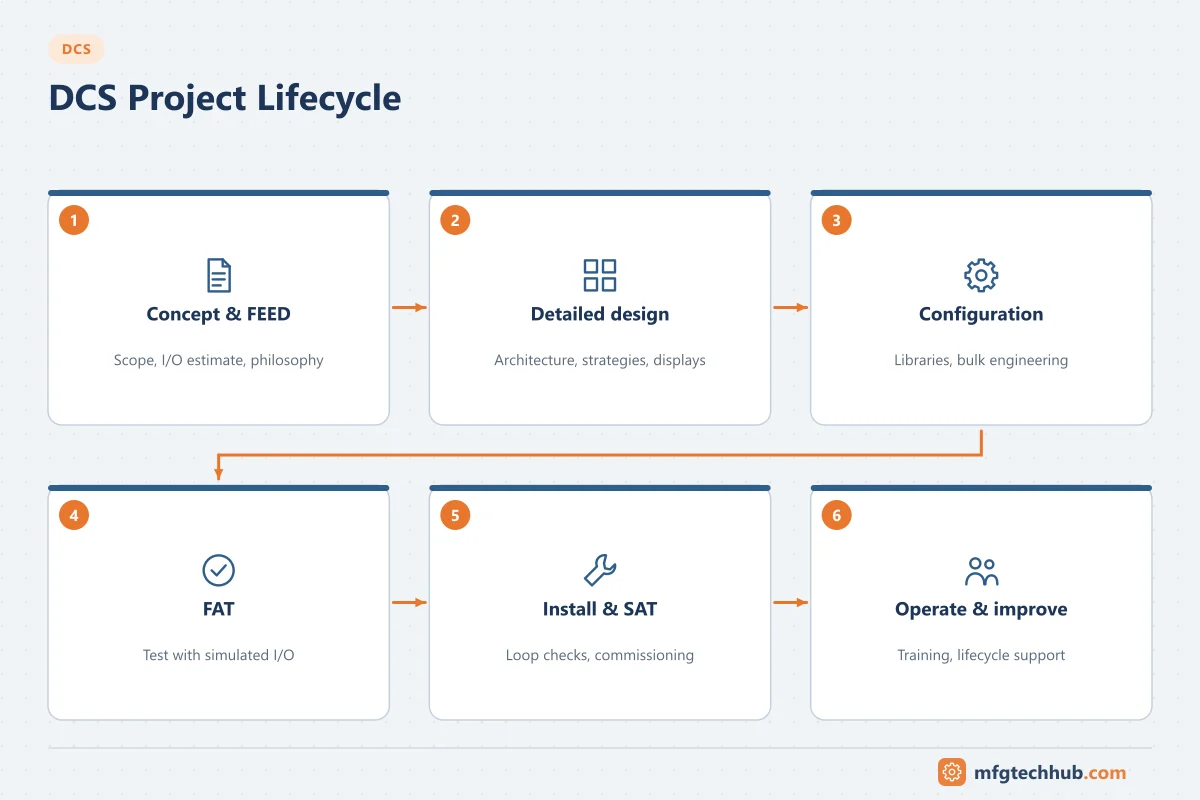
A DCS project turns a process design into a working, tested control system and a trained operating team. Whether it is a new plant or a replacement, the phases are the same: define, design, configure, test, install, commission, hand over. Each phase has defined deliverables that the next phase depends on; skipping or rushing one shows up later as rework during commissioning, when it is most expensive.
For the risks that commonly derail these projects, see DCS Implementation and Migration Challenges.
Who does what
| Party | Typical role |
|---|---|
| Owner / operator | Sets requirements and standards, approves designs, provides operators and maintenance staff, accepts the system |
| EPC contractor | Process and instrument design, installation, overall schedule |
| Main automation contractor (MAC) | Often the DCS vendor or its partner; responsible for DCS, and sometimes SIS and package integration |
| DCS vendor | Hardware, software, standard libraries, configuration tools, lifecycle support |
| Package suppliers | Skids and machines with their own control systems, integrated into the DCS |
Contract models vary. What matters is that each interface (process design to control design, packages to DCS, DCS to SIS) has a named owner.
Phase 1: Concept and FEED
Front-end engineering design (FEED) defines what will be built and sets the basis for cost and schedule.
Key activities: control system architecture, preliminary I/O count, vendor selection strategy, safety and security risk assessments, integration requirements (MES, historian, packages).
Deliverables:
- Automation basis of design and system architecture
- Preliminary I/O list and controller and station estimates
- Control, alarm and HMI philosophies (at least in draft)
- Cybersecurity risk assessment and zone concept (IEC 62443)
- Hazard and risk assessment outputs and SIL targets for the SIS (Functional Safety)
- Budget estimate and execution strategy
Phase 2: Detailed design
Key activities: finalise I/O, write functional specifications, design typicals, define interfaces.
Deliverables:
- Instrument index and final I/O list, with I/O allocated to controllers (Controllers and I/O)
- Functional design specification and control narratives per unit
- Typical designs (loop, motor, valve, sequence templates)
- Cause-and-effect matrices for interlocks and SIS
- Alarm philosophy and HMI style guide (HMI Displays and Alarms)
- Network and security design, cabinet layouts, power distribution
- Interface specifications for packages and other systems
Phase 3: Configuration
Key activities: build libraries from typicals, bulk-configure tags from the instrument database, build displays, configure alarms, interfaces and security.
Good practice:
- Approve typicals and a sample unit before bulk configuration.
- Generate configuration from the instrument database rather than typing it.
- Keep a change log from the first day; changes after the I/O freeze go through change control.
- Run internal tests before FAT so FAT verifies the system rather than debugging it.
Phase 4: Factory acceptance test (FAT)
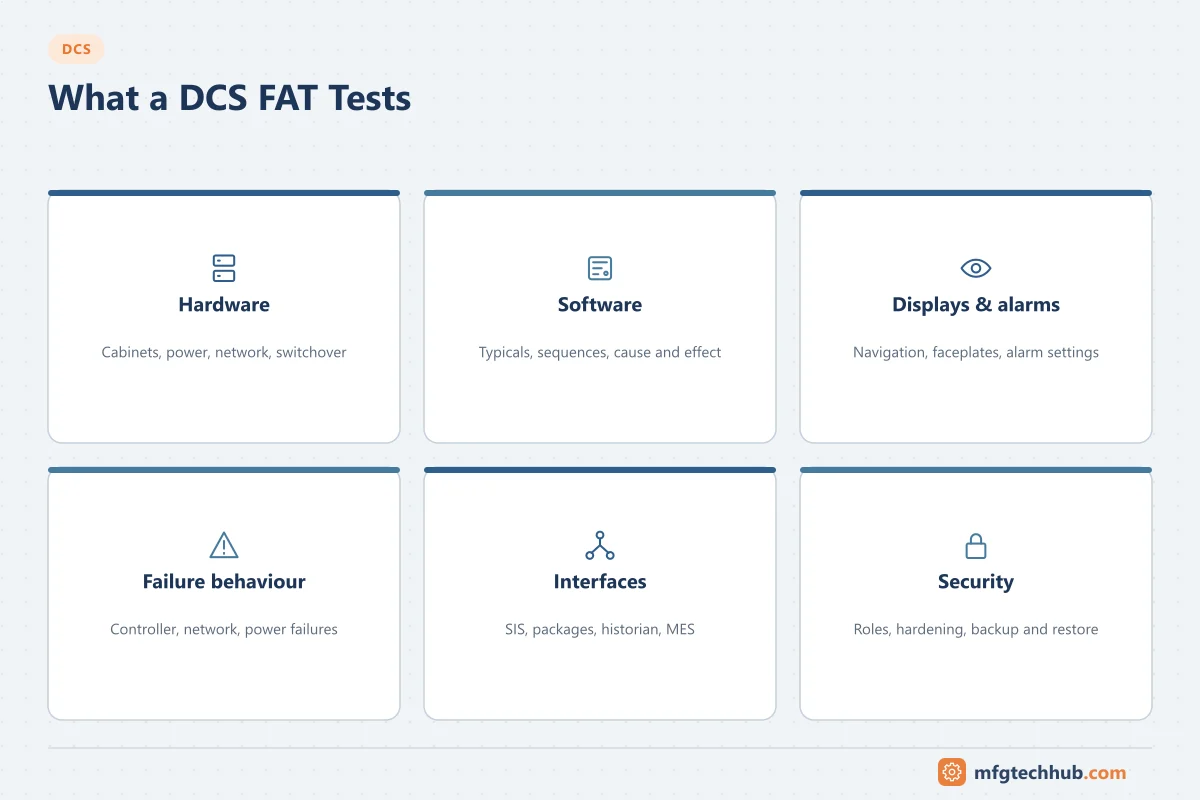
The FAT proves at the vendor’s facility that the system meets the specification before shipment. The structure is described in IEC 62381.
| FAT part | What is tested |
|---|---|
| Hardware | Cabinets, wiring, power, redundancy switchover, network |
| Software | Every loop and device typical, sequences, interlocks against cause-and-effect matrices |
| Displays and alarms | Display navigation, faceplates, alarm settings against the alarm database |
| Failure behaviour | Controller, network and power failures; fail-safe output states |
| Interfaces | Communication with SIS, packages, historian and MES (often simulated) |
| Security | User roles, hardening, backup and restore |
An integrated FAT tests the DCS with the SIS and key packages connected. Record all punch items and close them before or at site with agreed priorities.
Phase 5: Installation and site acceptance test (SAT)
Installation: cabinets, networks, stations and field cabling; power and grounding checks.
SAT: repeats key FAT tests on site with the real infrastructure: system health, redundancy, network, time synchronisation, interfaces.
Phase 6: Loop checks and commissioning
- Loop checks (IEC 62382) verify every signal from field device to operator display: range, alarms, direction, fail action. See DCS Field Devices.
- Functional checks of motors, valves, interlocks and sequences with the equipment, before process fluids.
- Commissioning with process: loops put in automatic and tuned, sequences run for real, alarms verified under operating conditions.
- SIS validation per IEC 61511 before hazards are introduced.
Phase 7: Handover and operation
Deliverables at handover:
- As-built documentation: I/O list, configuration backups, network drawings, functional specifications updated to match the system
- Operating and maintenance manuals, spare parts list
- Trained operators and maintenance staff (ideally trained on a simulator)
- Backup and restore procedures tested (OT Backup and Restore Runbook)
- Lifecycle support agreement and security maintenance plan
After start-up, the work continues: alarm performance reviews, loop tuning, management of change and planned upgrades.
Common pitfalls
| Pitfall | Effect | Prevention |
|---|---|---|
| Philosophies written after configuration | Inconsistent alarms and displays, rework | Agree them in FEED or early detailed design |
| No I/O freeze or change control | Endless late changes, configuration errors | Freeze dates, spare capacity, formal change process |
| FAT used for debugging | Schedule slip, incomplete testing | Internal testing before FAT |
| Package interfaces defined late | Integration problems on site | Interface specifications in purchase orders |
| Operators involved only at start-up | Poor acceptance, mistakes | Display reviews and simulator training |
| Documentation not updated | Future changes based on wrong documents | As-built updates as a handover condition |
Frequently asked questions
What is the difference between FAT and SAT?
The factory acceptance test checks the system at the vendor’s facility before shipment, usually with simulated I/O. The site acceptance test repeats key tests after installation with the real infrastructure, before loop checks and commissioning.
What documents does a DCS project need?
At minimum: architecture, I/O list, functional design specification and control narratives, cause-and-effect matrices, alarm philosophy, HMI style guide, network and security design, test procedures and as-built documentation.
What is a main automation contractor?
A contractor, often the DCS vendor, given overall responsibility for the automation scope: DCS, often the SIS, and integration of package control systems, as a single point of responsibility.
Key takeaways
- Each phase produces deliverables the next depends on; philosophies and typicals come early.
- Generate configuration from data, freeze I/O with change control, and test internally before FAT.
- FAT, SAT, loop checks and commissioning each verify different things.
- Handover includes as-built documents, trained people, tested backups and a support plan.
Related tutorials
Before you apply this in a plant: this article is for education. Always check the current edition of the relevant standards, the manufacturer's documentation for your exact product and version, and your site's procedures. Safety-related work needs qualified personnel. See our editorial policy.