
DCS Vendors and Platforms Compared: Major Systems and How to Choose
On this page
A DCS is usually chosen once for a plant’s lifetime of 20–30 years, often together with the main automation contractor. The decision affects engineering methods, operator experience, spare parts, skills and migration paths for decades. This page gives a vendor-neutral overview of widely used process control platforms and a framework for comparing them.
Last technical review: September 2026. Product names and capabilities change. Confirm current product information, lifecycle status and local support with each vendor.
Widely used DCS platforms
| Vendor | Platform(s) | Notes for evaluation |
|---|---|---|
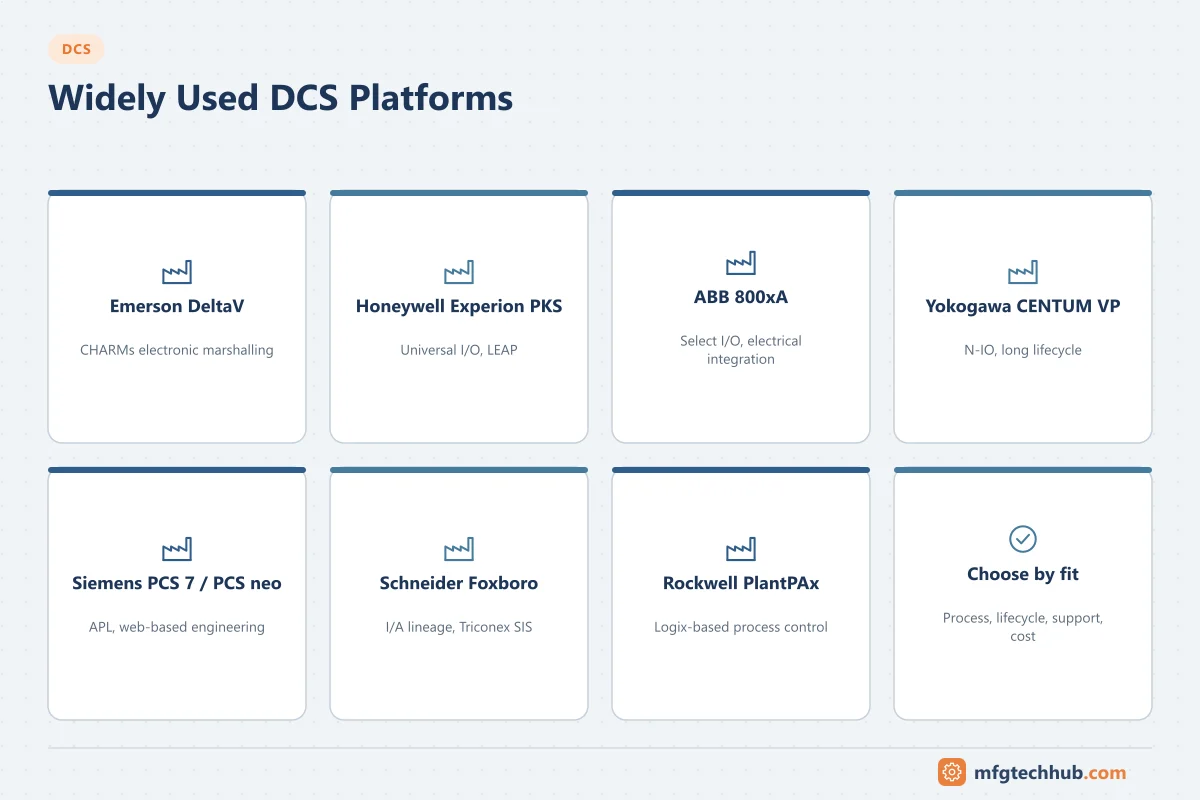
| Emerson | DeltaV (process), Ovation (power and water) | DeltaV is widely used in chemicals, life sciences, oil and gas; it includes configurable “electronic marshalling” I/O concepts. Ovation focuses on power generation and water/wastewater |
| Honeywell (Honeywell Technologies) | Experion PKS | Widely used in refining, petrochemicals and other continuous processes; long migration history from earlier Honeywell systems |
| ABB | ABB Ability System 800xA | Integrates process control, electrical control, safety and information management in a common environment; strong in pulp and paper, minerals, power and oil and gas |
| Yokogawa | CENTUM VP | Known for long lifecycle compatibility and high availability; widely used in oil and gas, chemicals and power |
| Siemens | SIMATIC PCS 7, SIMATIC PCS neo | PCS 7 is a mature, widely installed DCS; PCS neo is Siemens’ web-based, object-oriented DCS. Siemens offers both, based on common hardware |
| Schneider Electric | EcoStruxure Foxboro DCS; EcoStruxure Process Expert | Foxboro DCS continues the Foxboro I/A Series lineage; Process Expert (formerly EcoStruxure Hybrid DCS) targets hybrid and mid-sized applications. Schneider has also announced software-defined Foxboro architectures |
| Rockwell Automation | PlantPAx | A process control system built on Logix controllers and FactoryTalk software, common in hybrid industries such as food, life sciences and mining |
Other suppliers (for example regional vendors and specialised turbine or power-plant control systems) are important in particular markets. Turbine control systems such as those used on gas and steam turbines are specialised controllers rather than general-purpose plant DCS.
Vendor capability profiles
These profiles describe characteristic features of each platform family. Every vendor offers much more than listed; use the profiles to prepare questions for demonstrations, not to rank systems.
Emerson: DeltaV and Ovation
- Controllers and I/O: DeltaV controllers with CHARMs electronic marshalling, where each channel is characterised in software so wiring can be done before the final I/O assignment is known; support for HART, FOUNDATION Fieldbus, PROFIBUS DP and wireless.
- Engineering and operations: class-based configuration, DeltaV Live web-based operator interface, DeltaV Batch for ISA-88 batch control, and DeltaV SIS for safety.
- Ecosystem: Emerson owns AspenTech (since March 2025), linking DeltaV with advanced process control, optimisation and industrial data software.
- Ovation focuses on power generation and water/wastewater with plant-specific control and SCADA functions.
- Typical fit: chemicals, life sciences, oil and gas, and projects where late I/O changes are expected.
Honeywell (Honeywell Technologies): Experion PKS
- Controllers and I/O: C300 controllers and Universal I/O with software-configurable channel types; Safety Manager for SIS.
- Engineering approach: LEAP (Lean Execution of Automation Projects) separates physical and functional design so hardware and configuration can proceed in parallel, with virtualisation and cloud-based engineering options.
- Operations: Experion operator stations with integrated alarm management and operator tools; long migration paths from TDC and earlier Honeywell systems.
- Corporate: after the Aerospace spin-off in June 2026, the automation business operates as Honeywell Technologies.
- Typical fit: refining, petrochemicals, LNG, other large continuous processes; sites with installed Honeywell systems.
ABB: System 800xA
- Controllers and I/O: AC 800M controllers and Select I/O, single-channel Ethernet I/O that supports late binding of signals to controllers.
- Integration: 800xA combines process control, electrical integration (including IEC 61850), safety (SIL-rated controllers), information management and collaboration in one operator and engineering environment.
- Engineering: automated, data-driven engineering tools for project execution.
- Typical fit: pulp and paper, mining and minerals, power, oil and gas, and plants wanting integrated process and electrical control.
Yokogawa: CENTUM VP
- Controllers and I/O: field control stations with N-IO (network I/O) universal, software-configurable channels; ProSafe-RS for safety.
- Lifecycle: strong reputation for backward compatibility and phased migration within the CENTUM family; engineering with Automation Design Suite.
- Operations: consistent operator interface across generations and high-availability architecture.
- Typical fit: oil and gas, chemicals, power, LNG and long-life continuous plants; often paired with FAST/TOOLS for remote assets.
Siemens: SIMATIC PCS 7 and PCS neo
- PCS 7: mature DCS with the Advanced Process Library, SIMATIC BATCH, redundant controllers and Safety Integrated; very large installed base, especially in chemicals, pharma and hybrid industries.
- PCS neo: web-based, object-oriented DCS for new projects, with global multi-user engineering and browser-based operation.
- Both support modern field technology such as Ethernet-APL and modular plant integration via MTP (Module Type Package).
- Typical fit: chemicals, pharmaceuticals, food and beverage, water; plants with Siemens discrete automation that want one supplier.
Schneider Electric: EcoStruxure Foxboro DCS and Process Expert
- Foxboro DCS: continues the Foxboro I/A Series lineage with emphasis on continuity for installed bases; often combined with Triconex safety systems.
- EcoStruxure Process Expert: targets hybrid and mid-sized plants on Modicon hardware.
- Direction: Schneider promotes software-defined and open automation, including IEC 61499-based EcoStruxure Automation Expert.
- Typical fit: refining, chemicals, power and mining with Foxboro/Triconex installed bases; hybrid plants for Process Expert.
Rockwell Automation: PlantPAx
- Architecture: ControlLogix controllers, the PlantPAx library of process objects, FactoryTalk View SE, FactoryTalk Batch and FactoryTalk historian products.
- Strengths: one platform for process and discrete control, large pool of Logix skills, integration with Rockwell drives and motor control.
- Check: system sizing and performance rules, library version management, redundancy architecture.
- Typical fit: food and beverage, life sciences, mining, water and other hybrid industries.
Quick comparison by requirement
| If your priority is… | Questions to push in demonstrations |
|---|---|
| Late design changes and fast schedule | Software-configurable I/O (CHARMs, Universal I/O, N-IO, Select I/O) and parallel engineering methods |
| Long plant life and minimal disruption | Backward compatibility, phased migration, online upgrades |
| Integrated electrical and process control | IEC 61850 integration, motor control centre and drive integration |
| Batch and pharma | ISA-88 batch engine, EBR integration, validation support |
| Modular plants | MTP support and orchestration layer |
| Hybrid process and discrete | Common controller platform with machine control |
Objective selection criteria
| Criterion | Questions to ask |
|---|---|
| Process fit | Continuous, batch or hybrid? Size (I/O count, number of controllers and operator stations)? |
| Batch and recipes | ISA-88 batch management, recipe handling, electronic batch records integration? |
| I/O and field networks | Configurable I/O, HART, FOUNDATION Fieldbus, PROFIBUS PA, Ethernet-APL, wireless? Remote and hazardous-area I/O? |
| Availability | Controller, network, I/O and server redundancy; online upgrades and online changes? |
| Safety integration | Integrated or interfaced SIS, certified to IEC 61508/61511, with appropriate independence? |
| Engineering | Class-based libraries, bulk engineering from instrument databases, simulation, multi-user engineering, virtual commissioning? |
| Operations | High-performance HMI support, alarm management tools (ISA-18.2), operator training simulators? |
| Integration | OPC UA, historian, MES, asset management, advanced process control, MTP for modular plants? |
| Cybersecurity | IEC 62443-certified components and development process, patch management, security monitoring? |
| Lifecycle | Migration paths from older systems, backward compatibility, product roadmap, support period? |
| Support and skills | Local vendor presence, system integrators, availability of trained engineers? |
| Total cost | Hardware, licences, engineering, training, support contracts and upgrades over the plant’s life |
How DCS selection is usually done
- Define the automation strategy: plant size, process type, safety strategy, integration needs, cybersecurity requirements and company standards.
- Front-end engineering (FEED): estimate I/O counts, architecture and control philosophy.
- Request for proposals with a clear functional specification and scope (hardware, software, engineering, FAT, site services, lifecycle support).
- Technical evaluation against criteria like those above, including demonstrations with representative control strategies and displays.
- Commercial evaluation over the lifecycle, not only the initial price.
- Main automation contractor (MAC) model: many large projects award the DCS vendor responsibility for integrating the whole automation scope.
Migration considerations
For existing plants, the most important question is often how to migrate from the installed system:
- Does the vendor offer a phased migration path (HMI first, then controllers, then I/O)?
- Can existing field wiring be retained through termination adapters?
- Can control strategies be converted automatically, and how much re-engineering is needed?
- What is the cutover strategy for continuous processes with limited shutdown windows?
See Traditional vs Modern DCS Architecture.
Frequently asked questions
Which DCS is the best?
None is best in every situation. The major platforms are all capable of controlling large, complex plants. Differences lie in engineering approach, industry experience, integration features, lifecycle policies, local support and cost. Select against your plant’s requirements.
What is the difference between PCS 7 and PCS neo?
Both are Siemens process control systems. PCS 7 is the mature, widely installed platform; PCS neo is a newer, web-based system with object-oriented engineering. Siemens describes a strategy of supporting both on a common hardware basis.
Is PlantPAx a real DCS?
PlantPAx is Rockwell Automation’s process control system, built on Logix controllers and FactoryTalk software with process libraries and system-level tools. It is used as a DCS, particularly in hybrid industries where the same technology is used for machine and process control.
Key takeaways
- Major DCS platforms are all capable; choose by process fit, integration, lifecycle, support and total cost.
- Evaluate with demonstrations of your own control strategies and displays.
- For existing plants, the migration path is often the deciding factor.
Related tutorials
Before you apply this in a plant: this article is for education. Always check the current edition of the relevant standards, the manufacturer's documentation for your exact product and version, and your site's procedures. Safety-related work needs qualified personnel. See our editorial policy.