
Standards for DCS Engineers: Which Standard Applies to Which Task
On this page
A DCS project touches many standards, from the tag numbers on the P&ID to the firewall rules in the DMZ. Engineers do not need to know every clause, but they need to know which standard governs which decision, and which ones their company or regulator has made mandatory. This page maps the main standards to the tasks where they apply.
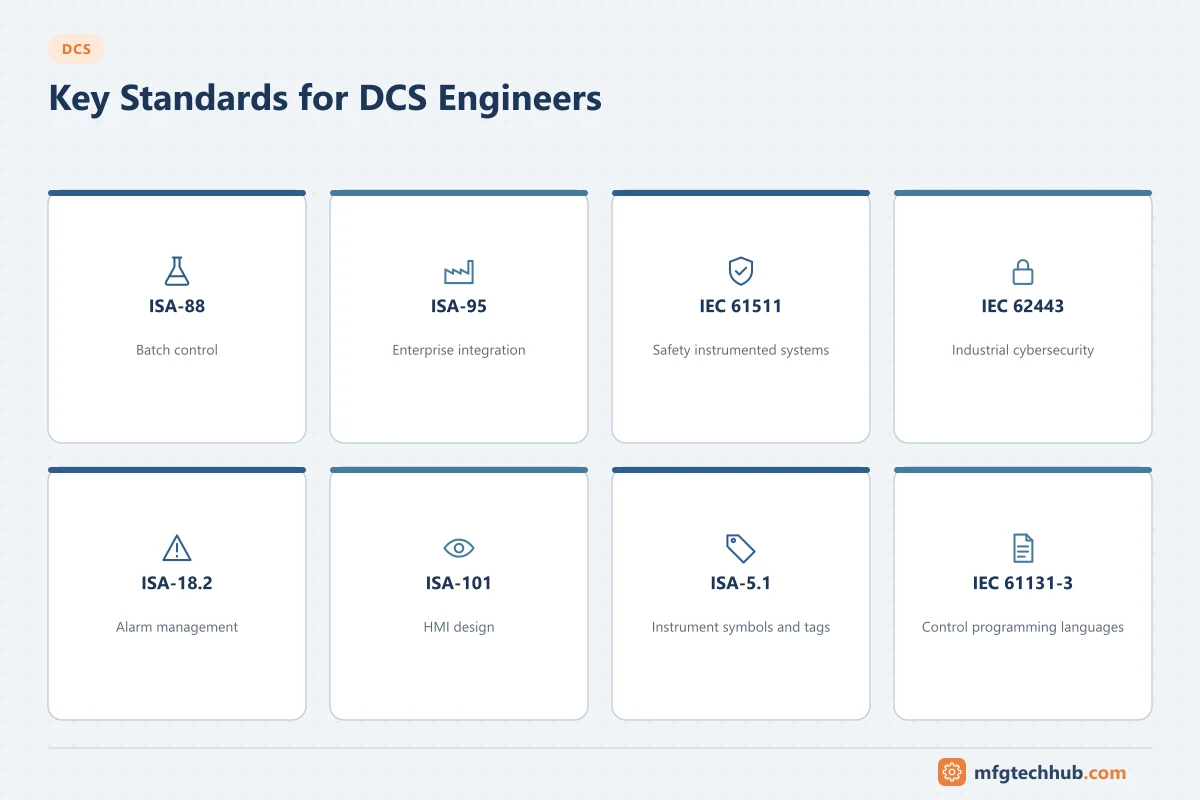
Standards are revised regularly. Always check the current edition and the edition named in your contract or site procedures.
Standards by task
| Task | Main standard or guideline | What it gives you |
|---|---|---|
| Instrument tags and symbols | ANSI/ISA-5.1 | Tag letters (FIC, LT, PV) and P&ID symbols; see P&ID Standards |
| Control programming | IEC 61131-3 | Languages: ladder, function block diagram, structured text, sequential function chart (instruction list was deprecated in the 2013 edition) |
| Distributed function-block applications | IEC 61499 | Event-driven function blocks for distributed, portable applications |
| Batch control | ISA-88 / IEC 61512 | Physical and procedural models, recipes, phases; see ISA-88 |
| Integration with MES and ERP | ISA-95 / IEC 62264 | Levels, activities and information models; see ISA-95 |
| Safety instrumented systems | IEC 61511 (ANSI/ISA-61511 in the US) | Safety lifecycle, SIL determination and verification; see Functional Safety |
| Burner and boiler safety | NFPA 85 (US) and regional equivalents | Burner management requirements for boilers |
| Alarm management | ISA-18.2 / IEC 62682, EEMUA 191 | Alarm philosophy, rationalisation, performance metrics |
| Operator displays | ISA-101 | HMI philosophy, style guide, display hierarchy |
| Control room design | ISO 11064 | Ergonomic design of control centres |
| Cybersecurity | ISA/IEC 62443 | Zones and conduits, security levels, supplier and product requirements; see ISA/IEC 62443 |
| Process control system practice | API RP 554 | Recommended practice for process control systems in refining |
| Factory and site testing | IEC 62381 | FAT, FIT (integration test) and SAT for process automation systems |
| Loop checks | IEC 62382 | Electrical and instrumentation loop checks |
| Hazardous areas | IEC 60079 series | Explosion protection, including intrinsic safety |
| Fieldbus | IEC 61158 / IEC 61784 | Fieldbus and industrial Ethernet profiles |
| Data exchange | IEC 62541 (OPC UA) | Standard interface to other systems; see OPC UA |
| Regulated industries (pharma) | GAMP 5, 21 CFR Part 11, EU GMP Annex 11 | Validation and electronic records; see Computerised System Validation |
NAMUR recommendations
NAMUR, the user association of automation technology in the process industries, publishes recommendations (NE) and worksheets (NA) that many DCS specifications reference. Frequently used ones:
| Recommendation | Subject |
|---|---|
| NE 43 | Signal levels for failure information of 4–20 mA transmitters |
| NE 107 | Self-monitoring and diagnosis of field devices (four status categories) |
| NE 21 | Electromagnetic compatibility of industrial equipment |
| VDI/VDE/NAMUR 2658 | Module Type Package (MTP) for modular plants |
See DCS Field Devices for NE 43 and NE 107 in practice.
Standards across the project lifecycle
| Phase | Standards typically applied |
|---|---|
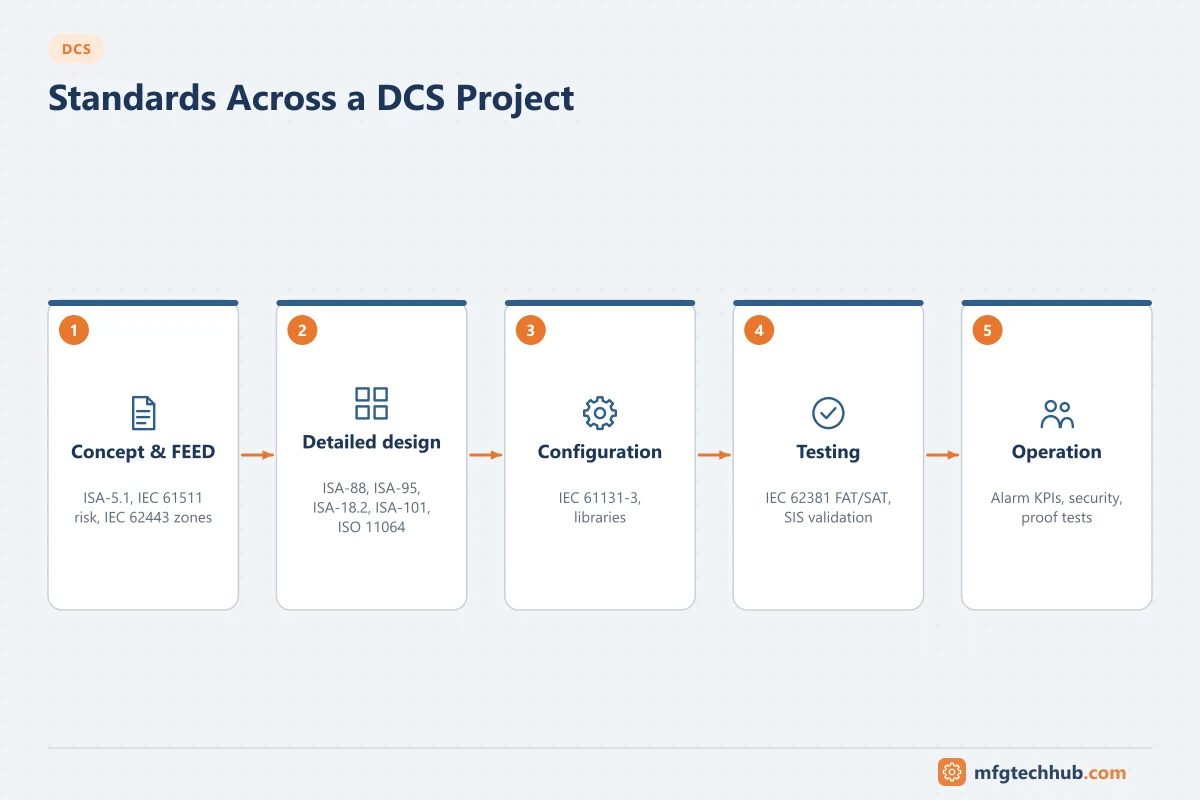
| Concept and FEED | ISA-5.1 (documentation), IEC 61511 (hazard and risk assessment, SIL targets), IEC 62443 (risk assessment, zones) |
| Detailed design | ISA-88, ISA-95, ISA-18.2 philosophy, ISA-101 style guide, ISO 11064, IEC 60079, API RP 554 |
| Configuration | IEC 61131-3, vendor standards, company typicals and libraries |
| Testing | IEC 62381 (FAT, SAT), IEC 61511 (SIS validation), GAMP 5 in regulated industries |
| Installation and commissioning | IEC 62382 (loop checks), IEC 60079 (inspection) |
| Operation | ISA-18.2 (alarm performance), IEC 62443 (security maintenance), IEC 61511 (proof testing, management of change) |
See DCS Project Process for the lifecycle itself.
Using standards in practice
- Name the standards and editions in the specification. A vague “according to international standards” cannot be tested at FAT.
- Turn standards into site documents. An alarm philosophy, HMI style guide, security policy and control narratives are how ISA-18.2, ISA-101 and IEC 62443 become real.
- Use certified products where it matters. IEC 61508/61511 certified safety systems; IEC 62443-certified components where the security programme requires them.
- Do not over-apply. A small utility system does not need the full ISA-88 model; a pharmaceutical batch plant does.
- Keep a register of standards, editions and the documents that implement them, and review it when standards are revised.
Frequently asked questions
Which standards are most important for a DCS engineer?
For most process plants: ISA-5.1 for documentation, IEC 61131-3 for configuration, IEC 61511 for safety systems, ISA-18.2 for alarms, ISA-101 for displays, ISA/IEC 62443 for security, and ISA-88 and ISA-95 where batch control or MES integration applies.
Are these standards legally required?
Some are required by law or regulators in particular countries or industries (for example functional safety or pharmaceutical regulations); many are contractual or recognised good practice. Check local regulations and your company standards.
What is NAMUR?
A user association of automation technology users in the process industries, mainly chemical and pharmaceutical companies. Its recommendations (such as NE 43 and NE 107) are widely referenced in DCS and instrument specifications.
Key takeaways
- Map each project task to the standard that governs it.
- Name standards and editions in specifications so compliance can be tested.
- Implement standards through site documents: philosophies, style guides and procedures.
- Review the standards register when new editions appear.
Related tutorials
Before you apply this in a plant: this article is for education. Always check the current edition of the relevant standards, the manufacturer's documentation for your exact product and version, and your site's procedures. Safety-related work needs qualified personnel. See our editorial policy.