
Industrial Communication Protocols Explained
On this page
Every automation system depends on communication: instruments talking to controllers, controllers talking to each other, and plant systems sharing data with SCADA, MES and the enterprise. Over the decades, dozens of industrial protocols have appeared, and most plants use several at once.
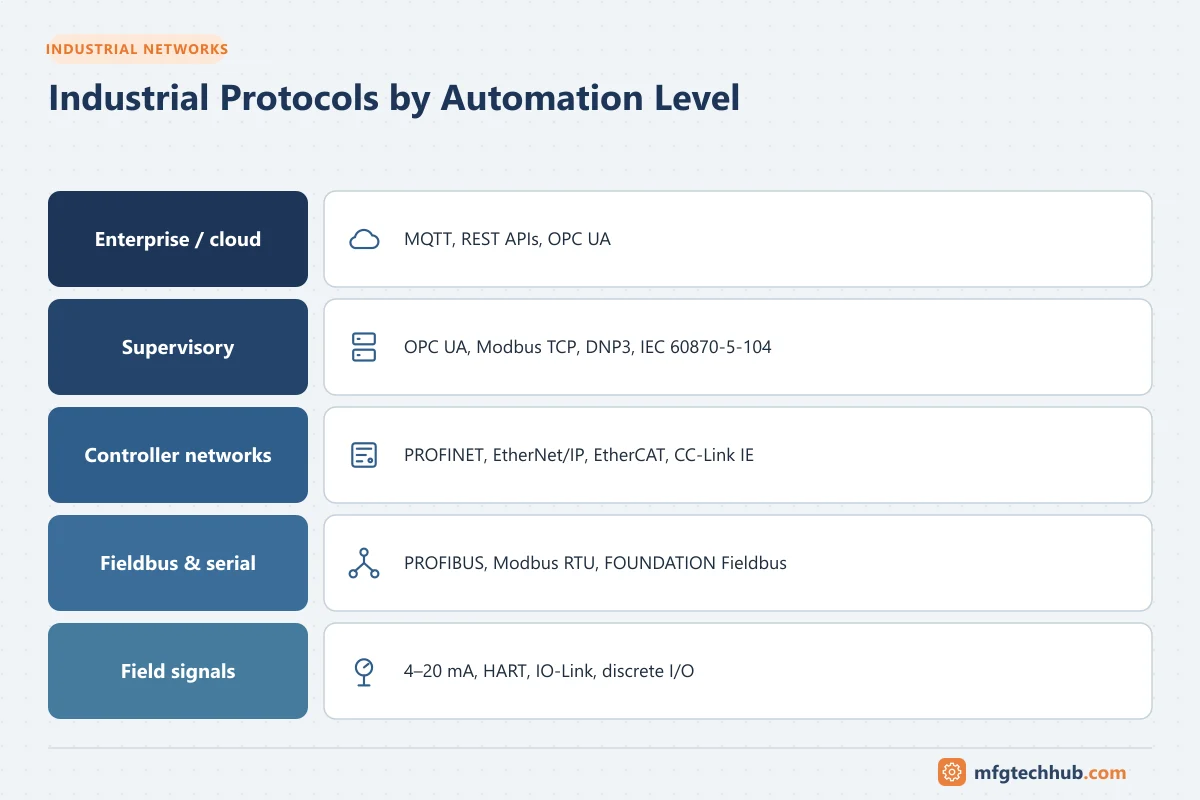
This guide explains the protocols you are most likely to meet, where each one fits, and how to choose between them.
Where protocols fit in the automation hierarchy
It helps to think in layers, similar to the levels in ISA-95:
| Level | Typical communication | Examples |
|---|---|---|
| Field devices (sensors, valves, drives) | Analog signals, fieldbus, device-level Ethernet | 4-20 mA, HART, IO-Link, PROFIBUS PA, Foundation Fieldbus |
| Control (PLC, DCS) | Real-time industrial Ethernet, fieldbus | PROFINET, EtherNet/IP, EtherCAT, Modbus TCP, PROFIBUS DP |
| Supervisory (SCADA, HMI, historians) | Client/server data access | OPC UA, OPC DA (legacy), Modbus TCP, DNP3, IEC 60870-5-104 |
| Operations and enterprise (MES, ERP, cloud) | IT protocols and messaging | OPC UA, MQTT, REST APIs, databases |
Lower levels need determinism and speed; higher levels need rich data models, security and scalability.
Analog and hybrid signals
4-20 mA
The 4-20 mA current loop remains the most common way to connect field instruments. A transmitter varies the loop current between 4 and 20 mA in proportion to the measured value. It is simple, robust over long distances and immune to voltage drops. Its limitation is that it carries only one value in one direction.
Our 4-20 mA calculator converts between current and engineering units.
HART
HART (Highway Addressable Remote Transducer) superimposes a digital signal on top of the 4-20 mA loop. The analog signal carries the primary measurement for control, while the digital signal lets engineers read diagnostics, configure the transmitter and access secondary variables, without extra wiring. HART is widely used for instrument configuration and asset management.
Deep dive: HART Protocol Explained.
IO-Link
IO-Link (IEC 61131-9) is a point-to-point digital link between a sensor or actuator and an IO-Link master, using standard unshielded cables. It is popular in factory automation for smart sensors, providing parameterization and diagnostics down to simple devices.
Serial and fieldbus protocols
Modbus RTU
Modbus was published by Modicon in 1979 and is still everywhere because it is simple and open. Modbus RTU runs over serial links, typically RS-485, using a master/slave (client/server) model: one master polls up to 247 addressed slave devices.
Modbus organizes data into four tables:
| Table | Access | Size |
|---|---|---|
| Coils | Read/write | 1 bit |
| Discrete inputs | Read-only | 1 bit |
| Holding registers | Read/write | 16 bits |
| Input registers | Read-only | 16 bits |
Common pitfalls include register address offsets (0-based vs 1-based addressing), byte and word order for 32-bit values, and mismatched serial settings (baud rate, parity, stop bits).
Deep dive: Modbus RTU and Modbus TCP Explained.
PROFIBUS
PROFIBUS (IEC 61158) is a fieldbus developed in Germany and widely used with Siemens and other European systems.
- PROFIBUS DP (Decentralized Periphery) connects remote I/O, drives and devices to controllers over RS-485 at speeds up to 12 Mbit/s.
- PROFIBUS PA (Process Automation) carries power and data on the same two wires and supports intrinsically safe installations in hazardous areas.
Foundation Fieldbus
Foundation Fieldbus H1 is a digital, two-wire fieldbus for process automation that can also power devices. A distinctive feature is that control functions, such as PID blocks, can run in the field devices themselves (“control in the field”). It is used mainly with DCS in the process industries.
DeviceNet and CAN-based protocols
DeviceNet and CANopen are based on the CAN bus originally developed for vehicles. They are common in machine building for connecting sensors, drives and small devices.
Industrial Ethernet protocols
Standard Ethernet was not designed for deterministic real-time control. Industrial Ethernet protocols add the timing and reliability that control requires, while using standard cabling and often coexisting with IT traffic.
PROFINET
PROFINET is the Ethernet-based successor to PROFIBUS, managed by PROFIBUS & PROFINET International (PI). It offers different performance classes, from standard real-time (RT) for most automation to isochronous real-time (IRT) for high-performance motion control. PROFINET is dominant in many European and Asian factories.
Deep dive: PROFINET Explained.
EtherNet/IP
EtherNet/IP (“IP” stands for Industrial Protocol) uses the Common Industrial Protocol (CIP) over standard Ethernet and TCP/UDP. It is managed by ODVA and is especially common with Rockwell Automation systems in North America. Real-time I/O data is exchanged using UDP-based “implicit” messaging.
Deep dive: EtherNet/IP and CIP Explained.
Modbus TCP
Modbus TCP carries the Modbus data model over Ethernet on TCP port 502. It inherits Modbus’s simplicity and is widely supported, but it has no built-in security and no real-time guarantees.
Deep dive: Modbus RTU and Modbus TCP Explained.
EtherCAT
EtherCAT processes Ethernet frames “on the fly” as they pass through each device, giving very short cycle times and precise synchronization. It is popular for high-speed motion control and machine automation.
Utility and SCADA telemetry protocols
Geographically distributed systems, such as electricity, water and pipelines, use protocols designed for remote telemetry over slower or less reliable links:
- DNP3: widely used in North American electric and water utilities; supports time-stamped events and report-by-exception.
- IEC 60870-5-101/104: common in European and international power utilities; 104 runs over TCP/IP.
- IEC 61850: a modern standard for communication within electrical substations.
Learn more in our tutorials on SCADA communication networks and SCADA for utilities.
Data integration protocols
OPC UA
OPC Unified Architecture (IEC 62541) is the leading standard for secure, vendor-neutral data exchange between industrial systems. Unlike the older Windows-based OPC DA (Classic OPC), OPC UA:
- Runs on any platform, from embedded devices to cloud servers
- Includes security: authentication, signing and encryption
- Provides a rich information model, so data carries its structure and meaning, not just values
- Supports client/server and publish/subscribe communication
- Is extended by companion specifications that standardize models for specific device types and industries
OPC UA is a common choice for connecting PLCs and DCS to SCADA, MES and historians. Deep dive: OPC UA Explained and OPC UA Certificate Errors.
MQTT
MQTT is a lightweight publish/subscribe protocol. Devices publish messages to a broker; applications subscribe to the topics they need. It is efficient on constrained networks and decouples data producers from consumers, which makes it popular for IIoT and cloud connectivity. The Sparkplug B specification adds a standard payload format and device state management for industrial use. Deep dive: MQTT and Sparkplug B for Industrial IoT.
For how these protocols travel across plant networks, see Industrial Network Design for OT Engineers.
Comparison at a glance
| Protocol | Physical layer | Typical use | Real-time | Built-in security |
|---|---|---|---|---|
| 4-20 mA / HART | Two-wire analog loop | Field instruments | Continuous analog | No |
| Modbus RTU | RS-485 serial | Simple devices, meters, legacy | No | No |
| Modbus TCP | Ethernet | SCADA, gateways, simple integration | No | No (secure variant exists) |
| PROFIBUS DP / PA | RS-485 / MBP | Remote I/O, drives, process devices | Yes | No |
| Foundation Fieldbus H1 | Two-wire | Process instruments with DCS | Yes | No |
| PROFINET | Ethernet | Factory and process automation | Yes (RT/IRT) | Security extensions available |
| EtherNet/IP | Ethernet | Factory automation | Yes | CIP Security available |
| EtherCAT | Ethernet | Motion and high-speed machines | Very fast | No |
| DNP3 / IEC 60870-5-104 | Serial / TCP | Utilities and telemetry | Event-based | Secure authentication options |
| OPC UA | TCP, HTTPS, pub/sub | System integration, SCADA, MES | Soft real-time (TSN for hard real-time) | Yes |
| MQTT | TCP | IIoT, cloud, event distribution | No | TLS and authentication |
How to choose a protocol
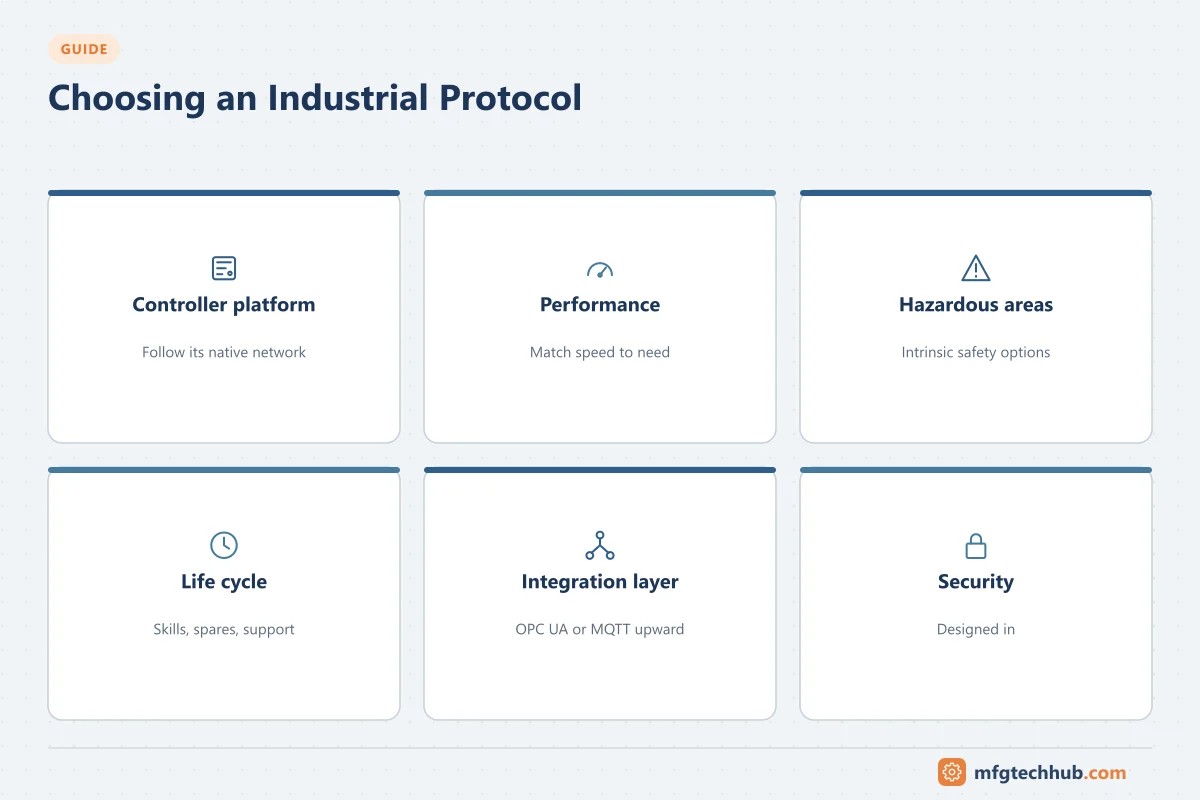
- Follow the controller platform. The PLC or DCS usually determines the preferred fieldbus or industrial Ethernet protocol.
- Match the performance to the need. Motion control needs EtherCAT, PROFINET IRT or similar; slow process data does not.
- Consider hazardous areas. PROFIBUS PA, Foundation Fieldbus and HART have established intrinsically safe solutions.
- Think about the whole life cycle. Engineering tools, diagnostics and local support skills matter as much as speed.
- Plan the integration layer. OPC UA and MQTT are the usual choices for getting data from control systems into SCADA, MES, historians and the cloud.
- Design security in. Many older protocols have no authentication or encryption. Protect them with network segmentation, as described in ISA-99 / IEC 62443.
Frequently asked questions
Is Modbus still used?
Yes. Modbus remains extremely common for energy meters, drives, analyzers, packaged equipment and gateways because it is simple and universally supported. Its main weaknesses are the lack of security and data modeling.
What is the difference between PROFIBUS and PROFINET?
PROFIBUS is a serial fieldbus using RS-485 (DP) or MBP (PA) physical layers. PROFINET is Ethernet-based, faster, and supports much larger networks and more data. Proxies allow PROFIBUS devices to be integrated into PROFINET networks.
Does OPC UA replace fieldbuses?
Not directly. OPC UA is mainly used above the control layer, although OPC UA over TSN (Time-Sensitive Networking) and the OPC UA FX initiative aim to extend it down to the field level.