
Industrial IoT (IIoT) Explained: Architecture, Protocols, Edge Computing and Use Cases
On this page
The Industrial Internet of Things (IIoT) connects machines, sensors, controllers and software systems so that operational data can move from the plant floor to the people and applications that need it. In practice, IIoT is less about “smart gadgets” and more about solving an old manufacturing problem: valuable data already exists inside PLCs, drives, instruments and control systems, but it is often trapped in isolated islands.
This guide explains what IIoT is, how a typical IIoT architecture is built, which protocols matter, where edge computing fits, and how to approach an IIoT project in a way that delivers measurable results.
What Is Industrial IoT?
Industrial IoT is the application of connected devices, networking and data platforms to industrial operations such as manufacturing, energy, utilities, oil and gas, water treatment and logistics.
A consumer IoT device, such as a smart thermostat, usually connects one product to one vendor’s cloud. An IIoT system is different in several important ways:
- It must coexist with control systems. PLCs, DCS and SCADA systems keep running the process; IIoT must not interfere with their real-time behavior or safety functions.
- Reliability expectations are much higher. Plants operate 24/7, and equipment often remains in service for 15 to 30 years.
- Data needs context. A raw value such as
41.7is meaningless until it is linked to an asset, a unit of measure, a product, a batch and a time. - Security failures have physical consequences. A compromised industrial network can affect safety, the environment and production, not only information.
IIoT is a core building block of Industry 4.0 and smart manufacturing, alongside MES, advanced analytics, digital twins and AI.
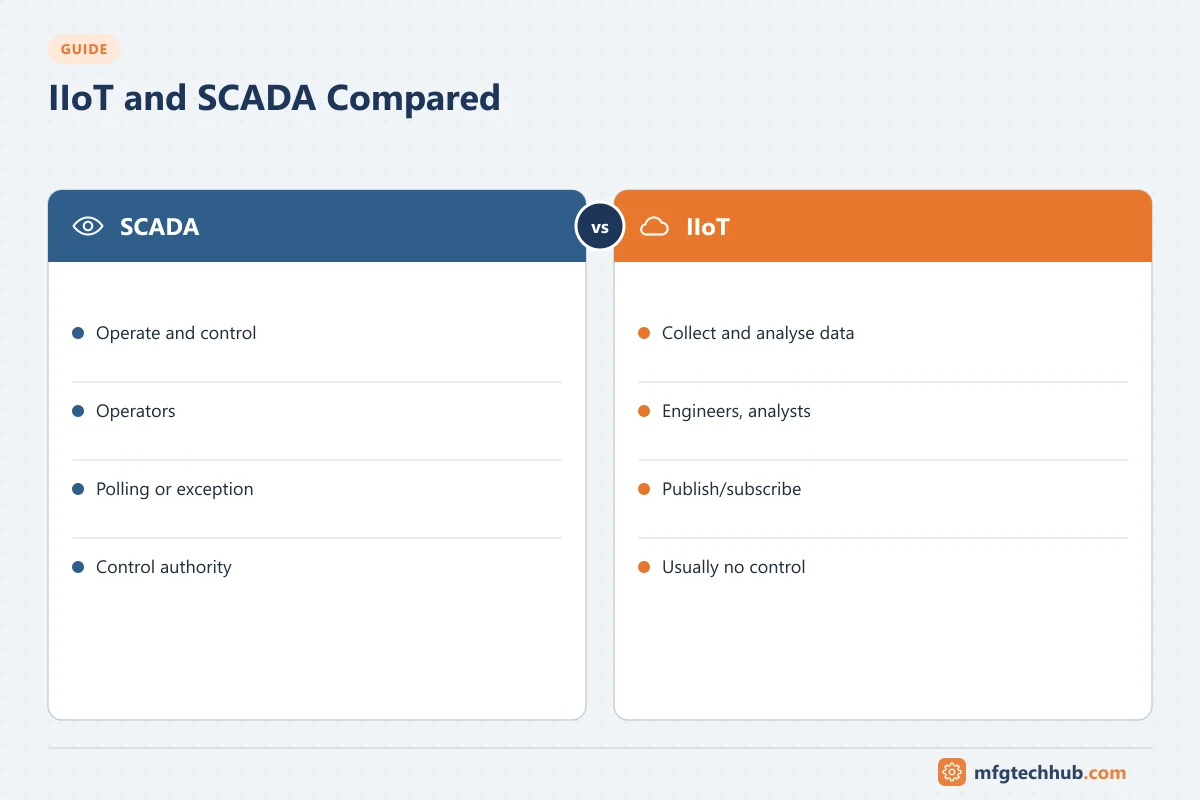
IIoT vs SCADA: What Is the Difference?
Engineers often ask whether IIoT simply replaces SCADA. It does not.
| Aspect | SCADA | IIoT |
|---|---|---|
| Primary purpose | Supervisory monitoring and control | Data collection, integration and analysis |
| Typical users | Operators and control engineers | Operations, maintenance, quality, engineering and management |
| Communication model | Mostly polling (request/response) | Often publish/subscribe and event-driven |
| Data scope | Real-time process values and alarms | Process, asset, quality, energy and business context |
| Where it runs | Control room servers | Edge devices, on-premises platforms and cloud services |
| Control authority | Yes, issues commands to the process | Usually read-only or advisory |
In a well-designed architecture, SCADA and DCS continue to handle supervisory control, while IIoT platforms make the same data available to analytics, maintenance and enterprise systems. You can learn more about supervisory systems in our SCADA tutorials.
A Typical IIoT Architecture
Most IIoT solutions follow a layered architecture. The names vary between vendors, but the functions are consistent.
1. Devices and Sensors
This layer includes field instruments, smart sensors, drives, meters, vision systems and the PLCs or DCS controllers that already measure and control the process. Many IIoT projects start by adding low-cost sensors where no measurement exists today, for example vibration and temperature sensors on motors, pumps and gearboxes.
For background on the measurement side, see Industrial Data Logging and Remote Monitoring and Signal Conditioning and Data Acquisition.
2. Connectivity
Data must travel from devices to an edge node or platform. Common options include:
- Industrial Ethernet networks (EtherNet/IP, PROFINET, Modbus TCP)
- Fieldbus gateways for older equipment (PROFIBUS, Modbus RTU, HART)
- Wireless technologies such as Wi-Fi, WirelessHART, ISA100.11a, LoRaWAN and private cellular (4G/5G)
3. Edge Computing
An edge device sits close to the equipment. It collects data from controllers and sensors, normalizes it, buffers it during network outages, and forwards it to higher-level systems. Edge nodes can also run local logic, such as calculating equipment states, filtering noise or executing simple analytics models.
Edge computing is valuable because it:
- Reduces bandwidth by sending only useful or summarized data
- Keeps working when the connection to the cloud or data center is lost
- Supports low-latency use cases that cannot wait for a round trip to the cloud
- Creates a controlled boundary between OT networks and IT or cloud systems
4. Platform and Data Storage
The platform layer receives, stores and organizes data. It may include a process historian, a time-series database, a data lake, or an industrial IoT platform running on premises or in the cloud. This is where asset models, units of measure and naming conventions become critical.
5. Applications
Finally, applications turn data into decisions: dashboards, OEE reporting, condition monitoring, energy management, quality analytics, MES functions and AI models. See our Manufacturing Data and Analytics guide for how this layer is typically built.
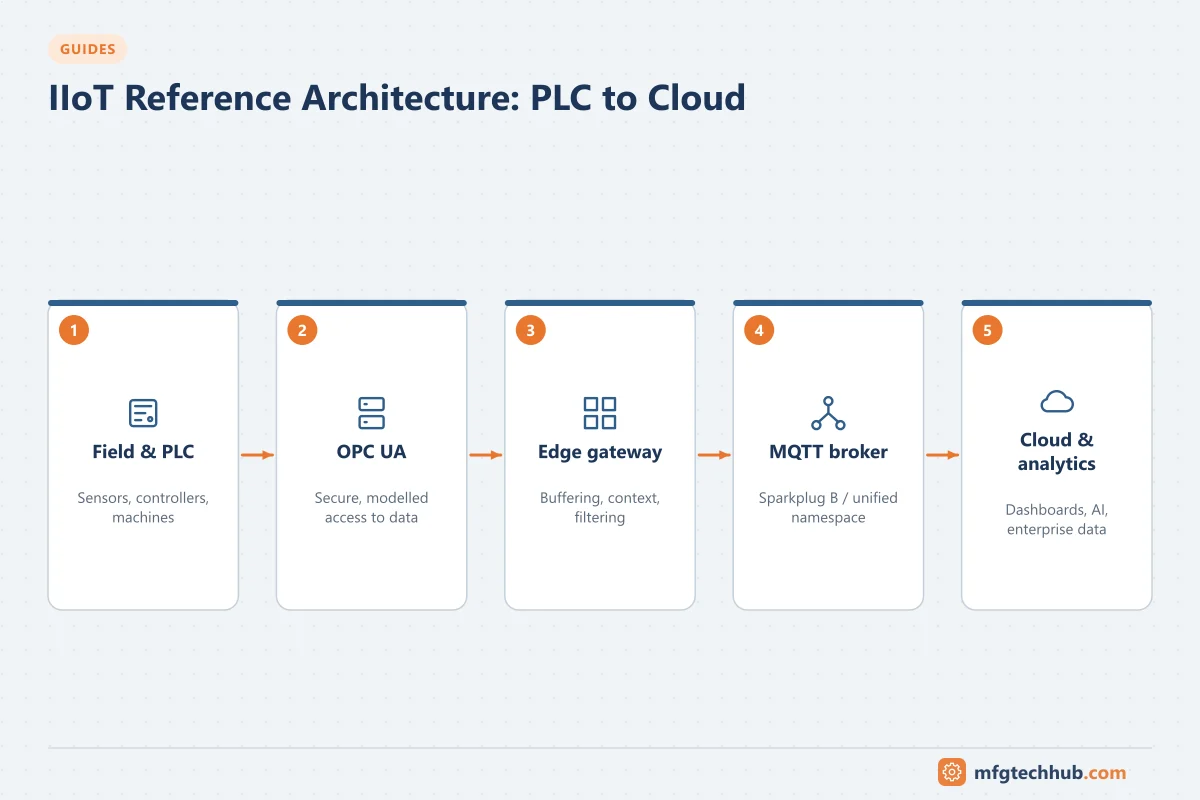
Reference Architecture: PLC to OPC UA, Edge, MQTT and Cloud
A common, secure pattern for moving controller data to enterprise and cloud platforms:
| Hop | From → To | Typical protocol | Zone placement | Reliability measures | Security measures |
|---|---|---|---|---|---|
| 1 | PLC → edge gateway | OPC UA (TCP 4840 by default) or native driver | Control / supervisory zone | Subscriptions with sensible sampling; limit sessions per PLC | OPC UA SignAndEncrypt, read-only user, restricted firewall rule |
| 2 | Edge gateway processing | Local | Supervisory zone or DMZ | Store-and-forward buffer sized for the longest expected outage | Hardened OS, no inbound connections from outside, managed updates |
| 3 | Edge → site or DMZ broker | MQTT over TLS (TCP 8883), often Sparkplug B | Broker in the DMZ | QoS 1, persistent sessions, broker clustering | Client certificates or credentials per device, topic ACLs |
| 4 | Site broker → enterprise/cloud | MQTT bridge or HTTPS/cloud IoT service | Outbound from DMZ | Bridge buffering, retries | Outbound-only connections, TLS with certificate validation |
| 5 | Cloud → consumers | Platform services, APIs | Cloud | Platform availability design | Identity and access management, data governance |
Design rules:
- Read by default: the data path is read-only; writing back to PLCs needs a separate, deliberately designed and approved path.
- No inbound connections into control zones: connections are initiated from the plant outward.
- Buffer at every hop that can lose its upstream connection, and monitor buffer levels.
- Model data at the edge: add units, asset hierarchy and quality before publishing, so consumers do not guess.
- Monitor the pipeline: connection status, message rates, stale data and certificate expiry. See Bad Tag Quality and Communication Failures.
- Test failure cases: PLC restart, network loss, broker failover, cloud outage, certificate expiry.
Deep dives: OPC UA Explained, MQTT and Sparkplug B, Industrial Network Design for OT Engineers and Certificates and PKI for OT.
Key IIoT Communication Protocols
OPC UA
OPC Unified Architecture (OPC UA) is a platform-independent standard (IEC 62541) for secure, reliable industrial data exchange. Its most important strengths are:
- A rich information model that describes not only values but also the structure and meaning of data
- Built-in security including authentication, signing and encryption
- Support for both client/server and publish/subscribe communication
- Broad support from PLC, DCS, SCADA and MES vendors
OPC UA is often the preferred way to read data from modern controllers and to exchange data between OT applications. See OPC UA Explained.
MQTT
MQTT is a lightweight publish/subscribe messaging protocol. Devices publish messages to a broker, and any authorized application can subscribe to the topics it needs. MQTT is well suited to IIoT because it:
- Uses little bandwidth and works over unreliable networks
- Decouples data producers from data consumers
- Scales from a single machine to thousands of devices
The Sparkplug B specification adds a standard payload format, device state awareness and birth/death certificates to MQTT, which helps different vendors’ devices interoperate. See MQTT and Sparkplug B.
Modbus and Legacy Protocols
Many plants still rely on Modbus RTU, Modbus TCP, PROFIBUS and proprietary protocols. Protocol gateways and edge software translate these into OPC UA or MQTT so that older equipment can participate in an IIoT architecture without being replaced.
The Unified Namespace Concept
A growing architectural pattern is the Unified Namespace (UNS): a central, event-driven data hub (often built on an MQTT broker) where every system publishes its current state using a consistent hierarchy, for example enterprise/site/area/line/cell/asset. Instead of creating many point-to-point integrations, applications subscribe to the data they need from one place. The hierarchy is frequently aligned with the equipment model described in ISA-95.
Common IIoT Use Cases in Manufacturing
Condition Monitoring and Predictive Maintenance
Vibration, temperature, current and pressure data are used to detect early signs of bearing wear, misalignment, cavitation or insulation breakdown. Maintenance teams can plan interventions before a failure stops production. This is one of the most common first IIoT projects because the value is easy to measure.
OEE and Downtime Tracking
By capturing machine states, counts and reject signals automatically, plants can calculate Overall Equipment Effectiveness (OEE) in real time and understand the true causes of downtime, instead of relying on manual logs.
Energy Monitoring
Smart meters and power analyzers provide energy consumption by line, machine or product. Combined with production data, this allows energy per unit to be tracked and reduced.
Remote Monitoring of Distributed Assets
Pumping stations, compressors, tanks, generators and skid-mounted equipment at remote sites can be monitored centrally, reducing travel and improving response times.
Quality and Traceability
Process parameters captured during production can be linked to batches, serial numbers and quality results. This supports root cause analysis and traceability requirements, often in combination with an MES.
Asset Tracking and Logistics
RFID, BLE and ultra-wideband tags help track work in progress, tools, containers and forklifts inside the plant.
IIoT Security Considerations
Connecting operational technology increases the attack surface, so security must be designed in from the start rather than added later. Good practice includes:
- Network segmentation into zones and conduits, as described in ISA-99 / IEC 62443
- Using an industrial DMZ between OT networks and IT or cloud systems
- Preferring outbound-only connections from the edge, so no inbound firewall ports are opened to the plant network
- Encrypting data in transit (for example, OPC UA security modes and MQTT over TLS)
- Managing certificates, credentials and device identities centrally
- Keeping edge devices patched and maintaining an accurate asset inventory
- Giving IIoT systems read-only access to controllers unless there is a documented, reviewed reason for write access
For more detail on controller-level risks, see PLC Security Concerns.
How to Start an IIoT Project
Many IIoT initiatives stall at the pilot stage. The following approach helps projects move from proof of concept to real value:
- Start with a business problem, not a technology. For example: “Reduce unplanned downtime on filling line 3 by 20 percent.”
- Identify the data you need. List the signals, their sources, required sample rates and the context required to interpret them.
- Assess what already exists. Many values are already available in PLCs, DCS or historians and do not need new sensors.
- Define a naming and asset model early. Consistent naming is far easier to set up at the start than to fix later.
- Choose an architecture that can scale. Prefer open standards such as OPC UA and MQTT to avoid lock-in.
- Involve OT, IT and security teams together. IIoT sits on the boundary between them.
- Measure the result. Compare the key performance indicator before and after, and use the result to justify the next phase.
Common Challenges
- Legacy equipment with limited connectivity or undocumented protocols
- Data without context, leading to dashboards that no one trusts
- Too many pilots that never scale beyond one line or site
- Skills gaps between control engineers, IT specialists and data scientists
- Ownership questions about who maintains edge devices, networks and data platforms
Addressing these issues early is usually more important than choosing the “best” platform.
Continue Learning
IIoT builds on a strong foundation in automation and manufacturing systems. These tutorials are good next steps:
- IoT and Smart PLCs
- SCADA Data Acquisition
- MES Real-Time Data Acquisition
- MES, IoT and Smart Manufacturing Trends
- ISA-95 Explained
- Manufacturing Data and Analytics
- AI in Manufacturing
Frequently Asked Questions
Is IIoT the same as Industry 4.0?
No. Industry 4.0 is the broader concept of digitally connected, data-driven manufacturing. IIoT is one of its enabling technologies, providing the connectivity and data flow that other Industry 4.0 capabilities rely on.
Do I need the cloud for IIoT?
Not necessarily. Many IIoT solutions run entirely on premises, especially where data sovereignty, latency or security requirements are strict. Hybrid architectures, with edge processing on site and selected data sent to the cloud, are very common.
Should IIoT systems write values back to PLCs?
In most cases, IIoT systems should be read-only. Where writing setpoints or parameters is required, it should go through a controlled, validated mechanism with proper authorization, change management and safety review.
Which protocol should I choose, OPC UA or MQTT?
They are complementary. OPC UA is excellent for structured access to controllers and OT applications. MQTT is excellent for scalable, event-driven distribution of data to many consumers. Many architectures use OPC UA at the edge and MQTT to move data upward.