
The Future of MES: Industry 4.0, IIoT, Composable MOM and AI
On this page
Traditional MES products were large, monolithic applications installed per plant, customised heavily and upgraded rarely. Industry 4.0, IIoT and cloud computing are changing how MES is built, deployed and connected. This article explains the main trends, which ones are already practical, and the questions to ask before adopting them.
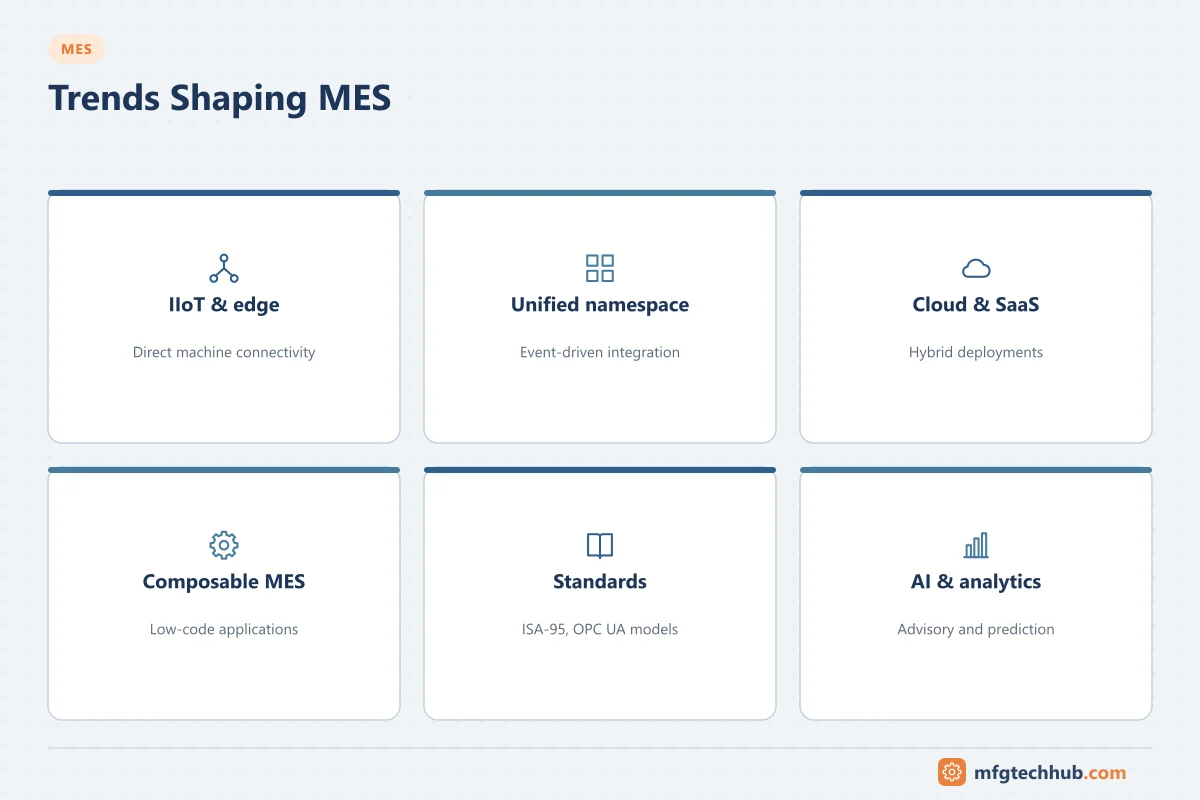
From monolithic MES to connected MOM
| Aspect | Traditional MES | Emerging approach |
|---|---|---|
| Scope | One large application with many modules | Manufacturing operations management (MOM) built from modules or services |
| Deployment | On-premise server per plant | On-premise, cloud or hybrid, with edge components |
| Integration | Point-to-point interfaces to ERP, SCADA, PLCs | Event-driven integration via brokers, APIs and standard models |
| Customisation | Custom code, hard to upgrade | Configuration, low-code apps and extensions via APIs |
| Upgrades | Every several years, as a project | Frequent updates (especially for SaaS), requiring change control |
| Data | Stored within MES database | Shared with historians, data platforms and analytics |
The term MOM (manufacturing operations management), used in ISA-95 Part 3, covers production, quality, maintenance and inventory operations. Many vendors now describe their products as MOM platforms rather than MES.
Trend 1: IIoT connectivity and edge computing
More machines and sensors now provide data directly, through OPC UA, MQTT or edge gateways. For MES this means:
- Automatic data capture of counts, states and process values replaces manual entry.
- Edge devices buffer data and keep critical functions running during network outages.
- Retrofit sensors (current, vibration, counters) make older machines visible without PLC changes.
Consider: data quality and context. A machine signal is only useful for MES when linked to the order, product and equipment. See Industrial IoT and MES Real-Time Data Acquisition.
Trend 2: Unified namespace and event-driven integration
Instead of many point-to-point interfaces, some manufacturers publish plant data and events to a central message broker (commonly MQTT), organised in a hierarchy that follows the ISA-95 equipment model (enterprise/site/area/line/cell). This is often called a unified namespace (UNS).
- Applications (MES, historian, analytics, dashboards) subscribe to what they need.
- New applications can be added without new interfaces to every system.
- Sparkplug B adds a defined payload and state management for MQTT in industrial use.
Consider: a UNS does not remove the need for transactional integrity. Order downloads, material consumption and quality results between MES and ERP still need reliable, acknowledged transactions. Governance of topic structure and data models is essential.
Trend 3: Cloud, hybrid and SaaS MES
Cloud MES reduces on-site infrastructure and can speed up multi-site rollouts. Most production deployments are hybrid: time-critical functions and machine connectivity run at the edge or on-premise; enterprise dashboards, analytics and some applications run in the cloud.
Consider: latency, behaviour during internet outages, data residency, cybersecurity, validation of frequent updates in regulated industries, and total subscription cost. See Cloud MES: Benefits, Risks and Architecture.
Trend 4: Composable MES and low-code applications
- Composable MES means assembling functions (for example, order execution, quality, genealogy, OEE) from modules or services that share data through APIs.
- Low-code/no-code platforms let process engineers build work instructions, checklists and data-collection apps without traditional software development.
Benefits: faster delivery of targeted improvements, easier adaptation to local processes.
Consider: without governance, many small apps can create inconsistent data and a maintenance burden. Define standards for data models, naming, validation and ownership.
Trend 5: Standards for interoperability
- ISA-95 / IEC 62264 remains the reference model for MES functions and ERP integration. See ISA-95.
- B2MML provides XML schemas based on ISA-95 for exchanging production information.
- OPC UA companion specifications define standard information models for machine types, which reduces integration effort.
- ISA-88 remains important for batch processes and recipes. See ISA-88.
Trend 6: AI and advanced analytics
MES provides the context (order, product, equipment, material, operator, quality result) that makes manufacturing data useful for analytics. Practical applications include:
- Downtime and scrap analysis to find recurring causes
- Predictive quality, estimating quality results from process data before lab results arrive
- Scheduling optimisation that considers constraints better than manual planning
- Anomaly detection on process and equipment data
Generative AI assistants are appearing in MES and MOM products to search procedures, summarise shift events, explain deviations or help configure applications. These can save time, but outputs must be verified, especially in regulated environments, and assistants should use approved, controlled data sources.
See MES Data Analytics and AI and AI in Manufacturing.
Trend 7: Digital thread and PLM integration
Linking PLM (product design and changes), MES (execution) and quality systems creates a digital thread: engineering changes flow to the shop floor faster, and as-built records can be compared with as-designed specifications. This is especially valuable in aerospace, automotive and medical devices.
Trend 8: Sustainability and energy tracking
Manufacturers increasingly need energy and emissions data per product or order. MES can provide the production context (what was made, when, on which equipment) to allocate energy measured by meters and utilities systems. See Real-Time Power Monitoring.
Trend 9: Security by design
As MES connects to more systems and cloud services, it becomes part of the attack surface. Expect requirements for IEC 62443-based architectures, identity and access management, secure APIs, certificate management and tested backup and recovery. See MES Data Management and Security.
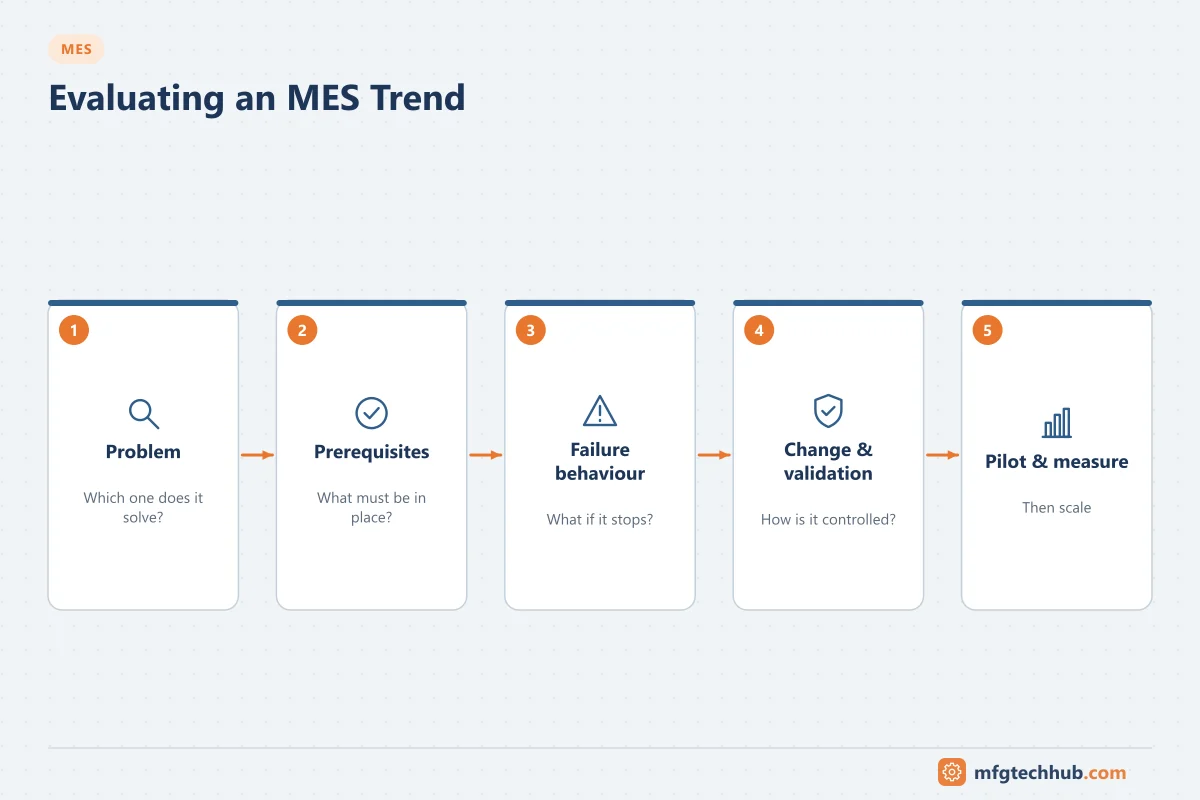
How to evaluate a new MES trend for your plant
- Which problem does it solve? Link it to a KPI (downtime, yield, lead time, compliance effort).
- What must already be in place? Connectivity, master data, network, skills.
- How does it behave when something fails? Network loss, cloud outage, broker failure.
- How is it validated and changed? Particularly for GMP-regulated manufacturing.
- What is the total cost over 5–10 years? Licences/subscriptions, infrastructure, support and internal effort.
- Pilot, measure, then scale.
Frequently asked questions
Will MES be replaced by IIoT platforms?
IIoT platforms are good at collecting and analysing data, but MES also manages execution: orders, work instructions, material consumption, genealogy, quality enforcement and electronic records. These transactional functions remain necessary. In practice, IIoT platforms and MES increasingly work together.
What is a unified namespace?
A unified namespace is an architecture where plant systems publish their current data and events to a central broker, organised in a consistent hierarchy, so that any authorised application can subscribe to the information it needs instead of using many point-to-point interfaces.
Is cloud MES suitable for regulated industries?
It can be, but it requires careful supplier assessment, validation of updates, data integrity controls and clear responsibilities between the manufacturer and the provider. Many regulated sites use hybrid architectures.
Key takeaways
- MES is evolving into modular, connected MOM platforms with edge, cloud and hybrid deployment.
- Event-driven integration and unified namespaces reduce point-to-point interfaces but need governance.
- AI and analytics depend on the context that MES provides.
- Evaluate each trend against a real problem, failure behaviour, validation and lifecycle cost.
Related tutorials
Before you apply this in a plant: this article is for education. Always check the current edition of the relevant standards, the manufacturer's documentation for your exact product and version, and your site's procedures. Safety-related work needs qualified personnel. See our editorial policy.