
MES for Process and Batch Manufacturing: ISA-88 Recipes, Weigh and Dispense, Genealogy, EBR and Continuous Operations
On this page
Process manufacturing makes products by mixing, reacting, heating, fermenting, separating or blending: pharmaceuticals, food and beverages, chemicals, cosmetics, paints, refining. Products are defined by formulas and recipes rather than bills of discrete parts, and once made they cannot be taken apart again. Production is batch (a defined quantity made in a sequence of steps), continuous (material flows through the plant without interruption), or a hybrid of both, such as a continuous process feeding batch packaging.
These characteristics change what an MES must do. This guide explains how, with the ISA-88 batch standard as the backbone.
What makes process MES different from discrete MES
| Aspect | Discrete manufacturing | Process manufacturing |
|---|---|---|
| Product definition | Bill of materials, routing | Formula or recipe with quantities, parameters and procedures |
| Units | Pieces, serial numbers | Mass, volume, concentration; conversions between units |
| Materials | Consistent components | Natural variation: potency, moisture, assay; lots with expiry |
| Outputs | One product per order | Co-products, by-products, waste streams, yield variation |
| Traceability | Serial or lot per part | Lots mixed in tanks and silos; genealogy by lot and by time |
| Execution | Operations at work centres | Phases executed by the control system (DCS/PLC) plus manual steps |
| Quality | Inspections per part or sample | In-process samples, lab results (LIMS), release of batches |
| Regulation | Varies by sector | Often strict: GMP, food safety, chemical regulations |
For the discrete counterpart, see MES for Discrete Manufacturing.
ISA-88: the model behind batch MES
ISA-88 (IEC 61512) separates what to make (recipes) from the equipment that makes it, so the same recipe can run on different equipment and equipment can run different recipes.
| ISA-88 concept | Meaning | Where it usually lives |
|---|---|---|
| General / site / master recipe | Product recipe from enterprise level down to a specific equipment class | MES or recipe management system |
| Control recipe | The master recipe instance for one batch, with actual quantities | Created at batch start by MES or the batch manager |
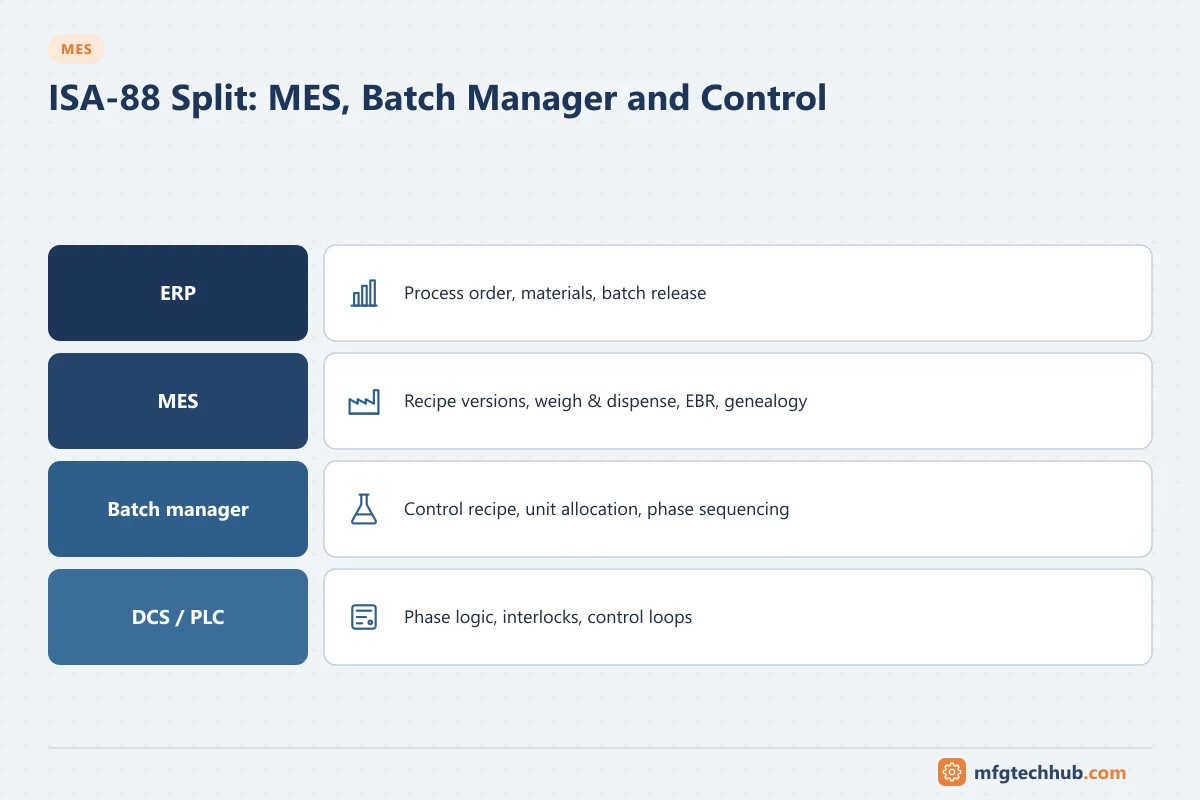
| Procedure → unit procedure → operation → phase | Procedural hierarchy; phases are the smallest steps (charge, heat, agitate, transfer) | Phases run in the DCS or PLC |
| Physical model | Site, area, process cell, unit, equipment module, control module | Control system engineering and MES equipment model |
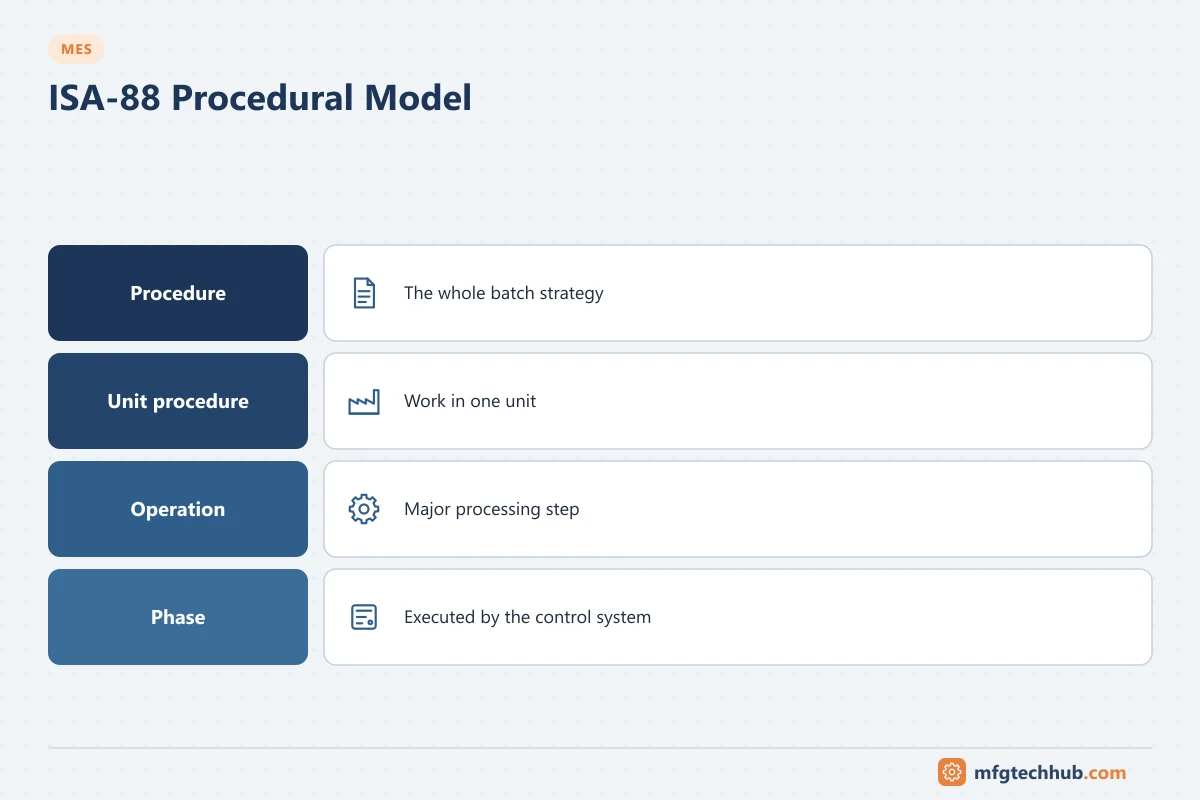
Who does what: MES, batch manager and control system
| Function | MES | Batch manager (often part of the DCS) | DCS / PLC |
|---|---|---|---|
| Order receipt from ERP, scheduling of batches | Yes | No | No |
| Recipe versioning and approval | Often | Sometimes | No |
| Material dispensing, lot verification | Yes | No | No |
| Sequencing phases and unit allocation | Sometimes | Yes | No |
| Phase logic, interlocks, control loops | No | No | Yes |
| Manual steps with instructions and signatures | Yes | Partly | No |
| Electronic batch record and review | Yes | Contributes data | Contributes data |
Draw this split clearly early in a project. Overlap between MES and the batch manager (for example both trying to manage recipes) is a common source of cost and confusion.
Weigh and dispense
Dispensing is often the first MES function implemented in pharmaceutical and fine chemical plants, because errors here are costly:
- The MES shows the next material to dispense for a batch, with target quantity and tolerance.
- The operator scans the material lot; the MES checks identity, release status and expiry.
- The scale is connected, so the weight is recorded automatically and checked against tolerance. Scale calibration status is verified.
- Dispensed containers get labels linking material, lot, quantity and batch.
- Potency or assay adjustment: when an active ingredient’s potency varies by lot, the MES calculates the quantity needed to reach the target amount of active substance, and may adjust a filler material to keep the batch mass constant.
Genealogy in process plants
Genealogy is harder when lots are mixed:
- Batch genealogy: input lots → batch → output lots, recorded at each step.
- Tanks, silos and continuous flows: material from several lots is blended. Genealogy is recorded by time windows: which lots were in the tank, and which output was produced during that period. The MES may estimate lot proportions from quantities and flows.
- Rework and recycled material must be recorded as inputs, or genealogy breaks.
A good test is a mock recall: trace a raw material lot forward to all finished lots, and a finished lot backward to all inputs, within the time the business or regulator expects.
Electronic batch records and review by exception
An electronic batch record (EBR) captures everything about a batch: materials and lots, equipment used and its status, process parameters, manual steps, in-process results, deviations and signatures. Benefits over paper records come from:
- Enforcement: steps cannot be skipped and values are checked at entry.
- Review by exception: reviewers see only flagged exceptions instead of checking every entry. See MES Process Management.
- Faster release and fewer documentation errors.
In GMP environments, EBR systems must meet requirements for electronic records and signatures (for example 21 CFR Part 11 in the US and EU GMP Annex 11), and must be validated. See Computerised System Validation and Data Integrity (ALCOA+).
Continuous processes: what MES does there
In continuous plants (refining, petrochemicals, pulp and paper, many food and chemical plants), there are no discrete batches to record, and MES functions shift:
| Function | Purpose |
|---|---|
| Production accounting / yield accounting | Reconciles measured inputs, outputs and tank inventories to calculate yields and losses (mass balance) |
| Grade or product changes | Manages transitions and records off-spec material produced during changes |
| Campaign and run tracking | Links production periods to products and quality results |
| Quality by time period | Associates lab results with production periods and lots created from continuous output |
| Operating targets and limits | Monitors product limits and operating envelopes. See Oil Refinery Automation |
The historian is central in continuous plants, because most records are time-series data rather than batch steps.
Industry requirements
| Industry | Typical drivers | Key MES functions |
|---|---|---|
| Pharmaceuticals and biotech | GMP, electronic records and signatures, batch release | Weigh and dispense, EBR, equipment status (cleaning, calibration), review by exception. See Pharmaceutical Manufacturing Automation |
| Food and beverage | Food safety plans (HACCP), allergen control, traceability, shelf life | CCP monitoring, allergen changeover checks, lot traceability, label control. See Food and Beverage Automation |
| Specialty and fine chemicals | Product quality, safety, chemical regulations, customer specifications | Recipe management, quality by batch, certificates of analysis |
| Cosmetics and personal care | Product consistency, regulatory documentation | Recipe and formula management, batch records, traceability |
| Refining and petrochemicals | Yield, energy, product quality | Production accounting, blending and grade changes, lab integration |
Regulatory details change; always check current regulations and guidance for your market.
Troubleshooting process MES problems
| Symptom | Likely causes | Check |
|---|---|---|
| Batch record incomplete at review | Interface gaps with DCS or LIMS; manual steps skipped via workarounds | Interface logs; enforcement of step completion |
| Genealogy cannot trace through a tank | Tank transfers or blends not recorded; time windows not defined | Transfer transactions and tank inventory records |
| Yield figures implausible | Meter errors, unit conversions, unrecorded rework or losses | Mass balance by step; meter calibration |
| Dispensing delays | Scale connection problems, slow lot checks, poor staging | Scale interfaces; staging process |
| Duplicate recipe maintenance in MES and batch system | Unclear ownership | Define the master system for each recipe level |
Frequently asked questions
What is the difference between process and discrete manufacturing MES?
Process MES works with formulas and recipes, quantities in mass or volume, natural material variation (potency, moisture), co-products, lots mixed in tanks, and phases executed by the control system. Discrete MES works with bills of materials, routings, piece counts and serial numbers.
How does ISA-88 relate to MES?
ISA-88 defines recipe and equipment models for batch control. MES usually manages master recipes, batch scheduling, materials and batch records, while a batch manager and the DCS or PLC execute the phases defined by the recipe.
What is weigh and dispense in MES?
A controlled process in which the MES guides operators to dispense the correct materials and quantities for a batch, verifies lot identity, status and expiry, records weights automatically from connected scales, and labels dispensed containers.
Does a continuous process plant need an MES?
It needs MES-type functions such as production accounting, grade change management, quality by time period and integration with ERP, often delivered by a combination of MES, historian and production accounting tools rather than batch-oriented MES.
Key takeaways
- Process manufacturing is recipe-based, with material variation, co-products and mixed lots.
- Use ISA-88 to split responsibilities between MES, the batch manager and the control system.
- Weigh and dispense, genealogy through tanks and electronic batch records are core process MES functions.
- Continuous plants rely on production accounting, grade change management and historian data.
Related tutorials
Before you apply this in a plant: this article is for education. Always check the current edition of the relevant standards, the manufacturer's documentation for your exact product and version, and your site's procedures. Safety-related work needs qualified personnel. See our editorial policy.