
How a Pharmaceutical Plant Works: Process, Automation, MES, Quality and Validation
On this page
Pharmaceutical manufacturing combines process engineering with some of the strictest quality regulations in industry. Every batch must be made to an approved recipe, every critical parameter recorded, and every record trustworthy. Automation engineers working in pharma therefore deal not only with control, but with validation, data integrity and batch records as part of daily work.
This page explains how a typical plant is structured and where each automation layer fits. See How a Factory Works for the general stack.
Two common types of plants
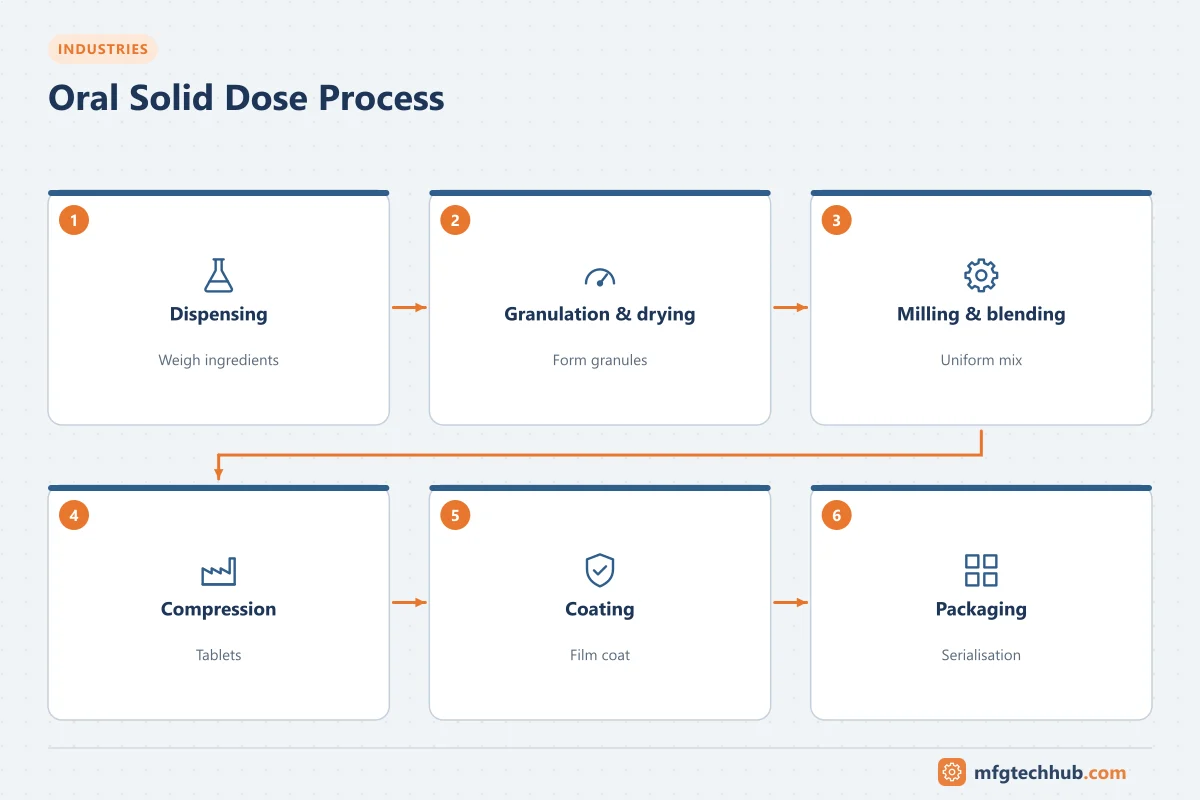
Oral solid dose (tablets and capsules)
| Step | What happens | Key measurements and controls |
|---|---|---|
| Dispensing | Weighing of active ingredients and excipients per batch | Calibrated scales, material identification (barcode), weight tolerance checks |
| Granulation | Wet or dry granulation to improve flow and uniformity | Mixer power/torque, spray rate, temperature |
| Drying | Often fluid bed dryers | Inlet/outlet air temperature, airflow, product temperature, moisture (sometimes NIR) |
| Milling and blending | Particle size and uniform blend | Speed, time; blend uniformity testing |
| Compression | Tablet presses | Compression force, tablet weight, hardness, speed; automatic weight control and rejection |
| Coating | Film coating in pans | Spray rate, air temperature, pan speed |
| Packaging | Blistering or bottling, cartoning, serialisation | Vision inspection, code verification, serialisation data for track-and-trace regulations |
Biologics (for example monoclonal antibodies, vaccines)
| Stage | What happens | Key controls |
|---|---|---|
| Upstream | Cells grown in bioreactors | Temperature, pH, dissolved oxygen, agitation, gas flows, feeds |
| Downstream | Harvest, chromatography, filtration, viral inactivation/removal | Flow, pressure, UV absorbance, conductivity, pH |
| Fill-finish | Aseptic filling into vials or syringes, often in isolators | Environmental monitoring, fill weight, stoppering, sterilisation |
Utilities and cleanrooms
Pharma plants depend on critical utilities that are themselves controlled and monitored systems:
- Purified water and water for injection (WFI) with conductivity, TOC and temperature monitoring and sanitisation cycles
- Clean steam for sterilisation
- HVAC for cleanrooms: room pressure cascades, temperature, humidity and particle counts; EU GMP Annex 1 defines grades A–D for sterile manufacturing
- Clean-in-place (CIP) and sterilise-in-place (SIP) for process equipment
- Compressed air and process gases with quality monitoring
An environmental monitoring system (EMS) often records GMP-relevant room conditions separately from the building management system. See Building Automation.
Automation architecture
| Level | Typical systems | Pharma-specific points |
|---|---|---|
| Field | Hygienic instruments (pressure, temperature, flow, pH, DO), scales, analysers | Hygienic design, calibration programmes, instrument classification by GMP criticality |
| Control | Skid PLCs (granulators, coaters, CIP), DCS or PLC-based batch systems in bulk/biotech | ISA-88 structure for equipment phases and recipes. See ISA-88 |
| Supervisory | SCADA/HMI, batch managers, EMS | Audit trails, user management, alarm management |
| Historian | Process data for batches and investigations | Validated collection, compression settings reviewed for GMP tags. See Industrial Historians |
| Operations | MES with electronic batch records (EBR), weighing and dispensing, LIMS, QMS | Review by exception, electronic signatures |
| Business | ERP (for example SAP with PP-PI and QM) | Batch management, quality release, inventory. See SAP PP-PI |
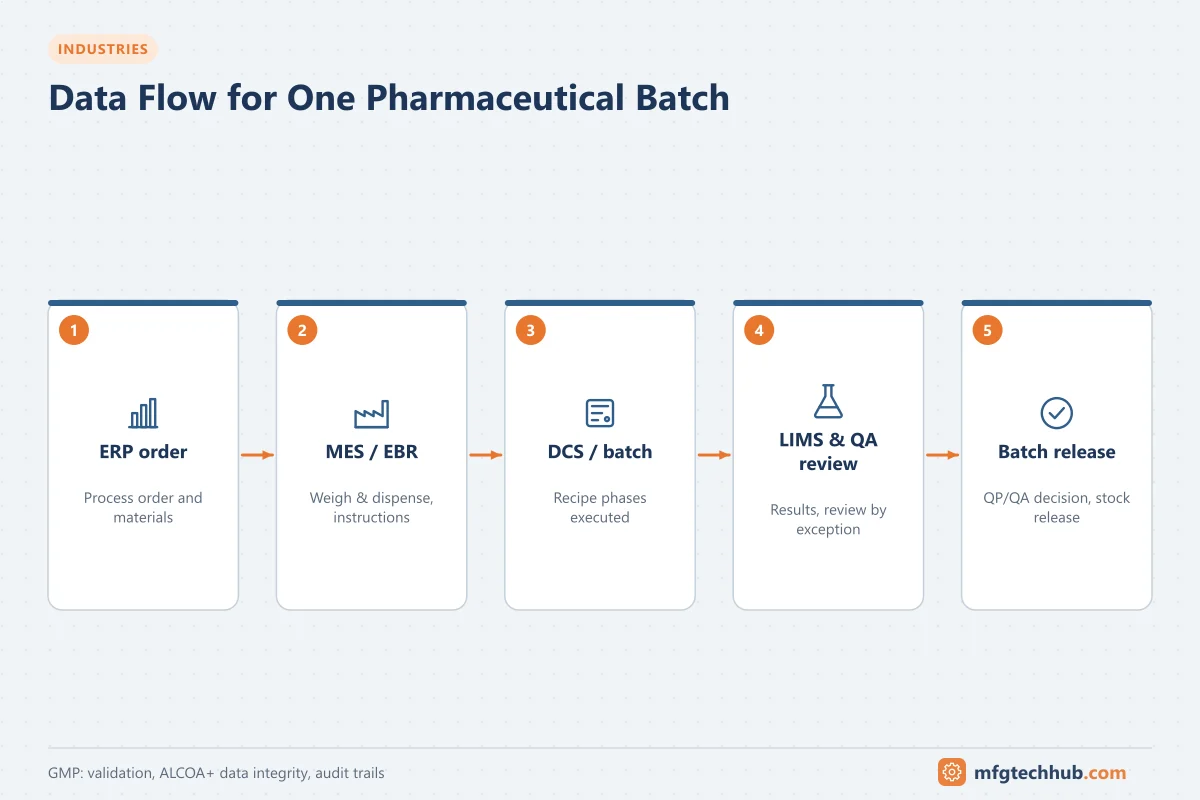
Data flow for one batch
- ERP releases a process order with recipe and materials.
- MES executes the electronic batch record: dispensing, equipment checks, operator instructions, electronic signatures.
- Equipment phases run in PLC/DCS batch control with parameters from the recipe.
- Process data flows to the historian; critical values and alarms are attached to the batch record.
- Samples go to LIMS; results return for review.
- Quality assurance reviews the batch record (ideally by exception) and releases the batch; ERP updates batch status.
Quality, validation and data integrity
- GMP regulations (for example US 21 CFR Parts 210/211, EU GMP) govern manufacturing; computerised systems must be validated. See Computerised System Validation.
- Data integrity (ALCOA+) applies to every system that creates GMP data. See Data Integrity.
- Change control governs every change to validated automation.
- Continued process verification uses historian and quality data to show that processes stay in control.
Typical challenges for automation engineers
| Challenge | Why it happens | Good practice |
|---|---|---|
| Slow changes | Validation and change control effort | Standard libraries, risk-based testing, good documentation from the start |
| Standalone equipment data | Skids with local HMIs and local data | Integrate data to SCADA/MES/historian; manage access and audit trails |
| Paper and hybrid records | Legacy processes | Move to EBR with review by exception |
| Alarm floods | Many equipment alarms without rationalisation | Alarm philosophy and rationalisation |
| Cybersecurity versus validation | Patching affects validated state | Risk-based patch process with defined testing |
Frequently asked questions
What automation systems does a pharmaceutical plant use?
Typically skid PLCs and a DCS or PLC-based batch system for process control, SCADA/HMI for supervision, a historian, an environmental monitoring system, MES with electronic batch records, LIMS for laboratory data, QMS, and ERP for planning, inventory and batch release.
Why is validation so important in pharma automation?
Because product quality and patient safety depend on the systems working as intended and on GMP data being trustworthy. Regulations require documented evidence that computerised systems are fit for their intended use.
What is an electronic batch record?
An electronic record of how a specific batch was manufactured, including materials, equipment, process parameters, operator actions and signatures, created and reviewed in an MES instead of on paper.
Key takeaways
- Pharma plants combine process steps (solid dose or biologics) with critical utilities and cleanrooms.
- The automation stack adds EBR, LIMS, EMS and strict validation and data-integrity requirements.
- ISA-88 batch structures, MES and historians are central to producing and releasing each batch.
Related tutorials
Before you apply this in a plant: this article is for education. Always check the current edition of the relevant standards, the manufacturer's documentation for your exact product and version, and your site's procedures. Safety-related work needs qualified personnel. See our editorial policy.