
MES Quality Management
On this page
Quality management is an essential component of any Manufacturing Execution System (MES). It serves as the backbone for ensuring that products meet or exceed customer expectations and regulatory standards. MES integrates quality management into the production process, enabling real-time monitoring, analysis, and control of quality metrics at every stage of manufacturing.
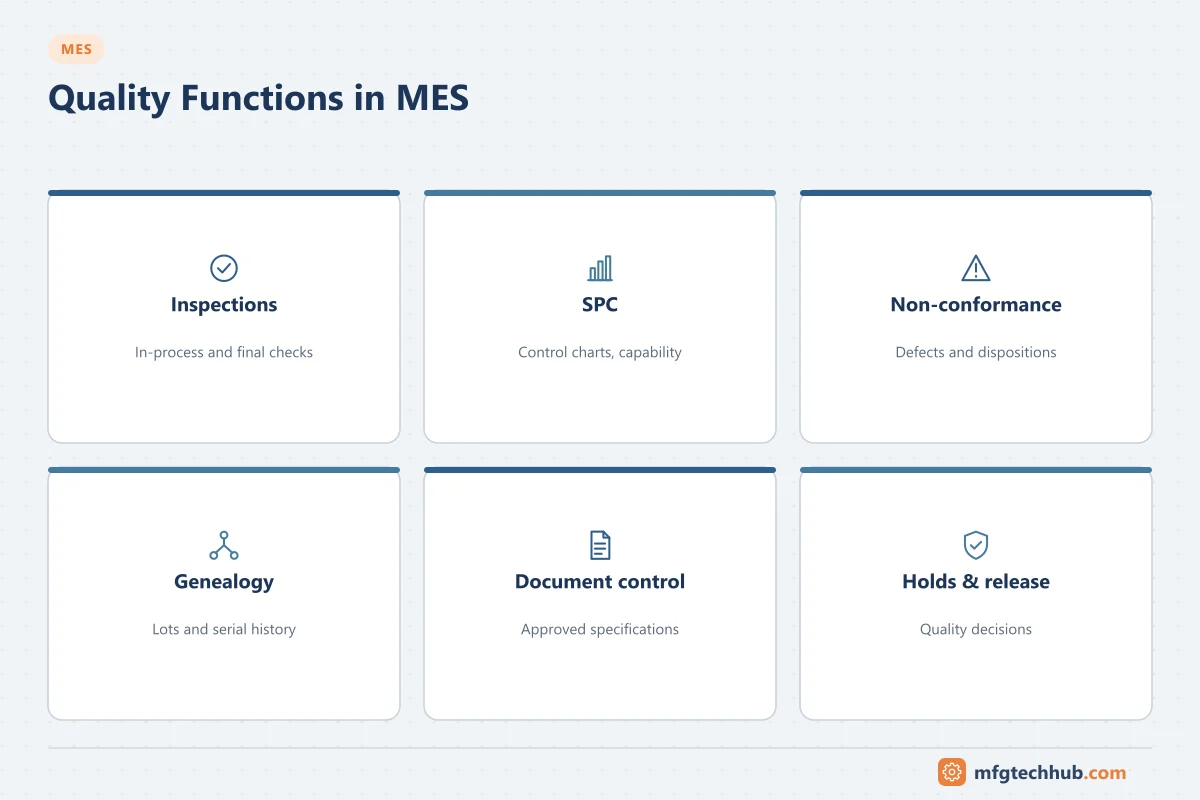
What is Quality Management in MES?
Quality Management in MES involves tracking, analyzing, and managing quality metrics throughout the production cycle. It ensures that manufacturing processes adhere to predefined quality standards and provides tools for detecting, addressing, and preventing defects.
Key functionalities include:
- Real-time quality data collection and analysis.
- Automated quality inspections during production.
- Immediate feedback to address quality issues before they escalate.
- Traceability of quality incidents for regulatory compliance.
Key Features of Quality Management in MES
1. Quality Control (QC)
- Definition: Ensures that products are consistently manufactured to meet quality standards.
- How it Works: MES collects data during production (e.g., measurements, defects) and compares it to acceptable tolerances.
- Example: Automatically rejecting a product on an assembly line if it fails dimensional accuracy tests.
2. Defect Tracking and Analysis
- Definition: Identifies, categorizes, and analyzes defects to uncover root causes.
- How it Works: MES assigns defects to specific batches, machines, or operators, enabling targeted corrective actions.
- Example: Analyzing frequent paint defects in a car manufacturing line and pinpointing the issue to a faulty spray nozzle.
3. Statistical Process Control (SPC)
- Definition: Uses statistical methods, mainly control charts, to tell normal process variation from special causes before products go out of specification.
- How it Works: MES collects samples of a quality characteristic (for example a weight or a dimension), plots them on control charts (such as X-bar/R or individuals charts), and applies rules to detect points outside control limits or non-random patterns. Control limits are calculated from the process’s own variation and are different from specification limits, which come from the product requirements. Capability indices (Cp, Cpk) compare the two.
- Example: Fill weights on a packaging line drift upwards over a shift; the control chart shows a trend before any pack exceeds its specification, so the filler is adjusted early. See MES Reporting, KPIs and Analytics for loss analysis.
4. Non-Conformance Management
- Definition: Addresses deviations from established quality standards.
- How it Works: MES generates non-conformance reports and triggers workflows for corrective actions.
- Example: Notifying a quality manager about a batch that does not meet tensile strength requirements.
5. Inspection Management
- Definition: Manages scheduled and unscheduled inspections during production.
- How it Works: MES provides digital checklists and records inspection results for compliance.
- Example: Conducting inline visual inspections of food packaging for defects.
6. Traceability and Genealogy
- Definition: Tracks every component or material used in production back to its source.
- How it Works: MES records batch numbers, supplier details, and production parameters for each product.
- Example: Tracing back to a specific raw material batch in the event of a product recall.
7. Document and Compliance Management
- Definition: Ensures adherence to regulatory standards and maintains required documentation.
- How it Works: MES manages controlled documents used on the shop floor (specifications, inspection plans, work instructions) with version control, so operators always use the approved revision, and keeps the quality records created during production.
- Example: Automatically updating compliance reports after every quality audit.
Benefits of Quality Management in MES
- Improved Product Quality:
- Early detection and prevention of defects.
- Consistency in meeting quality standards.
- Cost Savings:
- Reduces scrap and rework by addressing issues early.
- Lowers warranty claims and returns.
- Increased Efficiency:
- Automates quality inspections and data collection.
- Streamlines workflows for addressing quality issues.
- Regulatory Compliance:
- Maintains detailed records for audits.
- Simplifies compliance with standards like ISO, FDA, and GMP.
- Enhanced Customer Satisfaction:
- Delivers defect-free products.
- Builds trust and loyalty by consistently meeting expectations.
Challenges in Implementing Quality Management in MES
- Data Overload: Collecting excessive data can overwhelm operators.
- Integration Issues: MES must integrate with legacy systems and machines.
- Resistance to Change: Operators may require training to adapt to automated quality processes.
- High Initial Costs: Advanced quality management modules can be expensive to implement.
Role of Technology in MES Quality Management
Modern MES systems leverage advanced technologies to enhance quality management:
- Artificial Intelligence (AI): AI-powered tools can predict defects based on historical data.
- Machine Learning (ML): ML algorithms improve defect detection accuracy over time.
- Internet of Things (IoT): IoT-enabled devices collect real-time quality data from sensors.
- Cloud Integration: Provides remote access to quality data and analytics.
Real-Life Example: MES Quality Management in Pharmaceutical Manufacturing
In the pharmaceutical industry, quality management is critical for ensuring patient safety and regulatory compliance. MES quality modules help:
- Monitor environmental conditions (e.g., temperature, humidity) in cleanrooms.
- Automate inspections of drug formulations for consistency.
- Ensure traceability of raw materials used in production.
Advanced Strategies for MES Quality Management
- Closed-Loop Quality Control: MES integrates feedback loops where detected defects trigger immediate corrective actions on the shop floor, minimizing downtime.
- Digital Twins: Virtual replicas of production processes help simulate and predict quality outcomes before actual production, reducing risks.
- Supplier Quality Integration: MES extends beyond internal processes by tracking supplier performance, incoming raw materials, and their impact on final product quality.
- Mobile Quality Management: Operators can capture quality data on handheld devices or tablets, increasing flexibility in modern shop floors.
Industry Applications of MES Quality Management
- Automotive: Detecting welding defects in real-time to prevent costly recalls.
- Electronics: Ensuring precision in semiconductor production by monitoring micro-defects.
- Food & Beverage: Guaranteeing packaging integrity and preventing contamination with digital inspections.
- Aerospace: Managing traceability for safety-critical components with full genealogy data.
Future Trends in MES Quality Management
The future of MES quality management lies in combining AI-driven analytics, AR-enabled inspections, and cloud-based collaboration. Factories of the future will have self-learning systems where quality control becomes predictive rather than reactive. Blockchain is also emerging as a tool for tamper-proof quality traceability, particularly in high-regulation industries such as aerospace and pharmaceuticals.
Conclusion
Quality management in MES is not just a compliance requirement-it is a strategic enabler for competitiveness. By integrating technologies like IoT, AI, and digital twins, manufacturers can achieve real-time visibility, reduce costs, and ensure customer trust. Whether in pharmaceuticals, automotive, or electronics, MES-based quality management is transforming how industries deliver consistent, safe, and high-quality products.
Before you apply this in a plant: this article is for education. Always check the current edition of the relevant standards, the manufacturer's documentation for your exact product and version, and your site's procedures. Safety-related work needs qualified personnel. See our editorial policy.