
MES Architecture Explained: ISA-95 Position, Functional Model, Software Layers, Data Flow and Deployment Options
On this page
MES architecture describes where a Manufacturing Execution System sits among other systems, which functions it provides, how its software is structured, and how data flows through it. Architecture decisions made early (monolithic or modular, on-premise or cloud, one global template or site-specific systems) shape cost, flexibility and support for the next ten to fifteen years.
This guide covers the position, the functions, the layers, the data flow and the deployment options in one place. For network design, DMZ placement and high availability, see MES Infrastructure and Networking.
Where MES sits: the ISA-95 levels
| Level | Function | Typical systems | Timescale |
|---|---|---|---|
| Level 4 | Business planning and logistics | ERP, supply chain planning | Months, weeks, days |
| Level 3 | Manufacturing operations management | MES, LIMS, WMS, CMMS, historian | Days, shifts, hours, minutes |
| Level 2 | Monitoring and supervisory control | SCADA, HMI, DCS operator stations | Minutes to seconds |
| Level 1 | Sensing and manipulating the process | PLCs, DCS controllers | Seconds to milliseconds |
| Level 0 | The physical process | Sensors, actuators, machines | Real time |
The MES translates orders and master data from Level 4 into executable work at Level 2 and 1, and turns shop-floor events back into business information. See ISA-95 Model and How a Factory Works.
The functional model: what an MES does
ISA-95 Part 3 groups Level 3 activities into four areas: production, quality, maintenance and inventory operations management. Each area includes similar activities: definition management, resource management, detailed scheduling, dispatching, execution management, data collection, tracking and performance analysis.
The older MESA-11 model, still widely used to describe MES scope, lists eleven functions:
| MESA-11 function | Covered on this site |
|---|---|
| Resource allocation and status | Labour Management |
| Operations / detailed scheduling | Production Scheduling |
| Dispatching production units | Production Scheduling |
| Document control | Quality Management |
| Data collection / acquisition | Data Collection and Integration |
| Labour management | Labour Management |
| Quality management | Quality Management |
| Process management | Process Management |
| Maintenance management | Usually integrated with a CMMS; see SAP PM |
| Product tracking and genealogy | Material Management |
| Performance analysis | Reporting, KPIs and Analytics |
No product is equally strong in all functions, and no plant needs all of them on day one. Define the functional scope from business needs first, then map it to products.
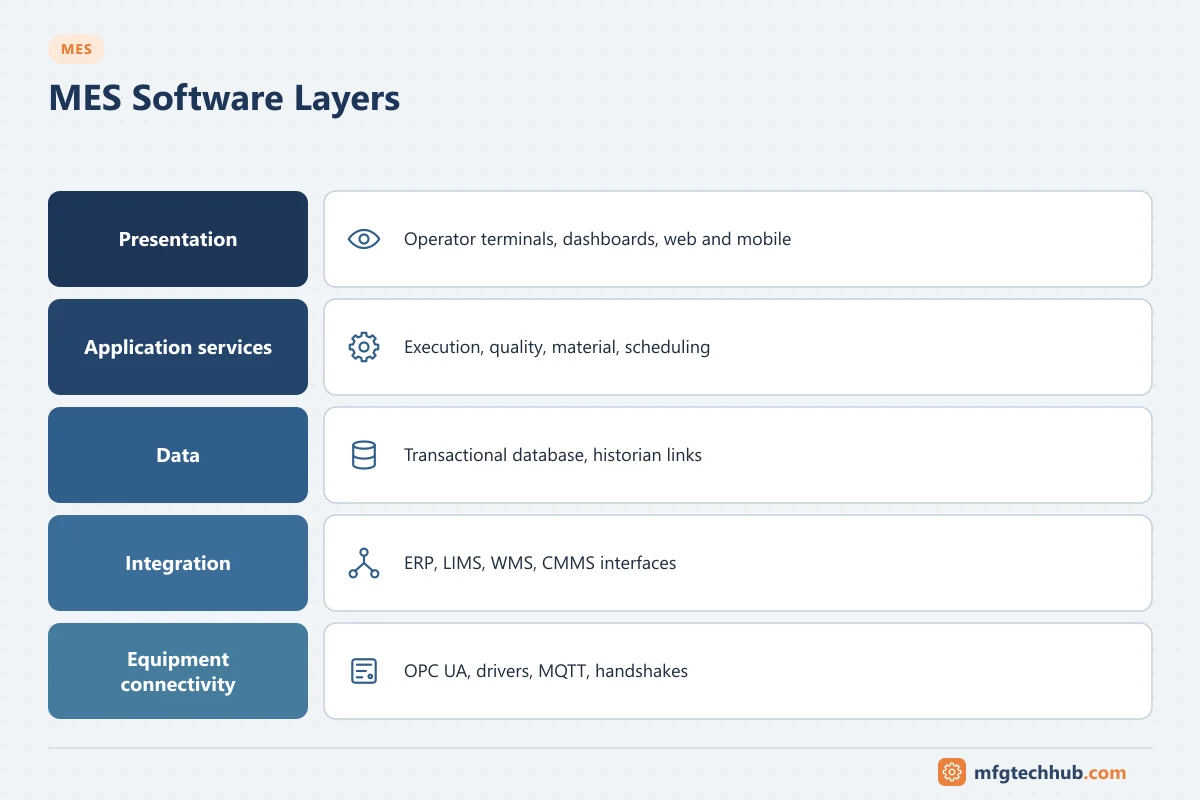
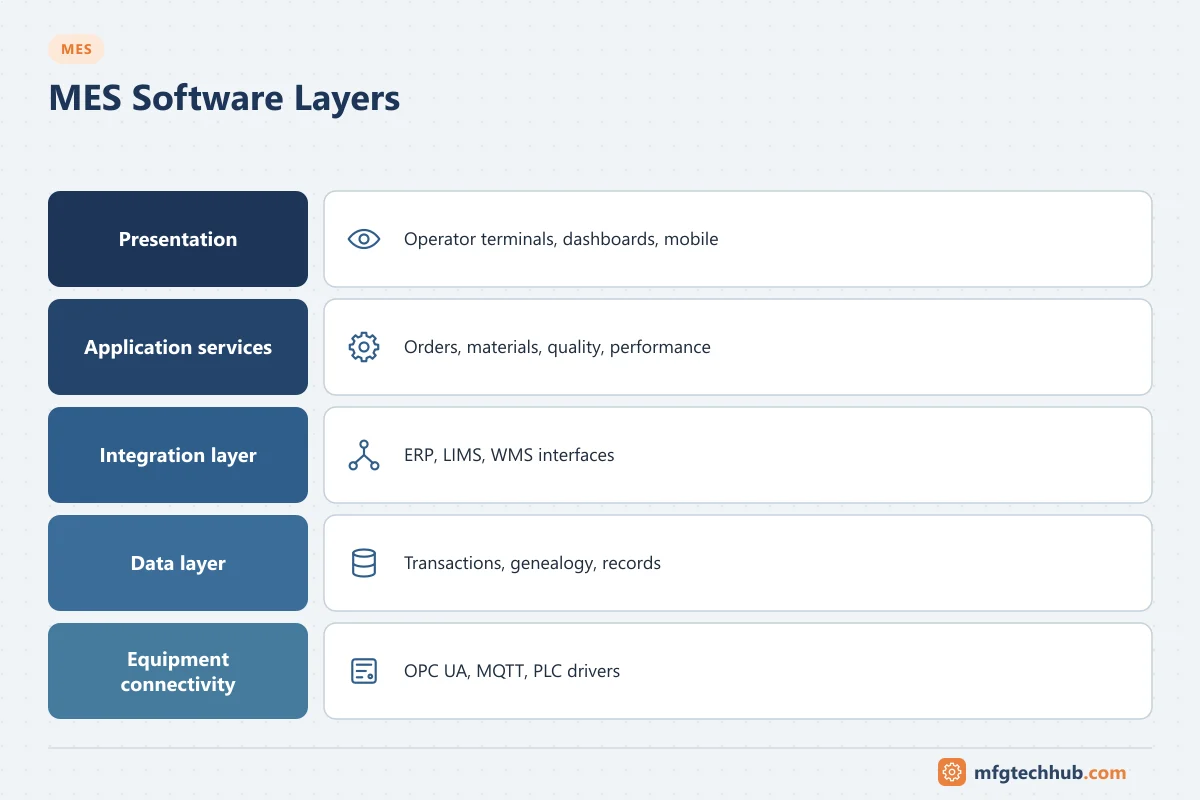
Software layers
| Layer | Contents | Design points |
|---|---|---|
| Presentation | Operator terminals, supervisor dashboards, web and mobile clients | Role-based screens; work on shop-floor hardware, gloves, scanners |
| Application services | Order execution, quality, material, scheduling, reporting services | Configurable workflows instead of custom code where possible |
| Data layer | Relational database for transactions and genealogy; links to historian for time-series | Sizing, archiving, backup; reporting replicas |
| Integration layer | ERP, LIMS, WMS, CMMS, QMS interfaces; message handling | Error queues, retry, monitoring; standard models such as ISA-95 Part 5 / B2MML |
| Equipment connectivity | PLC, SCADA and machine interfaces | OPC UA, drivers, MQTT, handshakes. See OPC UA Explained |
End-to-end data flow (illustrative, discrete or process)
- ERP releases a production order with product, quantity, BOM, routing or recipe and due date.
- MES receives the order, checks master data and makes it available for scheduling.
- Scheduling places the order on a line and sequence; the MES dispatch list shows it to the line.
- Material staging is requested from the warehouse; the MES confirms the right lots at the line.
- At start, the MES runs readiness checks (equipment status, materials, operator qualification) and downloads recipe parameters to the controller.
- During execution, the MES collects counts, states, process data, quality results and material consumption, and guides operators through work instructions.
- Exceptions (out-of-limit values, deviations) are recorded and may place lots on hold.
- At completion, the MES confirms quantities, scrap, consumption and times to ERP, and completes the batch or device history record.
- Data flows to reporting, the historian and enterprise analytics.
For interface details, see How MES Integrates with ERP, SCADA and PLC.
Traditional vs modern MES architectures
| Aspect | Traditional (monolithic, on-premise) | Modern (modular, services-based, hybrid or cloud) |
|---|---|---|
| Structure | One large application and database | Separate modules or services with APIs |
| Deployment | On-premise servers per site | On-premise, containers, private or public cloud, edge nodes |
| Customisation | Often custom code in the core | Configuration, low-code workflows, extensions through APIs |
| Integration | Point-to-point, database links, files | APIs, messaging, event streams, unified namespace |
| Upgrades | Large, infrequent projects | Smaller, more frequent releases (especially SaaS) |
| Multi-site | Separate installations drifting apart | Global template with site configuration |
| Strengths | Proven, predictable, runs without WAN | Flexibility, faster rollout, easier scaling and integration |
| Risks | Hard to change and upgrade; customisation lock-in | Dependence on networks and vendors; more components to secure and operate |
Cloud, hybrid and edge
- Shop-floor execution must keep running if the WAN fails. Hybrid designs keep execution-critical functions (dispatching, data collection, operator screens, buffering) on site or at the edge, with cloud services for analytics, cross-site reporting and non-critical functions.
- Latency and bandwidth: high-rate machine data is aggregated at the edge before being sent to the cloud.
- Regulated industries: check validation, data residency, audit trails and supplier controls for cloud services. See Computerised System Validation.
- Security: connections from plant to cloud are initiated outbound through the DMZ. See ISA/IEC 62443.
Multi-site architecture
| Approach | Description | Suits |
|---|---|---|
| Global template | One standard process and configuration, deployed with limited local variants | Similar plants and products; strong central governance |
| Site-specific systems | Each plant chooses and configures its own MES | Very different plants; acquisitions |
| Federated | Common core and data model with site-specific modules | Mixed portfolios; gradual harmonisation |
A shared data model (equipment hierarchy, material and reason codes, KPI definitions) is what makes cross-site reporting possible, whichever approach is chosen.
How to choose an architecture
- Start from requirements: functions, regulatory needs, number of sites, plant types, integration landscape.
- Decide what must work offline and design the site/edge part accordingly.
- Prefer configuration over customisation; every custom change is an upgrade cost.
- Define the integration approach (APIs, messaging, standard models) and data ownership per system.
- Plan operations: who runs servers or cloud tenancy, backups, patching, monitoring and support. See OT Backup and Restore Runbook.
- Prove it: a pilot on a representative line, including interfaces and failure cases, before rollout.
See also MES Planning and Strategy and MES System Selection.
Frequently asked questions
Where does MES sit in the ISA-95 model?
At Level 3, manufacturing operations management, between ERP at Level 4 and the control systems (SCADA, DCS, PLCs) at Levels 2 and 1.
What are the main layers of MES architecture?
Presentation (user interfaces), application services (execution, quality, material, scheduling, reporting), data (transactional database and links to the historian), integration with business systems, and equipment connectivity to PLCs, SCADA and machines.
Can MES run in the cloud?
Many vendors offer cloud or SaaS MES. Most plants use hybrid designs in which execution-critical functions keep running locally if the connection to the cloud fails, and analytics and cross-site functions run in the cloud.
What is the difference between ISA-95 Part 3 and MESA-11?
Both describe what MES does. ISA-95 Part 3 is the international standard activity model organised into production, quality, maintenance and inventory operations management. MESA-11 is an earlier industry model listing eleven MES functions and is still used to describe product scope.
Key takeaways
- MES is the Level 3 system linking ERP orders to shop-floor execution and back.
- Use ISA-95 Part 3 or MESA-11 to define functional scope before choosing products.
- Structure MES in layers with explicit integration and connectivity, and prefer configuration to customisation.
- Modern architectures are modular and hybrid; keep execution-critical functions running locally.
- Share one data model across sites, whatever the deployment approach.
Related tutorials
Before you apply this in a plant: this article is for education. Always check the current edition of the relevant standards, the manufacturer's documentation for your exact product and version, and your site's procedures. Safety-related work needs qualified personnel. See our editorial policy.