
History of MES: From Shop-Floor Data Collection to ISA-95 and Composable MOM
On this page
MES grew out of a gap that appeared when companies computerised planning: ERP and its predecessors knew what should be produced, and automation controlled the machines, but what actually happened on the shop floor (which lots were used, who did what, what was scrapped) was still recorded on paper. Each stage in MES history is an attempt to close that gap more completely and with less custom software.
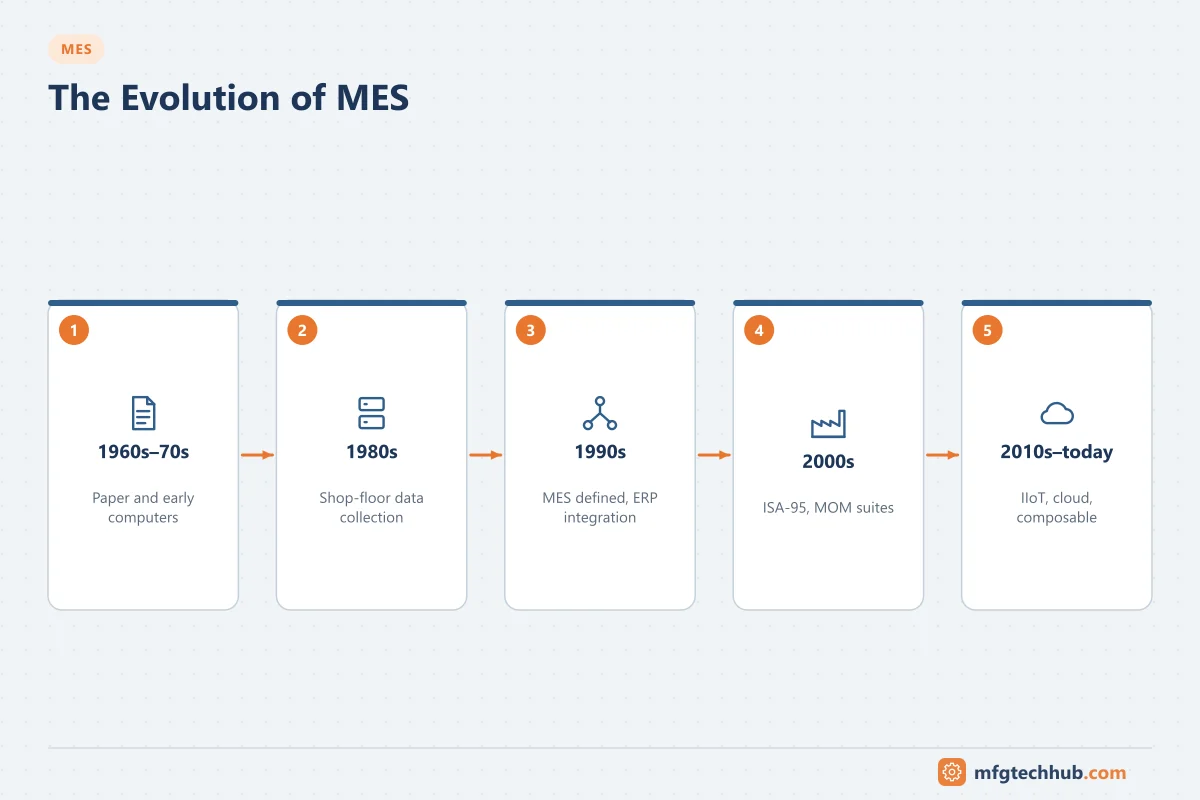
Before MES: paper and data collection (1960s–1980s)
- Paper travellers, route cards and batch records documented production. Traceability meant searching filing cabinets.
- Material requirements planning (MRP) from the 1960s and 1970s, and later MRP II, computerised planning but stopped at the factory door.
- Shop-floor data collection (SFDC) terminals, time and attendance systems and plant-specific databases captured counts and labour.
- Computer-integrated manufacturing (CIM) in the 1980s promoted linking design, planning and production, but most implementations were large custom projects.
The term MES and MESA (1990s)
- The term manufacturing execution system is generally attributed to the analyst firm AMR Research around 1990.
- MESA International (then the Manufacturing Execution Systems Association, now the Manufacturing Enterprise Solutions Association) was founded in 1992 to promote the concept.
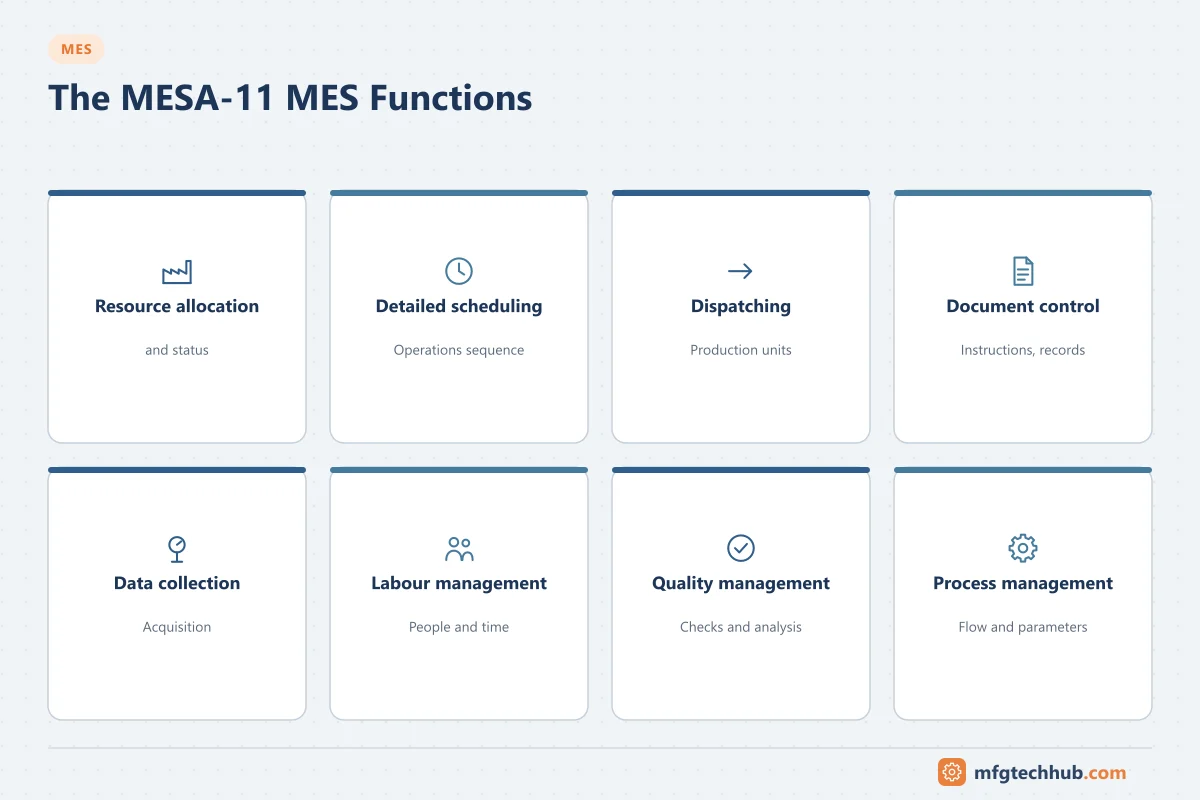
- In the mid-1990s MESA published the MESA-11 model, listing eleven MES functions: resource allocation and status, operations/detail scheduling, dispatching production units, document control, data collection/acquisition, labour management, quality management, process management, maintenance management, product tracking and genealogy, and performance analysis. It remains a common reference for what an MES does.
- Commercial MES products appeared, often specialised by industry (semiconductor, pharmaceuticals, discrete assembly).
Standards: ISA-95 and B2MML (2000s)
- ISA-95 Part 1 (2000) defined the levels and the interface between enterprise and control systems; later parts described the level 3 activities and object models. It was adopted internationally as IEC 62264.
- B2MML, an XML implementation of ISA-95 objects, gave ERP–MES integration a common language. See ISA-95.
- Regulated industries adopted electronic batch records and electronic signatures under rules such as 21 CFR Part 11, which pushed MES into pharmaceuticals and medical devices. See Data Integrity (ALCOA+).
- MESA updated its models (collaborative MES in the early 2000s, a strategic initiatives model in 2008) as MES became part of wider operations management.
MOM suites and consolidation (2000s–2010s)
- Vendors extended MES into manufacturing operations management (MOM) suites covering production, quality, inventory and maintenance operations.
- Large automation, ERP and PLM vendors acquired MES specialists, creating integrated portfolios. See MES Software Vendors Compared.
- Multi-site global templates became common for companies standardising operations across plants.
Cloud, IIoT and composable MES (2010s–today)
- Cloud and SaaS MES reduced infrastructure effort, usually in hybrid architectures that keep execution running during WAN outages. See Cloud-Based MES.
- IIoT connectivity (OPC UA, MQTT, unified namespace) made machine data easier to collect. See MES Data Collection.
- Composable and low-code platforms let plants build focused applications instead of deploying a monolithic suite.
- Analytics and AI are applied to downtime, quality and scheduling data. See MES Future Outlook.
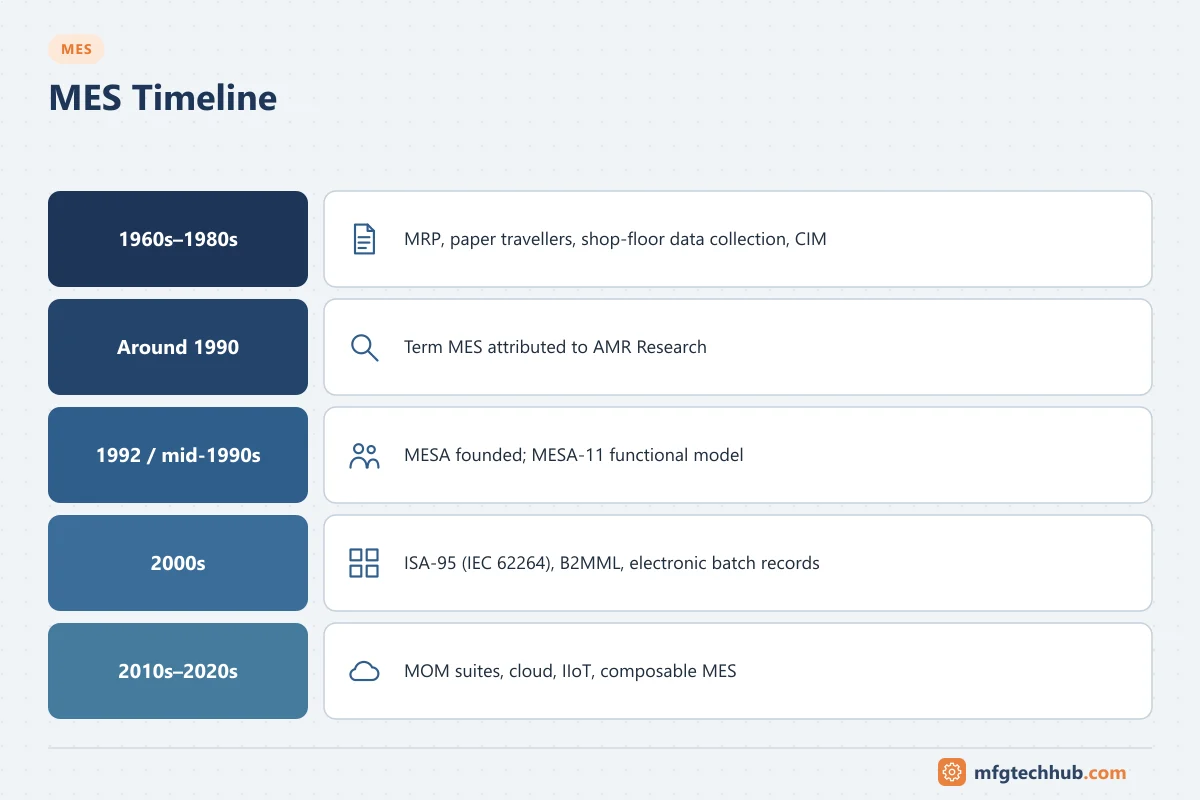
Timeline
| Period | Development |
|---|---|
| 1960s–1970s | MRP; paper travellers and batch records |
| 1980s | MRP II, shop-floor data collection, CIM initiatives |
| Around 1990 | Term MES attributed to AMR Research |
| 1992 | MESA founded |
| Mid-1990s | MESA-11 functional model |
| 2000 | ISA-95 Part 1 published (later IEC 62264) |
| 2000s | B2MML, electronic batch records under 21 CFR Part 11, MOM suites |
| 2008 | MESA strategic initiatives model |
| 2010s–2020s | Vendor consolidation, cloud/SaaS, IIoT, unified namespace, composable MES |
Lessons for today
- The core problem has not changed: connect plans to what really happened, accurately and quickly.
- Custom, monolithic projects were hard to upgrade; configuration, standards (ISA-95) and clear interfaces age better.
- Data from machines is only useful with context (order, material, product, time).
- Regulated records need governance as much as software.
Frequently asked questions
When did MES start?
Shop-floor data collection existed from the 1970s and 1980s, but the term manufacturing execution system is generally attributed to AMR Research around 1990, and MESA was founded in 1992.
What is the MESA-11 model?
A functional model published by MESA in the mid-1990s listing eleven MES functions, from resource allocation and scheduling to genealogy and performance analysis. It is still used to describe MES scope.
How is ISA-95 related to MES?
ISA-95 (IEC 62264) defines the levels of manufacturing systems and the activities and information exchanged at level 3, where MES operates. It is the main standard for MES scope and ERP integration.
Key takeaways
- MES emerged to close the gap between computerised planning and paper-based shop-floor records.
- AMR Research coined the term around 1990; MESA and its MESA-11 model shaped the concept.
- ISA-95 and B2MML standardised scope and integration; regulated industries drove electronic records.
- Today’s trends are MOM suites, cloud, IIoT connectivity and composable applications.
Related tutorials
Before you apply this in a plant: this article is for education. Always check the current edition of the relevant standards, the manufacturer's documentation for your exact product and version, and your site's procedures. Safety-related work needs qualified personnel. See our editorial policy.