
MES Software Vendors Compared: Siemens Opcenter, SAP Digital Manufacturing, Rockwell, AVEVA, Proficy, DELMIA, Körber, Critical Manufacturing, Tulip and More
On this page
The MES market is broad: some products are built for pharmaceutical batch records, others for semiconductor fabs, automotive assembly, food plants or low-code shop-floor apps. Comparing them only by feature lists rarely helps, because most vendors can claim most MES functions. This guide groups products by what they are designed for, profiles the main vendors, and gives an objective evaluation method.
For what an MES does and how it is structured, see What Is MES? and MES Architecture Explained.
Last technical review: September 2026. Ownership and product names change frequently. For example, GE Vernova sold Proficy to TPG (completed March 2026), SAP has announced the end of mainstream maintenance for SAP ME and MII in favour of SAP Digital Manufacturing, and Honeywell’s automation business now operates as Honeywell Technologies. Confirm current products, editions and support with each vendor.
There is no single best MES. The right product depends on your industry, processes, ERP and automation landscape, regulatory requirements, IT strategy and budget.
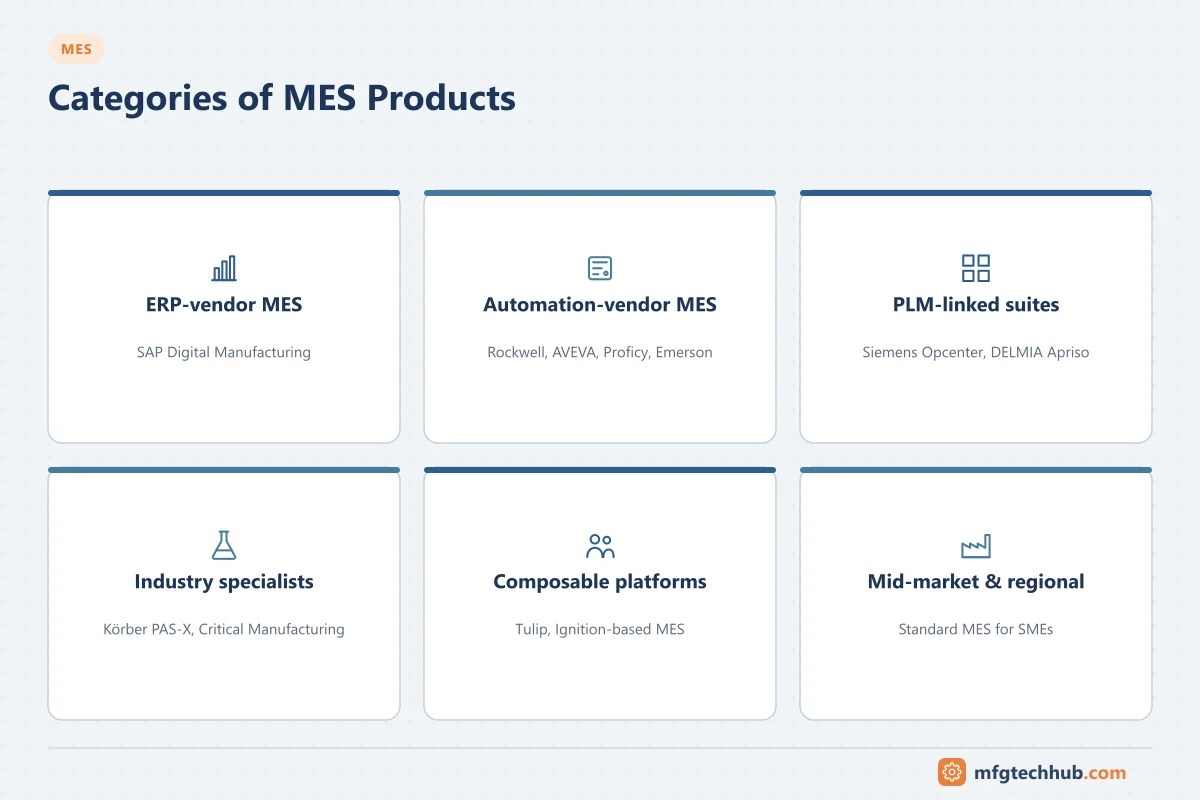
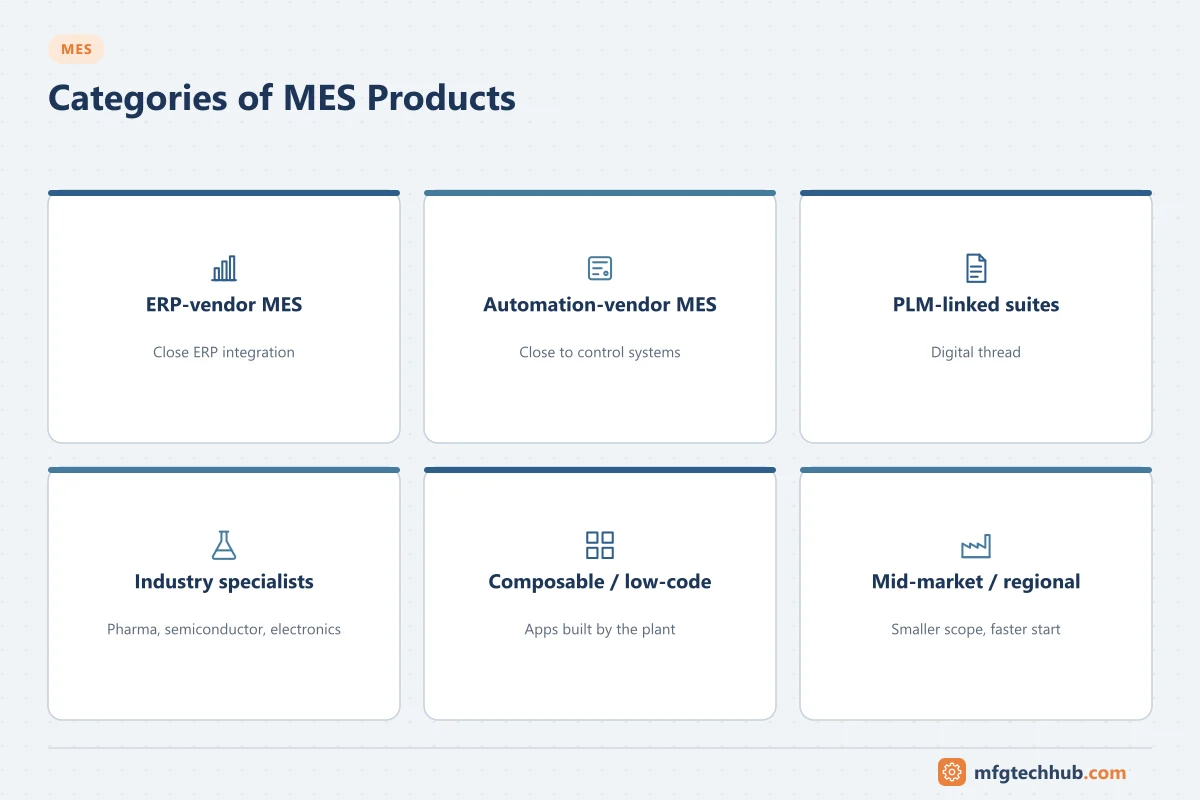
Categories of MES products
| Category | Characteristics | Examples |
|---|---|---|
| ERP-vendor MES | Deep integration with the vendor’s ERP; follows the ERP’s master data model | SAP Digital Manufacturing |
| Automation-vendor MES | Integration with the vendor’s control systems, historians and SCADA | Rockwell Automation (Plex, FactoryTalk PharmaSuite), AVEVA MES, Proficy Plant Applications, Emerson DeltaV MES |
| PLM-linked MES suites | Connect engineering (PLM) data with execution; strong in discrete and regulated industries | Siemens Opcenter, Dassault Systèmes DELMIA Apriso |
| Industry-specialist MES | Built around one industry’s processes and regulations | Körber PAS-X (pharma and biotech), Critical Manufacturing (semiconductor, electronics, medical devices) |
| Composable / low-code platforms | Apps built by engineers and operations teams; fast to deploy for specific use cases | Tulip; Ignition with MES modules (for example from Sepasoft) |
| Mid-market and regional MES | Standard MES for small and medium manufacturers, often with strong regional presence | For example MPDV HYDRA, Parsec TrakSYS, iTAC (Dürr group) and many others |
Vendor capability profiles
Siemens Opcenter
- Portfolio: Opcenter Execution with industry editions (Discrete, Process, Pharma, Electronics, Semiconductor, Medical Device), plus quality management, advanced planning and scheduling, R&D and intelligence modules.
- Known for: integration with Siemens PLM (Teamcenter) for a closed loop between engineering and production, and with Siemens automation; broad industry coverage.
- Check: which edition fits your industry, integration effort with non-Siemens ERP and automation, and deployment options (on-premise and cloud).
- Typical fit: discrete manufacturers with complex engineering change processes, electronics, medical devices, process and pharma companies standardising on Siemens.
SAP Digital Manufacturing
- Portfolio: SAP’s cloud manufacturing execution and insights solution, integrated with SAP S/4HANA, with an edge component for local execution and the Production Connector for shop-floor connectivity.
- Known for: standard integration with SAP master data, orders and confirmations; SAP’s strategic successor to SAP ME and MII.
- Check: fit of standard functions to your processes, shop-floor resilience design (edge), and migration effort from SAP ME/MII customisations. See Connecting SAP to the Shop Floor.
- Typical fit: SAP-centric companies wanting a cloud MES with minimal integration work to S/4HANA.
Rockwell Automation: Plex and FactoryTalk PharmaSuite
- Plex: a cloud-native MES (and ERP) platform, acquired by Rockwell in 2021, widely used in discrete manufacturing such as automotive suppliers and food.
- FactoryTalk PharmaSuite: MES for pharmaceutical and biopharmaceutical manufacturing with electronic batch records; version 12.00 was released in May 2025.
- Known for: integration with Rockwell controllers and FactoryTalk software; SaaS delivery for Plex.
- Typical fit: discrete manufacturers wanting cloud MES (Plex); life-sciences plants on Rockwell automation (PharmaSuite).
AVEVA MES (Schneider Electric)
- Portfolio: MES for batch and hybrid processes with a modular deployment approach and an enterprise architecture that can run one MES centrally for several plants with small local footprints.
- Known for: integration with AVEVA System Platform, AVEVA Historian and the PI System; food and beverage and CPG use.
- Typical fit: food and beverage, CPG, and hybrid manufacturers already using AVEVA software.
Proficy Plant Applications (TPG)
- Portfolio: Plant Applications MES with production, efficiency (OEE), quality and batch analysis functions, part of the Proficy suite with Proficy Historian, iFIX and Operations Hub.
- Check: roadmap and support under TPG ownership.
- Typical fit: existing Proficy users; manufacturers wanting historian, SCADA and MES from one supplier.
Dassault Systèmes DELMIA Apriso
- Portfolio: global manufacturing operations management covering production, quality, warehouse and maintenance, often deployed as a common template across many plants, and linked to Dassault’s 3DEXPERIENCE platform.
- Typical fit: global discrete manufacturers (automotive, aerospace, industrial equipment) standardising processes across many sites.
Körber PAS-X
- Portfolio: MES for pharmaceutical and biotech manufacturing (electronic batch records, weigh and dispense, review by exception), available as managed SaaS on AWS, with PAS-X Neo as an entry-level offering.
- Known for: a large installed base in pharma and biotech and pre-configured GMP content.
- Typical fit: pharmaceutical, biotech and cell and gene therapy manufacturers. See Pharmaceutical Manufacturing Automation.
Critical Manufacturing (ASMPT)
- Portfolio: MES for high-tech discrete manufacturing; a subsidiary of ASMPT since 2018.
- Known for: semiconductor back-end, electronics, medical devices and industrial equipment; equipment integration and material tracking at unit level.
- Typical fit: semiconductor, electronics and medical device plants.
Emerson DeltaV MES (formerly Syncade)
- Portfolio: MES for life sciences, biotech and specialty chemicals, now marketed as DeltaV MES (the Syncade brand has been unified under DeltaV), integrated with the DeltaV DCS for electronic records and procedural control.
- Typical fit: DeltaV users in pharma, biotech and specialty chemicals.
Tulip
- Portfolio: a cloud “frontline operations” platform in which engineers build apps (work instructions, quality checks, machine monitoring, traceability) with a no-code editor, connectors and edge devices.
- Known for: fast deployment and composability; strong in assembly, life sciences and continuous-improvement use cases.
- Check: how composed apps are governed, validated and scaled across sites; how genealogy and ERP integration are handled at scale.
- Typical fit: plants starting with specific digital use cases, or complementing a core MES with flexible apps.
Ignition-based MES
- Portfolio: Ignition SCADA combined with MES modules (for example from Sepasoft for OEE, track and trace, SPC and batch) or custom applications.
- Known for: unlimited-tag licensing, rapid development and integrator ecosystem.
- Check: long-term ownership of custom code, validation approach and multi-site governance.
- Typical fit: manufacturers already on Ignition, and integrator-led projects.
Industry fit at a glance
| Industry | Often-shortlisted MES types |
|---|---|
| Pharmaceuticals and biotech | Industry-specialist (Körber PAS-X), automation-vendor pharma MES (PharmaSuite, DeltaV MES), Siemens Opcenter Execution Pharma |
| Food, beverage and CPG | AVEVA MES, Siemens Opcenter Execution Process, Proficy, Plex, mid-market MES |
| Automotive and discrete assembly | Plex, Siemens Opcenter, DELMIA Apriso, SAP Digital Manufacturing, mid-market MES |
| Electronics and semiconductor | Critical Manufacturing, Siemens Opcenter Execution Electronics/Semiconductor |
| Chemicals and process | Siemens Opcenter Execution Process, AVEVA MES, DCS-vendor MES |
| Mixed, fast-changing or starting small | Composable platforms (Tulip), Ignition-based MES |
See also MES for Discrete Manufacturing and MES for Process and Batch Manufacturing.
Selection criteria
| Criterion | Questions to ask |
|---|---|
| Functional coverage | Which ISA-95 Part 3 / MESA-11 functions are standard, which are configured, which need custom development? |
| Industry content | Pre-built processes, templates and regulatory content for your industry? |
| Regulated use | Electronic records and signatures, audit trails, review by exception, validation documentation? See Computerised System Validation |
| ERP integration | Standard connectors for your ERP (for example SAP), supported messages and APIs? See SAP–MES Integration |
| Shop-floor connectivity | OPC UA, MQTT, PLC drivers, machine standards (PackML, MTConnect, IPC-CFX)? |
| Deployment and resilience | SaaS, private cloud, on-premise, hybrid; can the line keep running if the WAN or cloud is unavailable? |
| Configurability | Low-code configuration, extension model, upgrade impact of customisations? |
| Multi-site | Global template, local variants, central administration? |
| User experience | Operator screens usable at the line, with scanners and gloves, in local languages? |
| Analytics | OEE, SPC, genealogy queries, data export to data platforms? |
| Vendor and ecosystem | Ownership stability, roadmap, local partners, reference sites in your industry? |
| Total cost | Licences or subscriptions, implementation, integration, validation, infrastructure and support over 10 years |
A practical evaluation plan
- Define requirements and scope with operations, quality, IT and engineering; prioritise must-haves.
- Shortlist three or four vendors whose category and industry fit match your needs.
- Run scripted demonstrations: give each vendor the same scenarios based on your processes (order start, material verification, a deviation, a changeover, an ERP confirmation error) instead of accepting standard demos.
- Pilot the leading option on one line, including ERP and machine integration and a failure test (network or ERP outage).
- Check references at comparable plants and ask about upgrades, support and total cost.
- Plan the rollout with a template approach and a realistic change-management plan. See MES Planning and Strategy and MES System Selection and Integration.
Frequently asked questions
Which MES is best for pharmaceutical manufacturing?
Several products are widely used in pharma, including Körber PAS-X, Rockwell FactoryTalk PharmaSuite, Siemens Opcenter Execution Pharma and Emerson DeltaV MES. The best fit depends on your processes, automation systems, validation approach and IT strategy; evaluate with scripted demonstrations and references.
Is SAP Digital Manufacturing a replacement for SAP ME and MII?
SAP positions SAP Digital Manufacturing as the strategic successor to SAP ME and SAP MII, whose mainstream maintenance is reported to end in 2027. Migration usually requires redesigning custom MII or ME functions rather than a technical conversion.
Can a low-code platform replace a traditional MES?
For some plants and use cases, yes; for others, a low-code platform complements a core MES. Evaluate how genealogy, ERP integration, validation, performance and multi-site governance are handled at your scale.
Key takeaways
- MES products fall into ERP-vendor, automation-vendor, PLM-linked, industry-specialist, composable and mid-market categories.
- Match the category and vendor to your industry, processes, ERP and automation landscape.
- Evaluate with scripted demonstrations and a pilot on your own processes, including failure scenarios.
- Confirm ownership, roadmap and support; this market changes quickly.
Related tutorials
Before you apply this in a plant: this article is for education. Always check the current edition of the relevant standards, the manufacturer's documentation for your exact product and version, and your site's procedures. Safety-related work needs qualified personnel. See our editorial policy.