
MES Learning Resources: Books, Standards, Organisations and Training
On this page
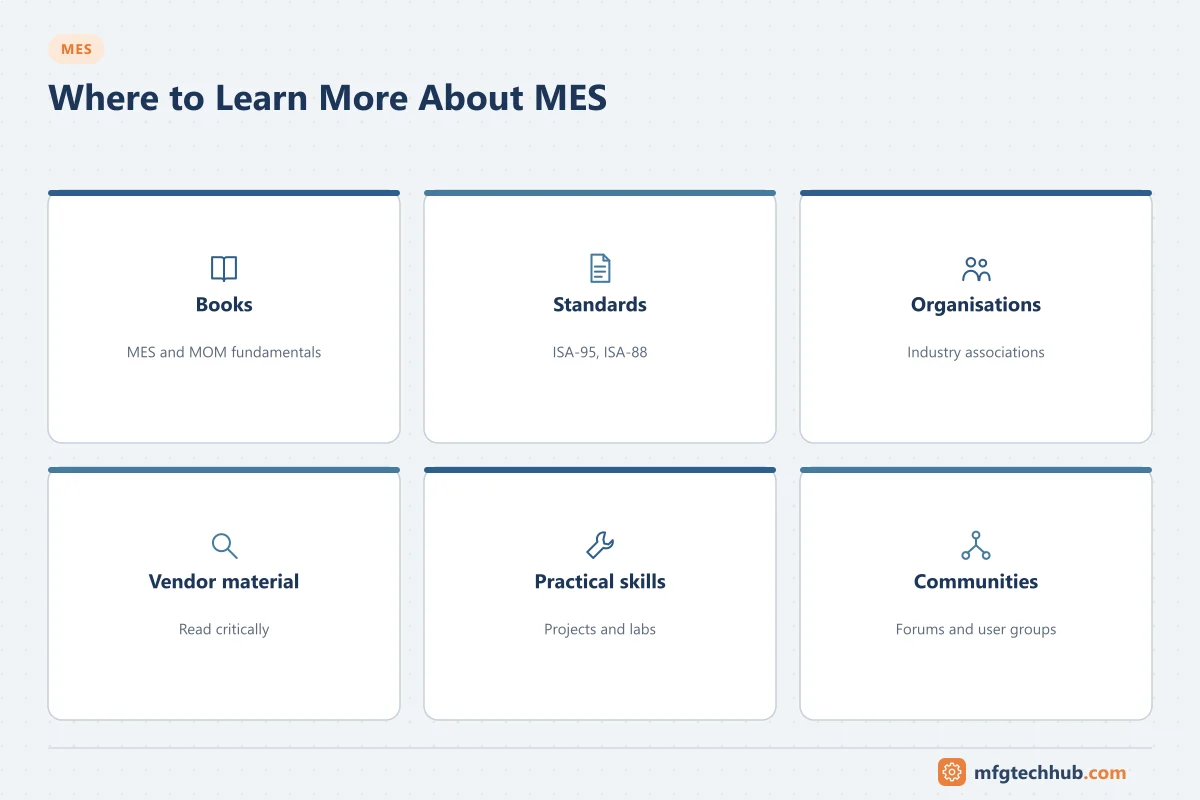
MES knowledge sits between operations management, IT and automation. Good resources cover the standards (ISA-95, ISA-88), the business processes (production, quality, inventory, maintenance operations) and implementation experience. This page lists established resources and explains how to use vendor material without being misled by marketing.
Books
| Book | Author(s) / publisher | Why it is useful |
|---|---|---|
| The Road to Integration: A Guide to Applying the ISA-95 Standard in Manufacturing | Bianca Scholten (ISA) | Practical explanation of ISA-95 models and how to apply them in projects |
| MES Guide for Executives: Why and How to Select, Implement, and Maintain a Manufacturing Execution System | Bianca Scholten (ISA) | Business-oriented guide to MES selection and implementation |
| Manufacturing Execution Systems: Optimal Design, Planning, and Deployment | Heiko Meyer, Franz Fuchs and Klaus Thiel (McGraw-Hill) | MES design and deployment from a European industrial perspective |
| Manufacturing Execution Systems – MES | Jürgen Kletti (editor) (Springer) | Concepts, functions and introduction strategies for MES |
| Applying Manufacturing Execution Systems | Michael McClellan (CRC Press) | One of the early practical books on MES concepts |
| The Hitchhiker’s Guide to Manufacturing Operations Management: ISA-95 Best Practices | Charlie Gifford (editor) (ISA) | Collection of ISA-95 best practices and MOM architecture topics |
| Automation, Production Systems, and Computer-Integrated Manufacturing | Mikell P. Groover (Pearson) | Broad textbook on manufacturing systems, useful context for MES |
| Industry 4.0: The Industrial Internet of Things | Alasdair Gilchrist (Apress) | Context on IIoT architectures that increasingly connect to MES |
Check the publisher for current editions.
Standards
| Standard | Why MES practitioners need it |
|---|---|
| ISA-95 / IEC 62264 | Defines the levels, functions, object models and activity models for manufacturing operations and enterprise integration. See ISA-95 |
| ISA-88 / IEC 61512 | Batch control models and recipe structures, essential for batch MES. See ISA-88 |
| B2MML | XML schemas implementing ISA-95 models for data exchange (published by MESA) |
| ISA/IEC 62443 | Security of automation and MES-connected systems. See ISA/IEC 62443 |
| 21 CFR Part 11 and EU GMP Annex 11 | Electronic records and signatures in regulated manufacturing |
| GAMP 5 (ISPE) | Risk-based approach to computerised system validation in GMP environments |
See MES Standards and Guidelines for how these standards are applied.
Organisations
- MESA International – the main association for manufacturing operations management; publishes models, white papers and B2MML.
- International Society of Automation (ISA) – ISA-95 and ISA-88 standards, books and training.
- ISPE – GAMP guidance for validation in pharmaceutical manufacturing.
- OPC Foundation – OPC UA and companion specifications, increasingly used for machine-to-MES connectivity.
- IPC – electronics manufacturing standards, including IPC-CFX for machine connectivity in electronics assembly.
Using vendor material critically
MES vendors publish useful documentation, webinars and training. Use it well:
- Product documentation and training are the best source for how a specific product works.
- Case studies are marketing: check the baseline, scope and whether results were independently measured.
- Terminology differs between vendors; map their terms back to ISA-95 functions so products can be compared.
- Product names change frequently because of acquisitions and rebranding. Always check the vendor’s current website before relying on a product name or capability.
For a structured way to compare products, see How to Select and Integrate an MES.
Building practical skills
- Learn ISA-95 levels and object models (equipment, material, personnel, process segments, production schedule and performance).
- Map a real process: take one production line and document orders, routings, materials, quality checks and data sources.
- Understand integration: how orders arrive from ERP and how confirmations return; how machine data is collected from PLCs. See How MES Integrates with ERP, SCADA and PLC.
- Practise with data: calculate OEE from shift data using the OEE calculator, then build a downtime Pareto.
- Learn a product: many vendors offer training or trial environments; low-code manufacturing app platforms are also a good way to practise building shop-floor applications.
Frequently asked questions
What is the best way to start learning MES?
Start with ISA-95 (Bianca Scholten’s The Road to Integration is an accessible introduction), then study the main MES functions: order execution, data collection, quality, genealogy and performance analysis. Combine this with hands-on work on a real or simulated production process.
Is MESA International useful for engineers?
Yes. MESA publishes models, white papers and the B2MML schemas, and runs events where practitioners share experiences. It focuses on manufacturing operations management across industries.
Related tutorials
Before you apply this in a plant: this article is for education. Always check the current edition of the relevant standards, the manufacturer's documentation for your exact product and version, and your site's procedures. Safety-related work needs qualified personnel. See our editorial policy.