
MES Data Management and Security: Master Data, Volume, Retention, Integrity, Access and Recovery
On this page
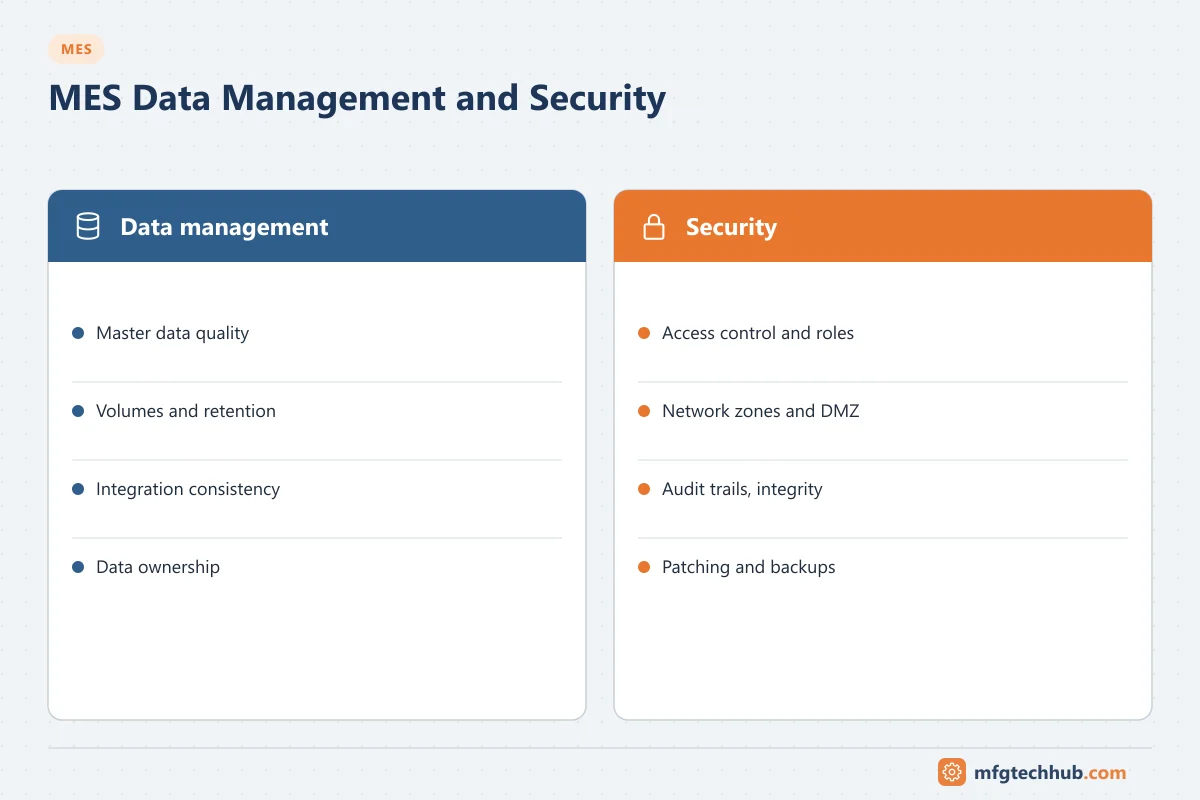
An MES is only as good as its data. If materials, recipes or routings are wrong, the MES enforces the wrong process; if production data lacks context, analysis is meaningless; if records can be changed without trace, they cannot be trusted by quality or regulators; and if the system is compromised or lost, production stops. Data management and security are therefore core design topics, not afterthoughts.
Master data: ownership and quality
| Master data | Typical master system | MES use |
|---|---|---|
| Materials, units of measure | ERP | Material verification, consumption |
| Bills of materials, routings | ERP or PLM | Operations, component checks |
| Recipes, specifications, parameters | PLM, recipe management or MES | Execution and limits |
| Equipment and plant model | MES or asset management | Dispatching, data collection |
| Inspection plans | QMS, ERP QM or MES | Quality checks |
| People and qualifications | HR, LMS | Qualification checks |
Rules that prevent most problems:
- One master per object, synchronised by interface rather than re-entered.
- Named data owners responsible for quality.
- Validation checks before data reaches the shop floor (for example BOM components that exist and are released).
Data model and context
Raw machine data (counts, states, temperatures) becomes useful only with context: which order, product, lot, equipment, shift and operator. Design the context model early, based on the ISA-95 equipment and material models. See MES Data Collection and Integration.
Volume, archiving and retention
| Data type | Volume driver | Typical handling |
|---|---|---|
| Genealogy and serial records | Units produced × components | Keep online for traceability needs; archive with search access |
| Process data (time series) | Tags × sample rate | Store in a historian; MES keeps summaries and links |
| Quality results | Checks × frequency | Keep with the batch or serial record |
| Event and audit logs | Transactions | Retain per policy; protect from change |
Define retention periods by product type and regulation (for example product shelf life plus a defined period, or longer in aerospace and medical devices), and test that archived records can still be retrieved and read.
Data integrity
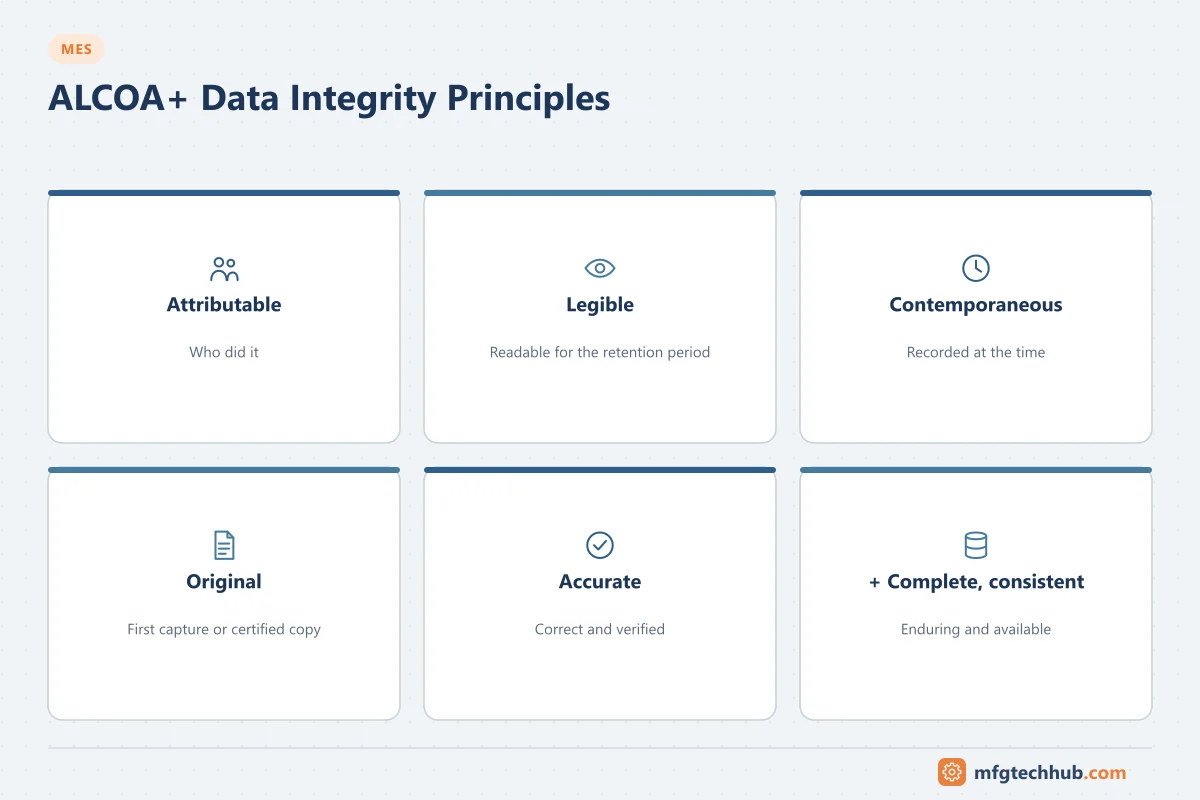
In regulated industries, MES records must follow ALCOA+ principles: attributable, legible, contemporaneous, original, accurate, plus complete, consistent, enduring and available. Practical controls:
- Individual user accounts and electronic signatures; no shared logins.
- Audit trails that record who changed what, when and why, and cannot be switched off by users.
- Time synchronisation across MES, PLCs and historians.
- Controlled handling of manual entries and corrections, with reasons.
- Periodic audit trail review for critical data.
Security architecture
| Layer | Measures |
|---|---|
| Network | MES servers at ISA-95 level 3 in an operations zone; industrial DMZ towards the enterprise; firewalls with defined connections to automation. See MES Network Architecture |
| Identity and access | Central identity management, role-based access, least privilege, multi-factor authentication for administration and remote access |
| Systems | Hardened servers and clients, vendor-approved patching, endpoint protection |
| Interfaces | Authenticated and encrypted connections (for example OPC UA with security, TLS for APIs) |
| Monitoring | Security logging and alerting, reviewed by a responsible team |
Use ISA/IEC 62443 for zones, conduits and security requirements. See ISA/IEC 62443.
Cloud and hybrid considerations
- Data residency and contractual rules for where data is stored.
- Keep execution-critical functions available during WAN outages (edge or plant-level components).
- Shared responsibility: clarify what the provider and the plant each secure.
- In GMP use, supplier assessment and quality agreements. See Cloud-Based MES.
Backup and disaster recovery
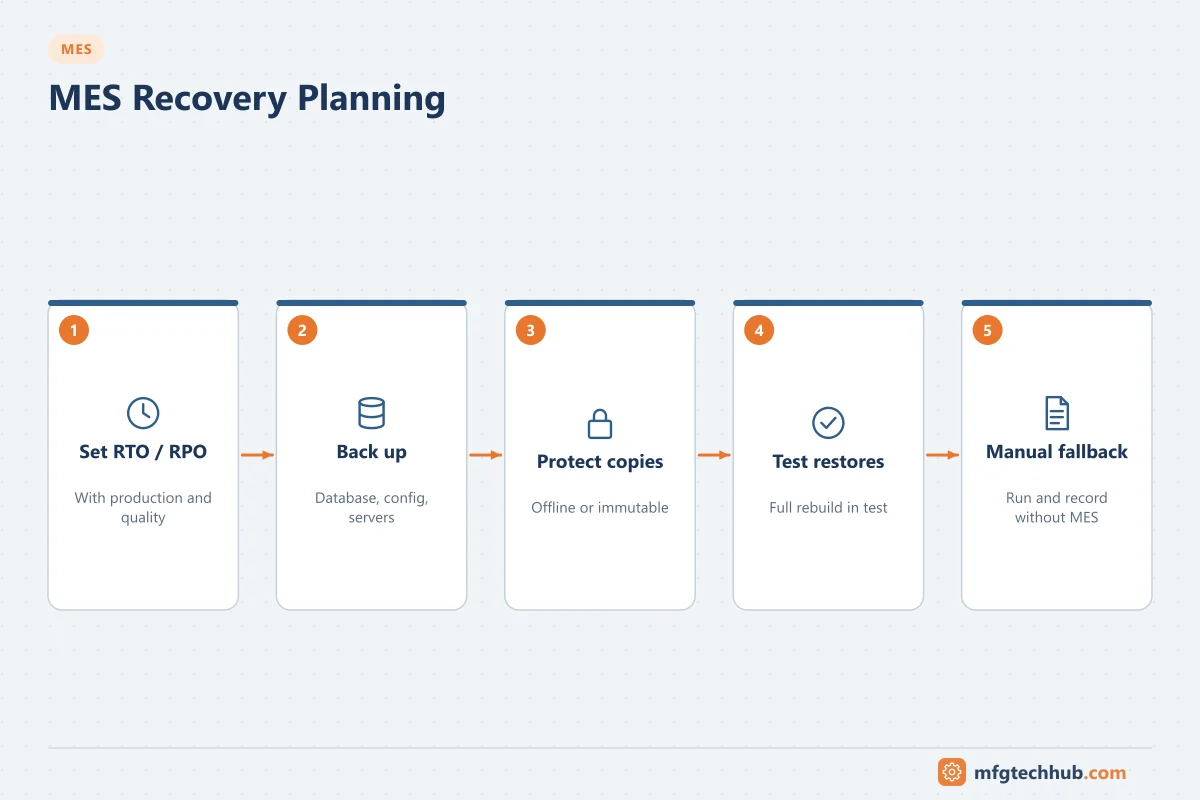
- Define recovery time and recovery point objectives with production and quality.
- Back up databases, configuration and application servers; keep copies offline or immutable against ransomware.
- Test restores regularly, including a full rebuild in a test environment.
- Prepare manual procedures for running production and recording data while the MES is unavailable, and for entering that data afterwards.
See the OT Backup and Restore Runbook.
Data quality checks
| Check | What it detects |
|---|---|
| Counts vs material consumption | Missing or double bookings |
| Unassigned downtime share | Operators not entering reasons, or bad state logic |
| Interface error queues | Messages rejected by ERP or MES |
| Stale data alarms | Machine data not updating while running |
| Manual corrections per shift | Process or usability problems |
Checklist
- Master system and owner defined for each master data object
- Context model (order, lot, equipment, time, person) designed
- Retention periods and archiving tested
- Audit trails, electronic signatures and time synchronisation in place
- MES in a defined security zone with DMZ and firewall rules
- Role-based access, MFA for admin and remote access
- Offline or immutable backups; restore tested
- Manual fallback procedures written and trained
Frequently asked questions
What are the main data challenges in an MES?
Master data quality and ownership, adding context to machine data, managing data volume and retention, ensuring data integrity for regulated records, and protecting the system against security threats and data loss.
How should an MES be secured?
Place it in a defined network zone with an industrial DMZ, use role-based access and multi-factor authentication for privileged access, harden and patch systems, secure interfaces, monitor security events and keep tested offline backups, following ISA/IEC 62443.
How long should MES data be kept?
As long as required by product type, customer contracts and regulations, which can range from a few years to decades in aerospace or medical devices. Define retention per record type and test that archives remain readable.
Key takeaways
- Assign one master and one owner for each type of master data.
- Design the context model and retention strategy early.
- Protect record integrity with audit trails, signatures and time synchronisation.
- Secure the MES with zones, access control and monitoring, and test recovery.
Related tutorials
Before you apply this in a plant: this article is for education. Always check the current edition of the relevant standards, the manufacturer's documentation for your exact product and version, and your site's procedures. Safety-related work needs qualified personnel. See our editorial policy.