
MES in Automotive, Aerospace and Electronics: Industry-Specific Requirements
On this page
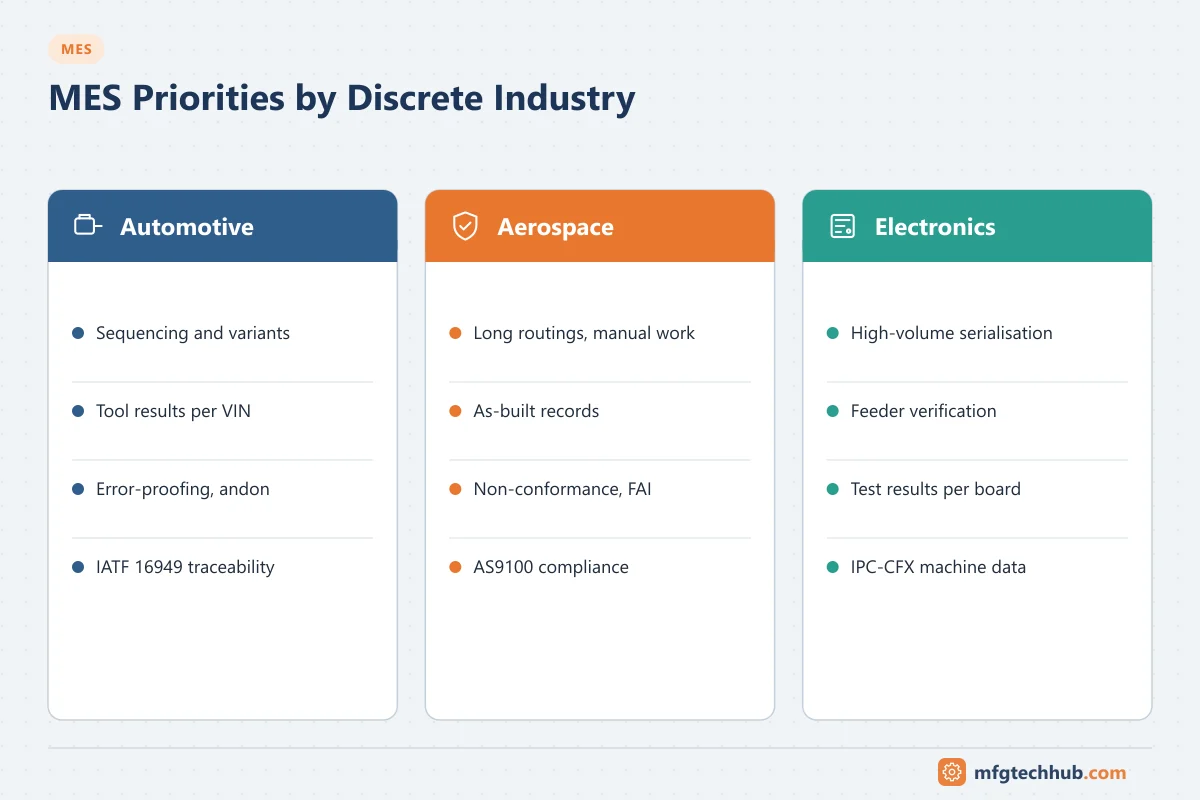
All discrete manufacturers use MES for orders, traceability, quality and performance, but the details differ strongly by industry. An MES that suits an automotive assembly plant may be a poor fit for an aerospace machine shop, and vice versa. This article explains the specific requirements of three demanding discrete industries and what they mean when you specify or select an MES.
For general discrete manufacturing, see MES in Discrete Manufacturing.
Comparison at a glance
| Aspect | Automotive | Aerospace | Electronics |
|---|---|---|---|
| Volume and mix | High volume, many variants on one line | Low volume, very high complexity | High volume, high mix |
| Cycle time | Seconds to minutes per station | Hours to weeks per operation | Seconds per board, many boards per panel |
| Traceability unit | Vehicle (VIN) and safety-critical parts | Serial number of every part and assembly | Board serial and component reel/lot |
| Key quality framework | IATF 16949 | AS9100, AS9102 (first article inspection) | IPC standards, customer requirements, ISO 9001 |
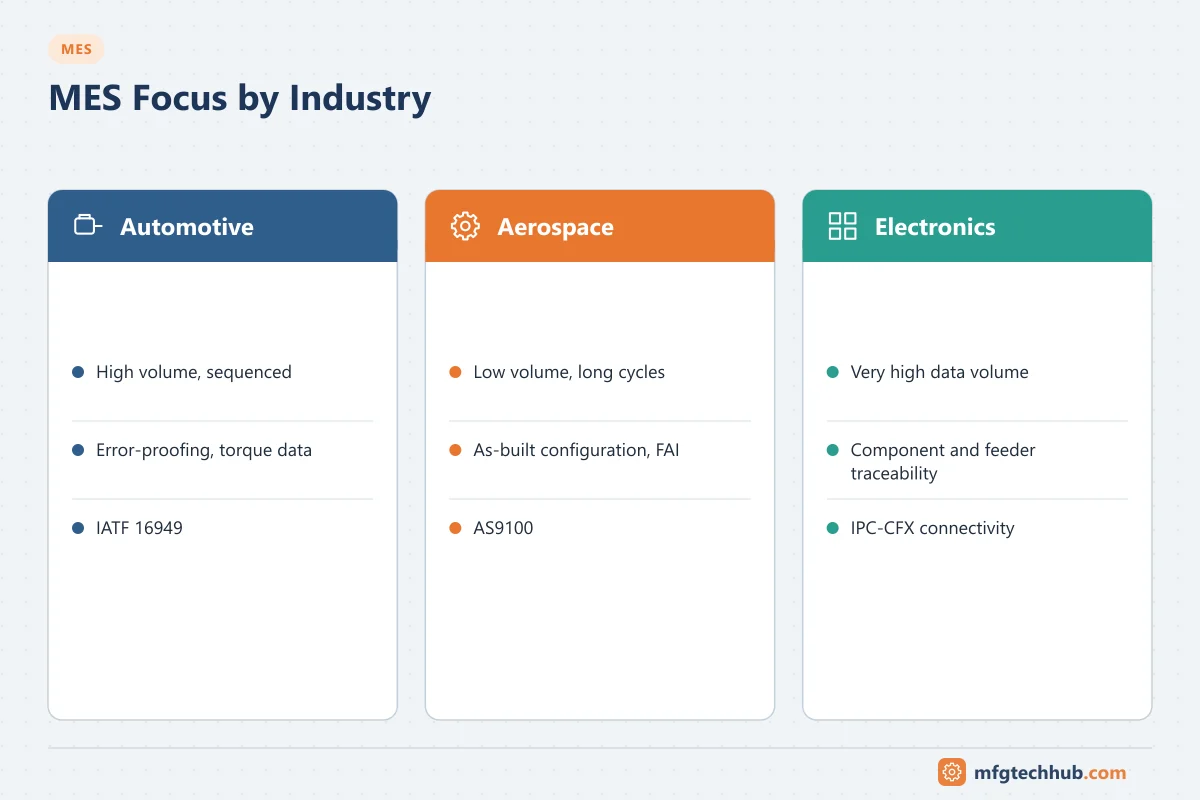
| Distinctive MES function | Sequencing, error proofing, andon | As-built configuration, certified operators, travellers | Machine connectivity, setup verification, test data |
Automotive
Requirements
- Sequencing: vehicles are built in a sequence that varies option by option. The MES receives the sequence (often called broadcast) and supplies suppliers and line-side stations just in sequence (JIS) or just in time (JIT).
- Build instructions per vehicle: each station shows the operations for that specific vehicle’s options.
- Error proofing (poka-yoke): scanning of parts, pick-to-light, verification that the right part and tool program are used.
- Torque and critical-process traceability: tightening results (torque and angle) from nut runners are recorded against the VIN for safety-critical joints; failed joints block the vehicle or trigger rework.
- Andon and line status: operators signal problems; the MES records stops and their causes.
- Genealogy: VIN linked to serial numbers of key components (engines, airbags, ECUs) to support recalls.
What to check when selecting an MES
- Handling of line speeds and sequence changes in real time
- Integration with tightening controllers, vision systems and PLCs
- Rework and repair loops with complete history
- Support for supplier sequencing messages
Aerospace
Requirements
- As-built configuration: every serial-numbered part, its revision and its source recorded against the higher assembly, compared with the as-designed configuration.
- Electronic travellers and work instructions: step-by-step instructions with buy-offs, stamps or electronic signatures, inspection points and data collection.
- Operator qualification: only certified operators can perform certain operations (for example special processes such as welding or non-destructive testing).
- First article inspection (FAI): documentation per AS9102 when a new part or process is introduced or changed.
- Non-conformance management: holds, material review board disposition and rework records.
- Engineering change control: changes flow from PLM with effectivity; work in progress must follow the correct revision.
- Long record retention: records must be kept for the life of the aircraft programme and beyond, as defined by customer and regulatory requirements.
What to check when selecting an MES
- Configuration management and PLM integration
- Electronic signatures and audit trails
- Handling of long, complex operations with many inspection points
- Support for quality management and non-conformance workflows
Electronics
Requirements
- Machine connectivity: SMT placement machines, printers, reflow ovens, inspection (SPI, AOI, X-ray) and test equipment. IPC-CFX (Connected Factory Exchange, IPC-2591) is a widely adopted standard for machine-to-system communication in electronics assembly; IPC-HERMES-9852 standardises board handover between machines in a line.
- Setup verification: scanning component reels and feeders before production prevents wrong-component errors.
- Component traceability: which reel, lot and date code was placed on which board (and sometimes which placement position).
- Moisture-sensitive devices: tracking exposure time of components per J-STD-033.
- Test and repair data: results from in-circuit and functional testers linked to board serial numbers; repair history.
- High data volume: every board generates many records; data retention and performance must be planned.
What to check when selecting an MES
- Native support for CFX and major machine vendors
- Data volume handling and archiving
- Material management at the line (reels, feeders, MSD tracking)
- Test data integration and yield analysis
Common lessons across these industries
- Traceability depth must be defined deliberately. Record what customers, regulations and recall scenarios require; recording everything creates cost without value.
- Integration effort is often larger than the MES itself: PLCs, tightening systems, test equipment, PLM, ERP and quality systems.
- Operator usability matters: fast stations and complex operations both fail if the screens slow people down.
- Plan data volumes from the start, especially in electronics.
See MES Implementation Lessons Learned and MES Integration Guide.
Frequently asked questions
What is just-in-sequence in automotive MES?
Just-in-sequence means parts arrive at the line in exactly the order of the vehicles being built. The MES shares the build sequence with suppliers and line-side logistics so the right variant reaches each vehicle at the right station.
What is an as-built record in aerospace?
An as-built record lists every part, serial number, revision and process actually used to build a specific product. It is compared with the as-designed configuration and kept for the life of the product.
What is IPC-CFX?
IPC-CFX (Connected Factory Exchange, IPC-2591) is an open standard for machine-to-machine and machine-to-system communication in electronics assembly, allowing equipment from different vendors to send standard messages to MES and other systems.
Key takeaways
- Automotive MES focuses on sequencing, error proofing and critical-process traceability.
- Aerospace MES focuses on configuration control, certified operations, travellers and quality records.
- Electronics MES focuses on machine connectivity, setup verification, component traceability and high data volumes.
Related tutorials
Before you apply this in a plant: this article is for education. Always check the current edition of the relevant standards, the manufacturer's documentation for your exact product and version, and your site's procedures. Safety-related work needs qualified personnel. See our editorial policy.