
MES Labour Management: Qualifications, Labour Tracking, Crew Assignment and Privacy
On this page
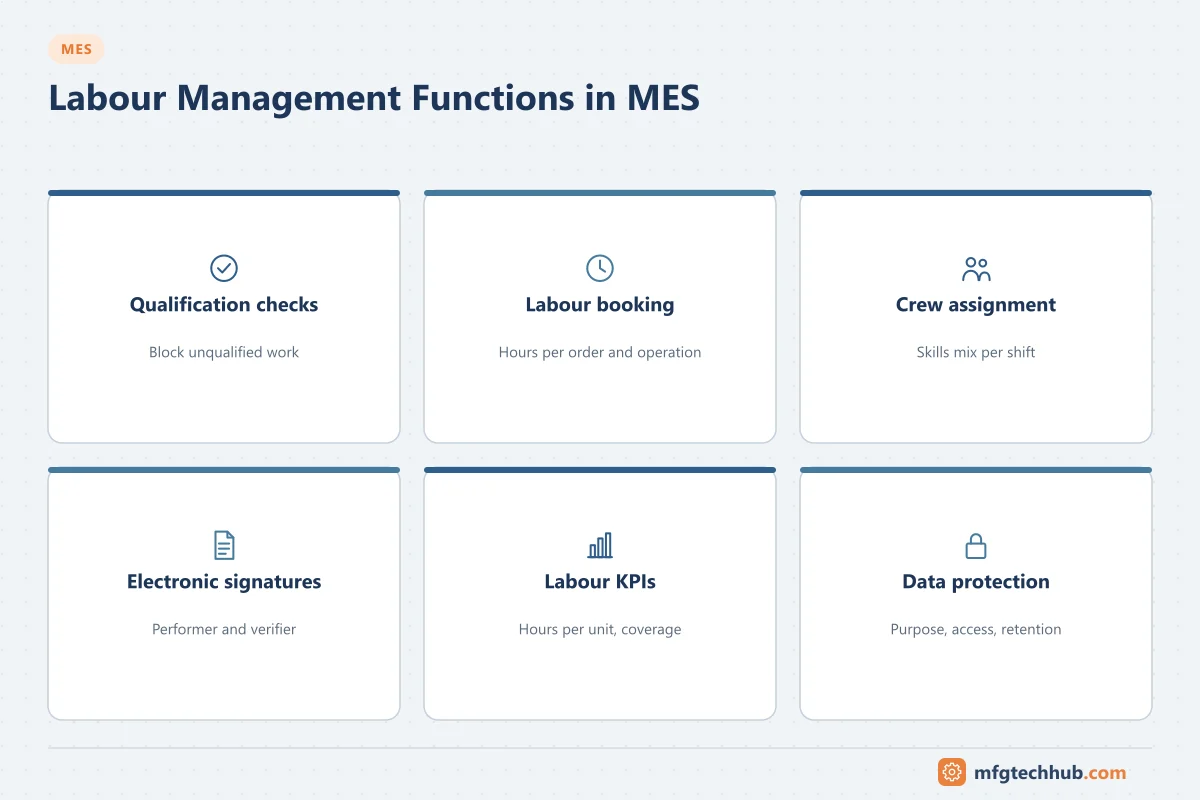
Labour management in an MES is not about payroll or HR administration. It answers shop-floor questions: is this person qualified to do this operation, who performed each step, and how much labour did this order take? Done well, it prevents unqualified work, supports traceability and gives realistic labour costs. Done badly, it becomes a surveillance tool that operators resist.
Who does what: HR, time and attendance, MES
| System | Responsibility |
|---|---|
| HR system | Employees, contracts, organisation, payroll |
| Time and attendance | Clock-in/out, shifts, absences, overtime rules |
| Learning management (LMS) | Training courses and records |
| MES | Who is logged on to which line or station, qualification checks at the point of work, labour booked to orders and operations, electronic signatures on production steps |
The MES usually receives employee and qualification data from HR and LMS systems and sends labour hours per order to ERP for costing. Avoid maintaining the same people data in several systems by hand.
Qualification checks at the point of work
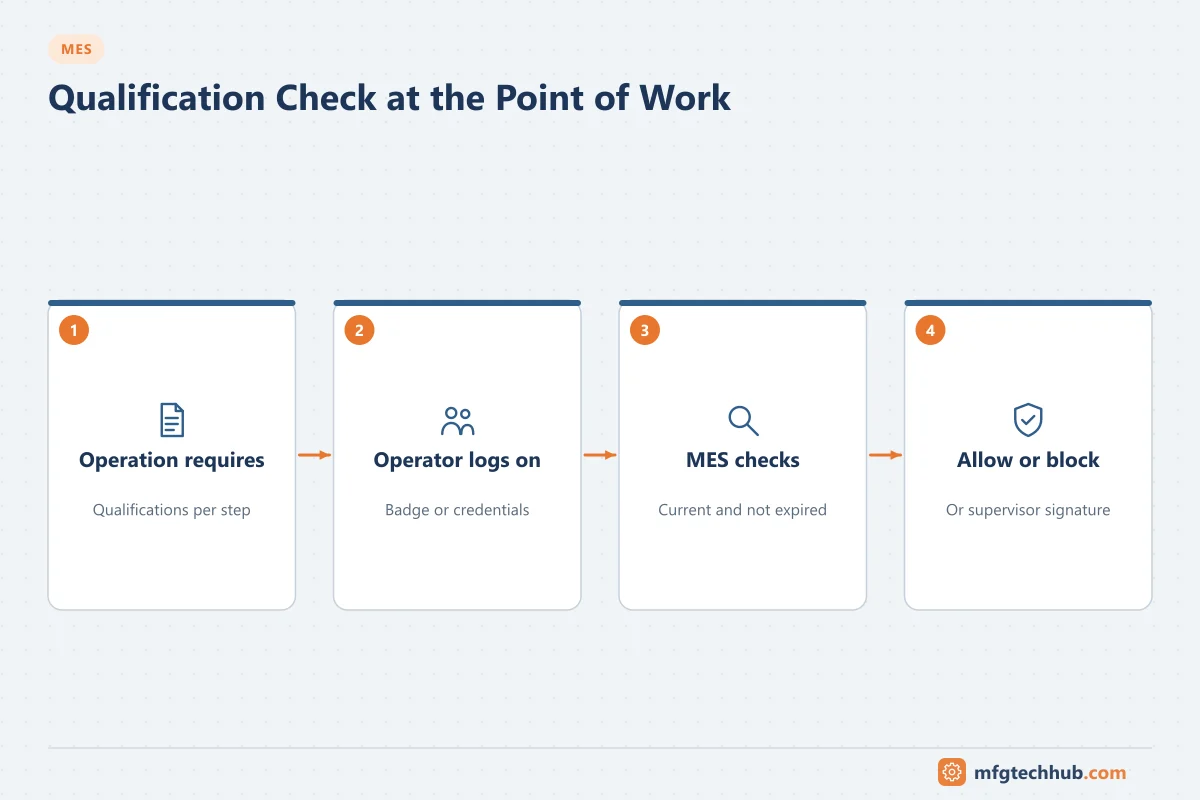
The most valuable labour function in many plants is enforcing qualifications:
- Each operation or equipment type lists the required qualifications (training, certification, medical clearance where relevant).
- When an operator logs on or starts an operation, the MES checks their current qualifications, including expiry dates.
- If a qualification is missing or expired, the MES blocks the action or requires a qualified supervisor to sign.
- Expiring qualifications are reported in advance, so training can be scheduled.
This matters especially in regulated industries (pharmaceuticals, medical devices, aerospace), where only trained and authorised people may perform or verify GMP or safety-critical steps.
Labour booking and tracking
| Method | How it works | Suits |
|---|---|---|
| Log on to a line or work centre | Operators badge in; labour is split across the orders running there | High-volume lines with crews |
| Start/stop per operation | Operator starts and ends each operation or job | Job shops, assembly, repair |
| Automatic from electronic signatures | Each executed step records the performer and verifier | Regulated batch and assembly processes |
Keep booking as simple as possible: every extra scan costs time and reduces data quality.
Crew and shift assignment
- Assign crews to lines per shift, checking that the required skills mix is present.
- Show supervisors gaps (for example no qualified forklift driver or no certified tester on shift).
- Record handover information between shifts together with open issues.
Labour KPIs
| KPI | Meaning | Caution |
|---|---|---|
| Labour hours per unit or per order | Actual labour content | Include indirect time consistently |
| Labour efficiency | Standard hours earned divided by actual hours | Only meaningful with realistic standards |
| Qualification coverage | Share of operations with enough qualified people | Useful for training planning |
| Overtime per line | Signal of capacity problems | Interpret with the schedule |
Use labour data to improve processes and plan capacity, not to rank individuals publicly.
Regulated industries
- Electronic signatures must identify the individual, be linked to the record and follow rules such as 21 CFR Part 11 and EU GMP Annex 11. See Data Integrity (ALCOA+).
- Training records must show that people were qualified at the time of the work, not only today.
- Segregation of duties: the performer and verifier of a critical step must be different people where required.
Data protection and works councils
Labour data is personal data. In many countries, recording who did what and how long it took is subject to data protection law (for example the GDPR in the EU) and, in some countries, co-determination rights of works councils. Practical steps:
- Define the purpose of each type of labour data and collect only what is needed.
- Agree access rights and retention periods.
- Involve employee representatives early where required.
- Prefer team- or line-level performance reporting to individual rankings.
Troubleshooting labour management
| Problem | Likely cause | Remedy |
|---|---|---|
| Operators share one login | Logging on is slow or inconvenient | Badge or RFID log-on; short timeouts |
| Qualified operators blocked | Qualification data not synchronised from LMS | Automated interface and exception handling |
| Labour hours per order implausible | People not logged off, crew splitting rules wrong | Automatic log-off at shift end; review allocation rules |
| Resistance from staff | Data seen as surveillance | Clear purpose, aggregated reporting, involvement of representatives |
Frequently asked questions
Does an MES replace HR software?
No. HR and time-and-attendance systems manage employees, contracts and payroll. The MES uses employee and qualification data at the point of work and records who performed each production step.
How does an MES enforce training requirements?
Each operation lists required qualifications; when an operator starts it, the MES checks that the operator’s qualifications are current and blocks the step or requires a supervisor signature if they are not.
Is labour tracking in MES allowed under data protection law?
It can be, if the purpose is defined, only necessary data is collected, access and retention are controlled, and local rules such as the GDPR and works council agreements are followed.
Key takeaways
- MES labour management checks qualifications, records who did what and books labour to orders.
- Keep HR, time and attendance and LMS as the masters of people data; integrate rather than duplicate.
- In regulated industries, signatures and training records must meet data integrity rules.
- Treat labour data as personal data and use it for process improvement, not surveillance.
Related tutorials
Before you apply this in a plant: this article is for education. Always check the current edition of the relevant standards, the manufacturer's documentation for your exact product and version, and your site's procedures. Safety-related work needs qualified personnel. See our editorial policy.