
Cloud MES vs On-Premise MES: Benefits, Risks and Hybrid Architecture
On this page
“Cloud MES” can mean several different things: a vendor-hosted SaaS product, an MES installed on the manufacturer’s own cloud infrastructure, or a hybrid in which some functions run in the plant and others in the cloud. The right choice depends less on technology fashion and more on what must keep running when the network fails, how the system is validated and changed, and the total cost over its lifetime.
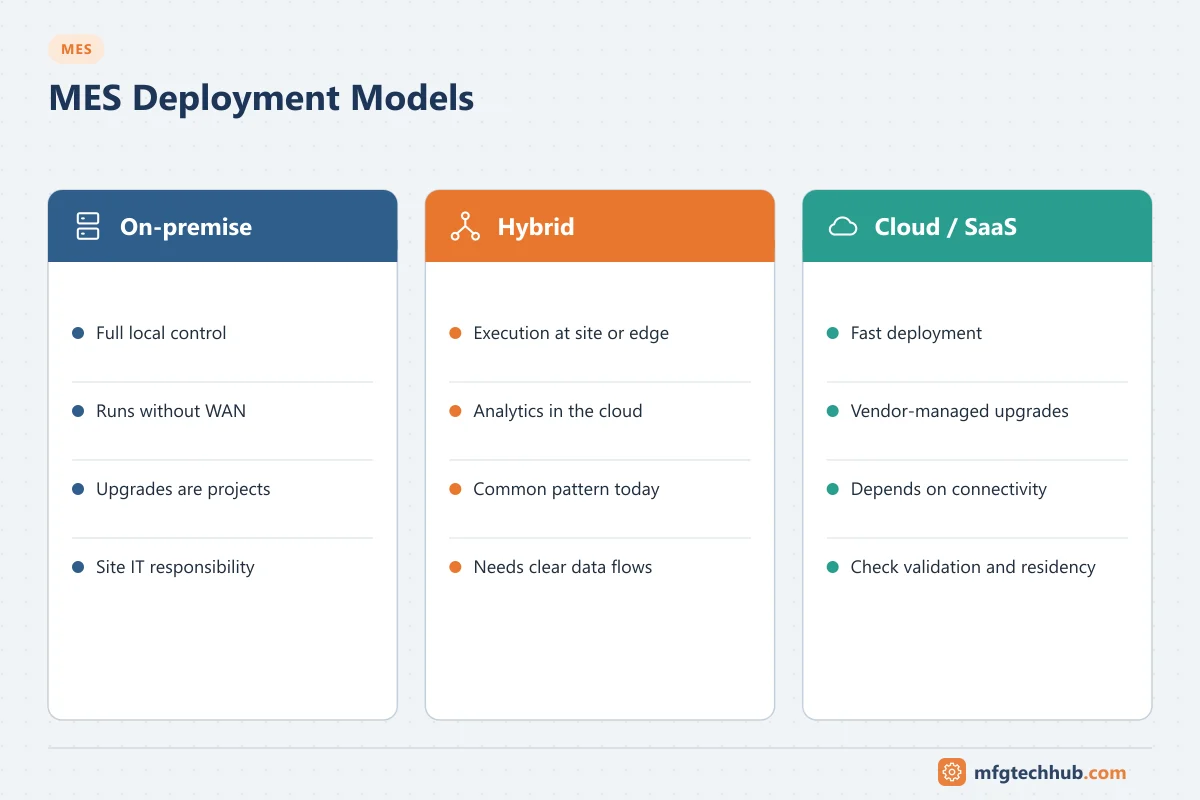
Deployment models
| Model | Description | Who operates infrastructure |
|---|---|---|
| On-premise | MES servers and databases in the plant or company data centre | Manufacturer (IT/OT) |
| Private/customer cloud (IaaS) | Traditional MES installed on virtual machines in a cloud subscription | Manufacturer, on cloud infrastructure |
| SaaS (vendor-hosted) | Multi-tenant or single-tenant MES delivered as a service | Vendor |
| Hybrid | Edge/on-premise components for connectivity and critical execution, cloud for central functions | Shared |
Where cloud MES helps
- Faster multi-site rollouts: one template deployed to many plants without building server rooms at each site.
- Lower upfront infrastructure: fewer local servers, less hardware refresh.
- Central visibility: enterprise dashboards and comparisons across sites.
- Elastic computing for analytics and reporting.
- Vendor-managed updates (for SaaS), reducing upgrade projects.
Where cloud MES is harder
| Concern | Why it matters | Typical mitigation |
|---|---|---|
| Internet or WAN outage | Operators may be unable to start orders, record consumption or print labels | Edge components that run locally and synchronise later; redundant WAN links |
| Latency | Machine interlocks, label printing and scanning need fast responses | Keep time-critical functions at the edge or on-premise |
| Frequent updates | Changes can affect validated processes and user training | Update schedules, release notes, regression testing, sandbox environments |
| Data residency and sovereignty | Some companies or regulations require data to stay in specific regions | Choose regions and contractual terms carefully |
| Cybersecurity | Plant networks connect outward to cloud services | IEC 62443-based zones and conduits, outbound-only connections, DMZ, certificate management |
| Integration | PLCs, scales, printers and scanners are local | Edge gateways and local connectors |
| Cost over time | Subscriptions grow with users, sites and data | Model 5–10 year total cost, including data egress and storage |
| Vendor dependence | Data and configuration held by the provider | Data export rights, exit plan, API access |
Hybrid architecture: the common pattern
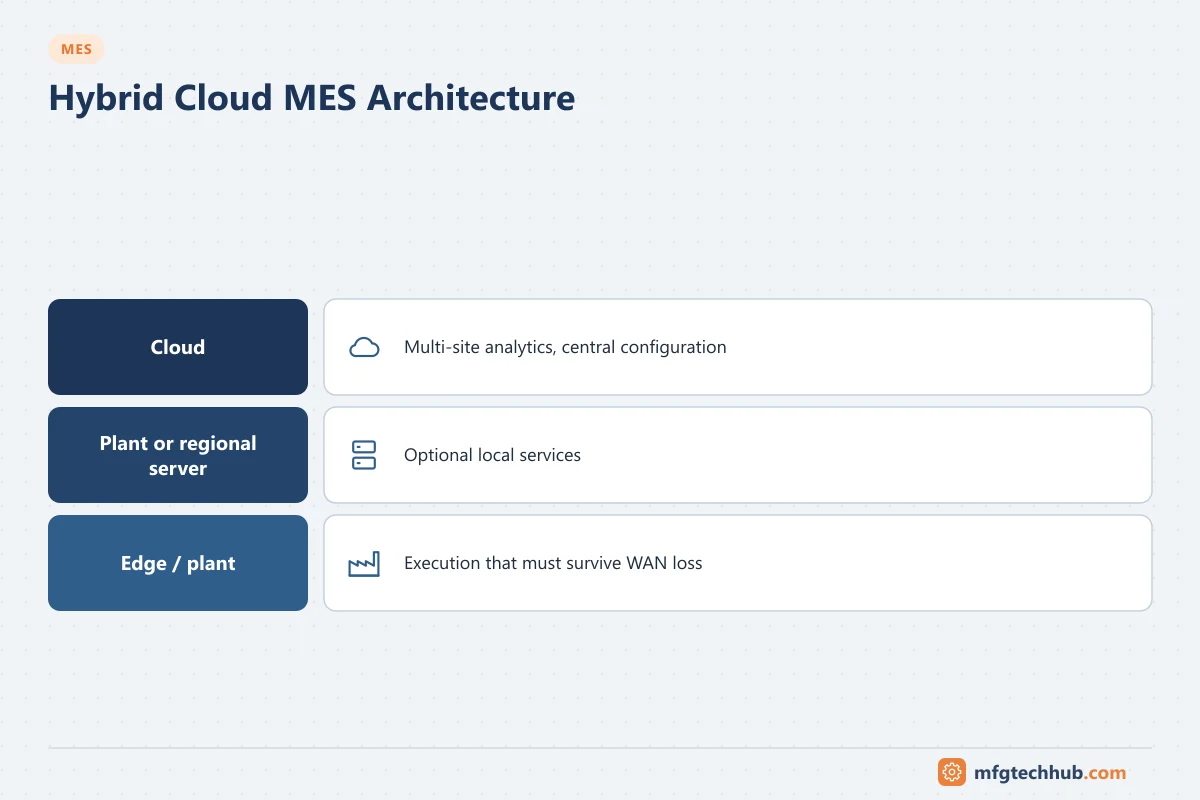
A typical hybrid MES splits functions like this:
| Layer | Runs | Examples |
|---|---|---|
| Edge / plant | Locally, must work offline | Machine connectivity, data buffering (store-and-forward), order execution at the line, scanning, label printing, interlocks with PLC |
| Plant or regional server (optional) | On-premise | Local database, historian, integration with local systems |
| Cloud | Central | Master data, multi-site dashboards, analytics, reporting, AI models, ERP integration |
Design rule: list every shop-floor transaction and ask, “Can production continue if the cloud is unreachable for 8 hours?” If the answer must be yes, that function needs a local path.
Security considerations
- Connections from the plant to the cloud should normally be outbound-initiated through a DMZ or secure gateway; avoid inbound connections into the control network.
- Use TLS with certificate validation, managed certificate lifecycles and strong identity management (single sign-on, MFA for remote users).
- Keep the control network (PLC/SCADA) separate from cloud connectivity. See ISA/IEC 62443.
- Clarify shared responsibilities: what the provider secures and what remains the manufacturer’s responsibility.
Regulated industries (GMP)
Cloud and SaaS MES can be used in regulated manufacturing, but:
- Supplier assessment of the provider’s quality system and development practices is required.
- Validation strategy must address frequent updates, typically with a risk-based approach (computer software assurance principles), vendor documentation and targeted regression testing.
- Data integrity controls (audit trails, electronic signatures, backup, retention) must meet applicable rules such as 21 CFR Part 11 and EU GMP Annex 11.
- Contracts and quality agreements must define responsibilities, change notification and data access.
See Computerised System Validation and Data Integrity (ALCOA+) for the regulatory background.
Decision checklist
- Which functions must work offline, and for how long?
- What response time do line-side operations need?
- Is there a reliable, redundant WAN connection at each site?
- Are there data residency or customer requirements?
- How will updates be tested and approved?
- What is the 5–10 year total cost (subscriptions, edge hardware, network, integration, internal support)?
- Can data be exported in usable form if you change provider?
- Does IT/OT have the skills to operate a hybrid architecture?
Frequently asked questions
Is cloud MES cheaper than on-premise MES?
Not necessarily. Cloud MES usually lowers upfront infrastructure costs and can reduce upgrade effort, but subscription fees, network upgrades, edge hardware and integration continue for the life of the system. Compare total cost of ownership over the expected lifetime.
What happens to production if the internet connection fails?
With a pure cloud design, shop-floor transactions may stop. Well-designed hybrid systems use edge components that keep critical functions running locally and synchronise with the cloud when the connection returns.
Can SaaS MES be customised?
Usually through configuration, extensions and APIs rather than code changes to the core product. This keeps upgrades simpler but may require adapting some processes to the product.
Key takeaways
- “Cloud MES” covers SaaS, customer-hosted cloud and hybrid models; most plants use hybrid.
- Keep time-critical and offline-critical functions at the edge or on-premise.
- Evaluate outages, latency, security, validation, data residency and lifetime cost, not only upfront cost.
Related tutorials
Before you apply this in a plant: this article is for education. Always check the current edition of the relevant standards, the manufacturer's documentation for your exact product and version, and your site's procedures. Safety-related work needs qualified personnel. See our editorial policy.