
MES Implementation Lessons Learned: Typical Projects, Pitfalls and What Works
On this page
Vendor case studies usually describe successful outcomes. The more useful lessons come from how projects actually unfold: where scope grows, where integration takes longer than expected, and why some systems are used enthusiastically while others are worked around.
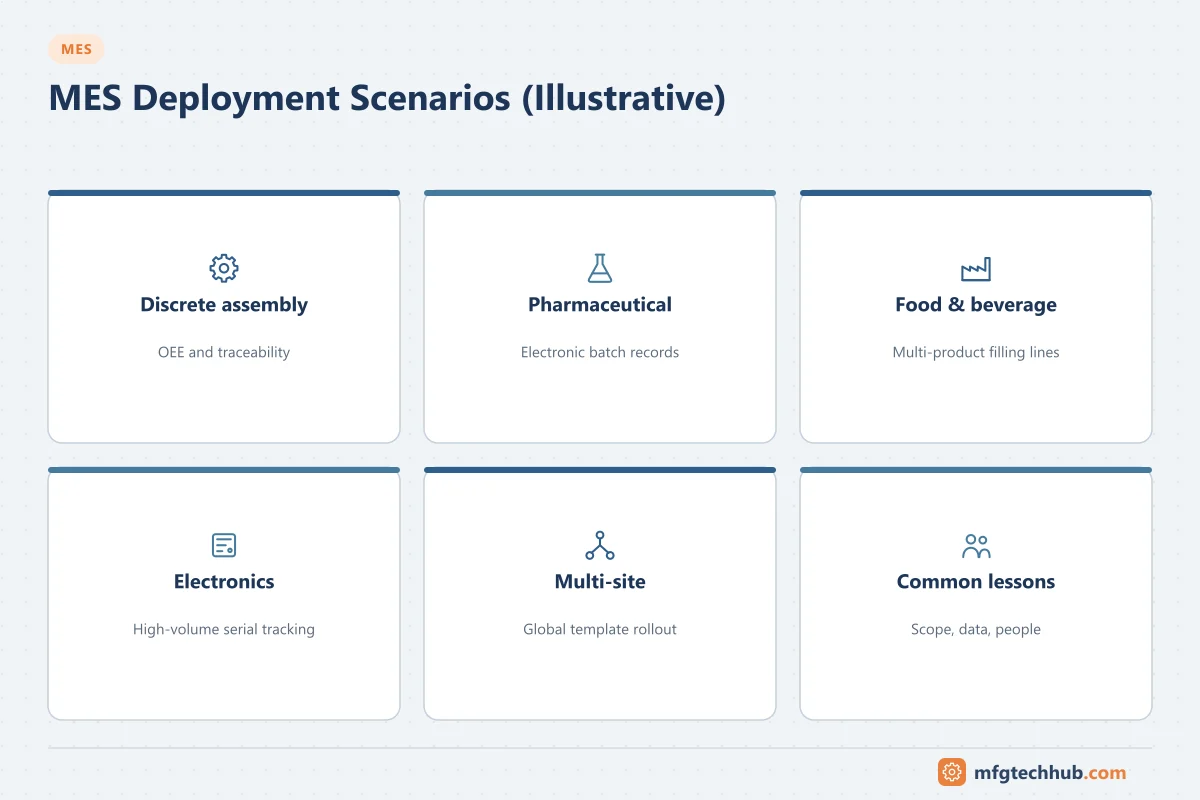
The five scenarios below are illustrative composites based on patterns that recur across MES projects. They are not descriptions of specific companies or products, and the numbers are examples of what to measure, not promised results. For published results, read vendors’ and manufacturers’ own case studies and check how the baseline was measured.
Scenario 1: Discrete assembly plant, OEE and traceability
Starting point: An automotive supplier assembles components on six lines. Production counts are written on shift reports; downtime reasons are estimated. A customer requires serial-number traceability of critical parts.
Scope: Machine data collection from PLCs, downtime reason codes, serial and component traceability, integration with ERP for orders and confirmations.
What went wrong:
- The project started with all six lines at once. PLC programs on older lines did not expose the required signals, and each line needed different changes.
- Downtime reason lists were designed by engineers and had over 80 codes. Operators chose “other” most of the time.
What worked:
- Re-planning to a pilot line first, with a standard PLC interface block (state, counts, reject, current order) then rolled out to other lines.
- Reducing reason codes to a short, two-level list agreed with operators, with automatic state detection from the PLC.
- Showing OEE on line-side screens, so operators saw the benefit of accurate data.
KPIs to track: OEE and its components, unplanned downtime by reason, time to trace a serial number, percentage of downtime with a valid reason.
Scenario 2: Pharmaceutical plant, electronic batch records
Starting point: A solid-dose plant uses paper batch records. Review and release takes days per batch and documentation errors are a frequent source of deviations.
Scope: Electronic batch records (EBR), weighing and dispensing integration, equipment status and cleaning logbooks, ERP integration.
What went wrong:
- Master batch records were converted one-for-one from paper, including steps that only existed because of paper limitations.
- Validation effort was underestimated; every recipe change needed re-testing.
What worked:
- Redesigning the process for electronic execution: automatic checks and calculations, review by exception, fewer manual entries.
- Building reusable, validated recipe building blocks (weighing, charging, sampling), so new products reused tested components.
- A risk-based validation approach aligned with the company’s quality system.
KPIs to track: documentation-related deviations, batch record review time, time from end of production to release, right-first-time batches.
See MES Quality Management and MES in Batch Manufacturing.
Scenario 3: Food and beverage, multi-product filling lines
Starting point: Frequent product changeovers on filling lines, recipe parameters entered manually, and allergen control relying on paper checklists.
Scope: Recipe download to line PLCs, changeover checklists, line clearance, labelling verification, genealogy of ingredients.
What went wrong:
- Recipe parameter ownership was unclear between production, quality and engineering, so recipes were inconsistent in MES and in the PLCs.
- Barcode scanners and label verification were added late, causing rework.
What worked:
- Making MES the single source of recipe parameters, with approval workflow and electronic download to the PLC.
- Enforced line-clearance steps before a new order can start.
- Testing label printing and scanning with the real printers, labels and lighting early.
KPIs to track: changeover time, labelling errors, allergen-related incidents, time to trace an ingredient lot.
Scenario 4: Electronics assembly, high-volume traceability
Starting point: SMT lines produce large volumes of boards; customers require component-level traceability and test result records.
Scope: Integration with pick-and-place machines, reflow ovens, inspection (AOI) and test stations; material verification at feeder setup.
What went wrong:
- The volume of machine data was much larger than expected; database growth and report speed became problems.
- Different machine vendors used different interfaces, and some required separate licences.
What worked:
- Using an industry interface standard where available (the IPC Connected Factory Exchange, CFX, is widely used in electronics assembly) and gateways for older machines.
- Separating high-volume machine data (historian or data platform) from transactional MES data, with defined retention rules.
- Feeder setup verification by scanning reel and feeder, preventing wrong-component errors at the source.
KPIs to track: first-pass yield by line and product, setup errors, time to answer a traceability request, database growth and report response time.
Scenario 5: Multi-site rollout with a global template
Starting point: A manufacturer with plants in several countries wants one MES standard.
What went wrong:
- The global template was designed by the corporate team with limited plant input; local processes did not fit, and sites requested many exceptions.
- Master data (routings, bills of materials, equipment hierarchy) quality differed between plants.
What worked:
- A core template plus controlled local variants, with a design authority deciding what is global.
- A master data readiness check before each site’s rollout.
- Rollout waves with a trained core team moving from site to site, and local key users trained as first-line support.
KPIs to track: time and cost per site rollout, number of local customisations, adoption (percentage of transactions done in MES rather than on paper), support tickets after go-live.
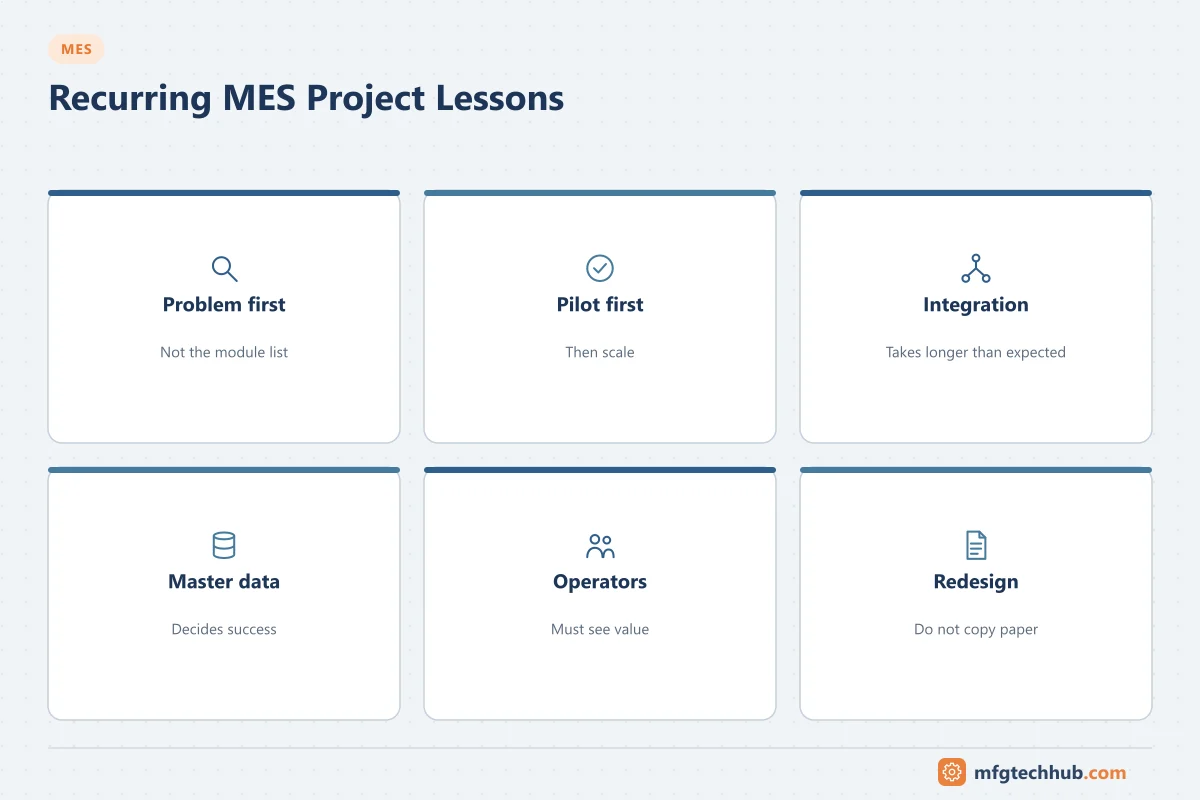
Lessons that recur across projects
| Lesson | Practical action |
|---|---|
| Start with the business problem, not the module list | Define 3–5 KPIs and baseline them before the project |
| Pilot before scaling | One line or area, measured against the baseline |
| Integration takes longer than expected | Inventory every interface early; test with real systems, not only simulators |
| Master data decides success | Clean routings, BOMs, equipment models and material data before go-live |
| Operators must see value | Line-side displays, simpler screens, fewer manual entries |
| Don’t copy paper into software | Redesign workflows for electronic execution |
| Plan for data volumes | Retention rules, archiving and separation of time-series data |
| Change management is part of the scope | Training, key users, communication, support after go-live |
| Governance for customisation | Design authority, template, controlled variants |
Frequently asked questions
Why do MES implementations fail?
Common reasons are unclear objectives, underestimated integration and master data work, too large an initial scope, poor user adoption and weak project governance. Technology is rarely the only cause.
How long does an MES implementation take?
A focused pilot on one line may take a few months; a full plant implementation often takes 6–18 months, and multi-site programmes take several years. Regulated industries need additional time for validation.
Where can I find verified MES case studies?
MES vendors, system integrators and industry associations (such as MESA International) publish case studies. Treat quoted improvements carefully: check the baseline, the scope and whether results were independently measured.
Key takeaways
- Most MES challenges come from scope, integration, master data and adoption, not from software features.
- Pilot first, measure against a baseline, then scale with a template.
- Redesign processes for electronic execution instead of copying paper.
Related tutorials
Before you apply this in a plant: this article is for education. Always check the current edition of the relevant standards, the manufacturer's documentation for your exact product and version, and your site's procedures. Safety-related work needs qualified personnel. See our editorial policy.