
MES for Discrete Manufacturing: Routings, Serialisation, Error-Proofing, Work Instructions and Traceability
On this page
Discrete manufacturing makes countable items: vehicles, aircraft parts, electronics, machines, appliances, medical devices. Products are defined by bills of materials (BOMs) and routings (sequences of operations at work centres), and each unit or lot can be identified, counted and, in many industries, serialised.
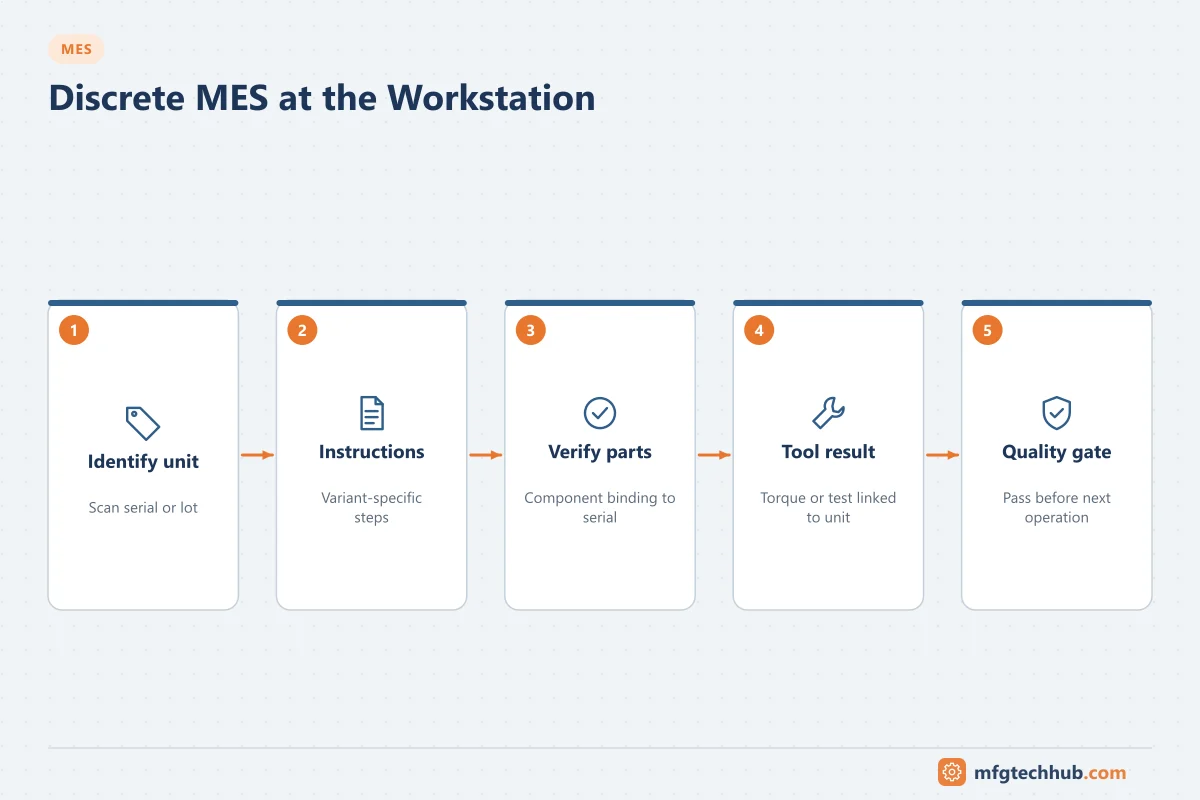
An MES in a discrete plant tracks each unit or lot through its operations, makes sure the right parts, tools and instructions are used at every step, and records what happened. This guide explains the core functions and how to design them.
For the process-industry counterpart, see MES for Process and Batch Manufacturing.
Production types in discrete manufacturing
| Type | Characteristics | MES emphasis |
|---|---|---|
| High-volume repetitive (automotive assembly, consumer electronics) | Paced lines, many variants, short cycle times | Sequencing, error-proofing, fast station integration, andon |
| Batch / lot-based (machined parts, moulded parts) | Lots move between work centres | Lot tracking, WIP, setup and changeover, SPC |
| Engineer-to-order / low volume (aerospace, machinery) | Long routings, complex assemblies, many manual steps | Work instructions, as-built records, non-conformance, operator qualifications |
| Regulated (medical devices, aerospace, defence) | Strict records and traceability | Device history records, serialisation, signatures, first article inspection |
See MES for Make-to-Order and Make-to-Stock for how order strategy changes MES use.
Core functions
Routings, operations and WIP tracking
- The ERP order brings the routing: operations, work centres, standard times and required components per operation.
- The MES starts and completes operations per unit or lot, by scanning at stations or automatically from machine signals.
- WIP tracking shows where every unit or lot is, how long it has waited and which operations remain.
- Rework and repair loops send units to repair stations and back into the routing, with the rework recorded.
Serialisation and traceability
- Serial numbers (or lot numbers for small parts) identify each product, often with direct part marking (laser-etched 2D codes) or labels.
- Component binding: at each station, the serials or lots of installed components are scanned and linked to the parent serial, building the as-built genealogy.
- Genealogy supports targeted recalls: find every product containing a suspect component lot, instead of recalling an entire production period.
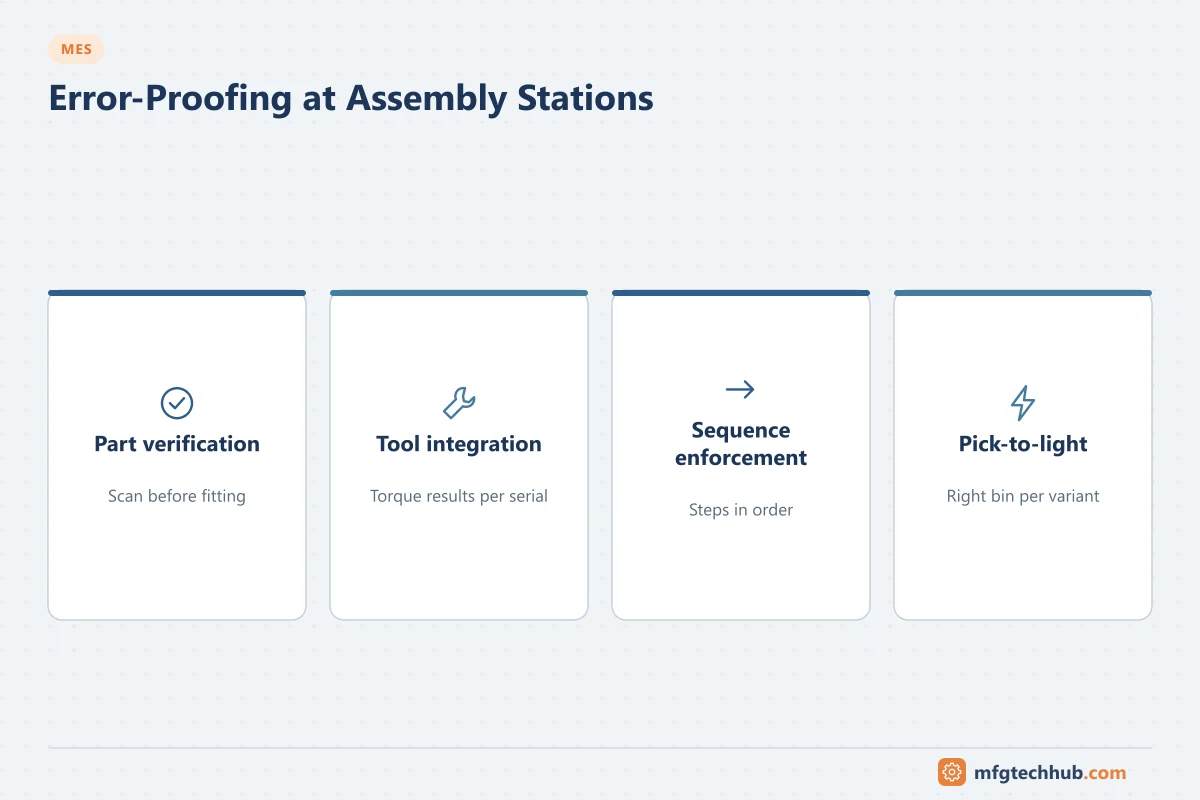
Error-proofing (poka-yoke) and station integration
- Part verification: scanned part must match the BOM for this variant and operation.
- Tool integration: the MES selects the correct program on a DC nutrunner, press, dispensing or welding controller for the variant, and receives the result (torque and angle, force and displacement) linked to the serial.
- Sequence enforcement: an operation cannot be completed until previous operations and required results are OK.
- Pick-to-light and container checks prevent wrong-part picks.
Interlocks that protect people or machines stay in the PLC; the MES provides the product-specific checks. See PLC Programming Best Practices.
Electronic work instructions
- Step-by-step instructions for the specific variant, with images, 3D views or video.
- Required confirmations, scans and measurements at each step.
- Always the released revision of the instructions, with operator qualification checks. See MES Labour Management.
Variants and sequencing
High-mix lines build many configurations on one line. The MES receives the build sequence, provides the right instructions, parts and tool programs per unit, and supports sequenced parts supply from suppliers or the warehouse. See MES Production Scheduling.
Quality gates and non-conformance
- Inspection points and quality gates in the routing: units cannot pass until checks are recorded and OK.
- Test results (end-of-line tests, in-circuit tests, leak tests) linked to the serial.
- SPC on critical characteristics; non-conformance records with disposition (use as is, rework, scrap). See MES Quality Management.
- First article inspection when a new part, process or supplier is introduced (common in aerospace).
Andon and performance
Andon calls (material, quality, maintenance help) raised at stations, with response times tracked, plus OEE and loss analysis per line. See MES Reporting, KPIs and Analytics.
Standards and interfaces relevant to discrete MES
| Standard | Relevance |
|---|---|
| ISA-95 / IEC 62264 | Models and terminology for MES functions and ERP integration. See ISA-95 |
| OPC UA and companion specifications | Machine and robot data with standard information models (for example umati for machine tools, robotics). See OPC UA Explained |
| MTConnect | Read-only data standard for CNC machine tools |
| IPC-CFX (IPC-2591, Connected Factory Exchange) | Standard messaging for electronics assembly equipment and MES |
| IPC-HERMES-9852 | Board handover between machines on electronics assembly lines |
| Quality management standards | For example IATF 16949 (automotive) and AS9100 (aerospace) set expectations for traceability and records that MES helps meet |
| Medical devices | Device history records and electronic records requirements under applicable regulations |
ISA-88 is a batch-control standard; its modular ideas are sometimes borrowed in discrete plants, but it is not a core discrete MES standard.
Industry examples
For automotive, aerospace and electronics in more detail, see MES in Automotive, Aerospace and Electronics.
Troubleshooting discrete MES problems
| Symptom | Likely causes | Check |
|---|---|---|
| Units “lost” in WIP | Operations completed outside the MES; missed scans at transfers | Scan compliance; automatic completion from machine signals |
| Genealogy missing components | Component scans optional or bypassed | Enforce binding at operation completion |
| Tool results not linked to serial | Tool controller not integrated, or result arrives before the unit is identified | Station integration sequence and handshakes |
| Wrong instructions shown | Variant data or revision mismatch between ERP/PLM and MES | Master data synchronisation and revision control |
| Station waits for MES | Slow interface or server response on a paced line | Response times; local buffering; station fallback mode |
Frequently asked questions
What does MES do in discrete manufacturing?
It tracks units or lots through their routings, records WIP, binds component serials and lots to products, enforces error-proofing and quality gates, provides electronic work instructions, integrates tools and test equipment, and reports performance.
What is component binding?
Scanning the serial or lot number of each component installed at a station and linking it to the serial number of the product being built, which creates the as-built genealogy used for recalls and investigations.
Which standards apply to discrete MES?
ISA-95 for functions and ERP integration, OPC UA and its companion specifications and MTConnect for machine connectivity, IPC-CFX and IPC-HERMES-9852 in electronics assembly, and sector quality standards such as IATF 16949 and AS9100 for traceability and records.
Key takeaways
- Discrete MES is built around routings, operations, WIP and serial or lot identity.
- Component binding creates the as-built genealogy that enables targeted recalls.
- Error-proofing, tool integration, work instructions and quality gates prevent defects at the station.
- Use ISA-95, OPC UA, MTConnect and, in electronics, IPC-CFX for integration.
Related tutorials
Before you apply this in a plant: this article is for education. Always check the current edition of the relevant standards, the manufacturer's documentation for your exact product and version, and your site's procedures. Safety-related work needs qualified personnel. See our editorial policy.