
MES Process Management and Monitoring: Recipe Downloads, Parameter Verification, Limits, Holds and Review by Exception
On this page
An MES does not control the process in real time. Loops, sequences, interlocks and safety functions run in PLCs, DCS controllers and safety systems. What an MES does is manage and monitor the process at the order and batch level: make sure the right recipe and parameters are used, the right equipment and materials are ready, the process stays within product specifications, and any deviation is caught and handled before the product is released.
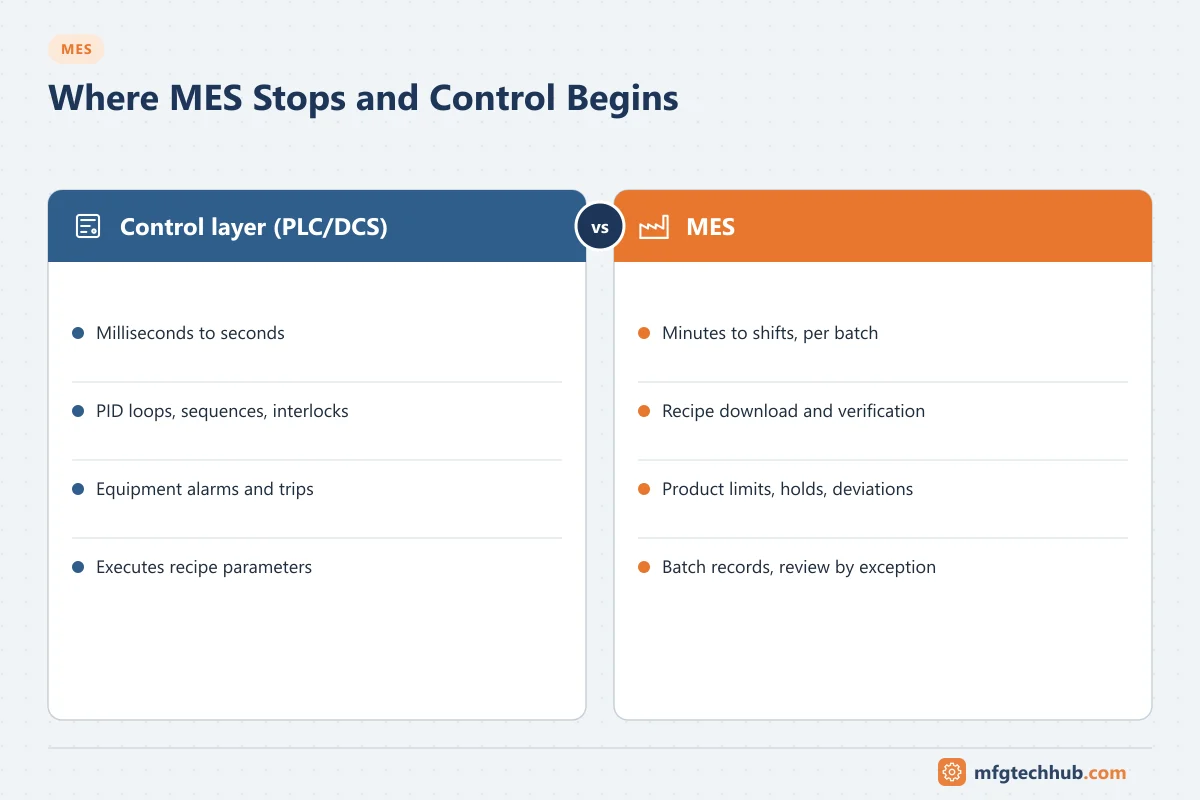
This guide explains that boundary and the MES functions that sit on top of the control layer.
Where MES stops and control begins
| Responsibility | Control layer (PLC, DCS, SCADA) | MES |
|---|---|---|
| Timescale | Milliseconds to seconds | Minutes to shifts, per order or batch |
| PID loops, sequences, interlocks | Yes | No |
| Safety functions | Safety instrumented systems | No |
| Recipe and parameter set for an order | Executes it | Selects, downloads and verifies it |
| Process limits | Alarm and trip limits for equipment and safety | Product specification and quality limits per product and step |
| Response to deviation | Alarm, interlock, trip | Record, notify, hold the order or lot, start a deviation workflow |
| Records | Alarms, events, trends | Batch or device history record, genealogy, deviations, signatures |
In ISA-95 terms, the control layer is Level 2 and the MES is Level 3. For batch processes, ISA-88 defines how recipes and equipment phases split between the two.
Recipe and parameter management
- Master recipes or parameter sets are maintained per product, with versions and approval workflows.
- When an order starts, the MES selects the approved version for that product and equipment.
- The MES downloads parameters to the controller (setpoints, speeds, times, temperatures), usually via a handshake. See MES Data Collection and Integration.
- The MES reads back and verifies the parameters actually loaded, and blocks the start if they differ.
- Changes to parameters during the run are recorded with user, reason and approval where required.
This removes manual setpoint entry, one of the most common sources of product quality errors.
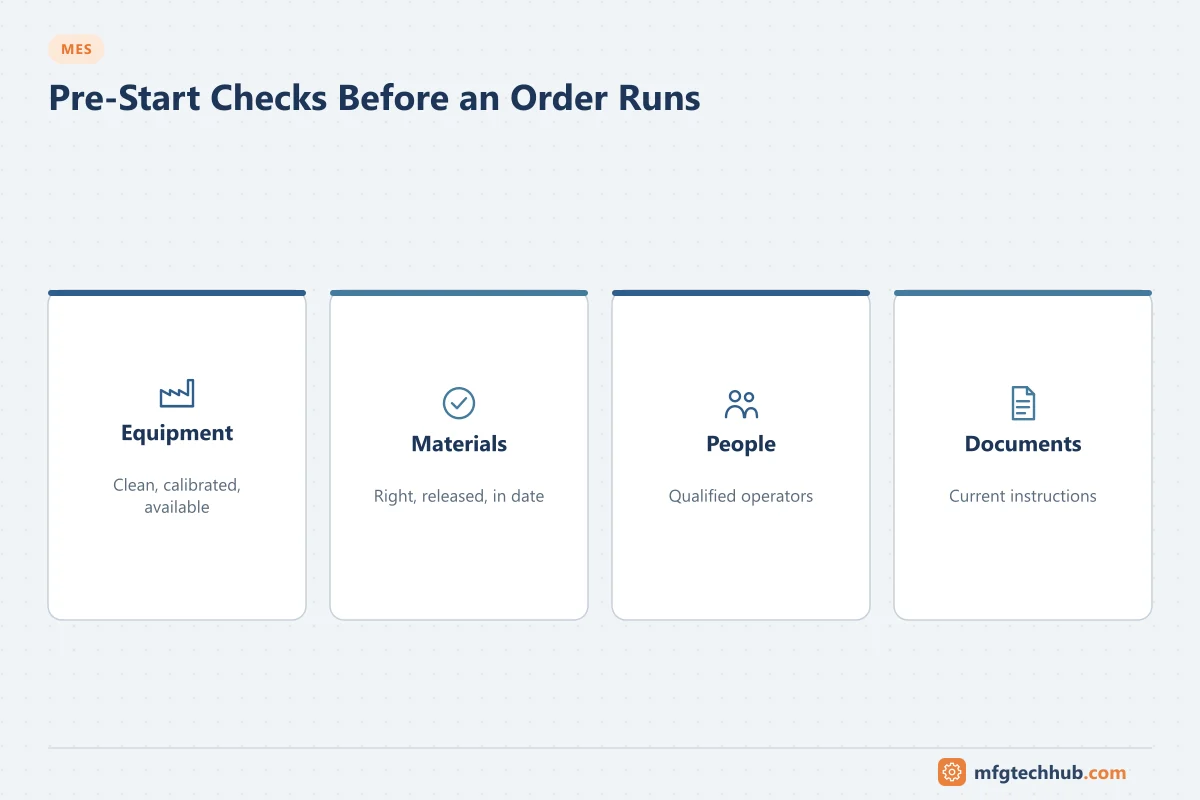
Pre-start checks: is everything ready?
Before an operation starts, an MES can verify:
- Equipment status: clean/dirty status, cleaning expiry, calibration due dates, maintenance holds, line clearance completed.
- Materials: correct material and lot, lot released by quality, not expired, correct quantity.
- People: operator logged in and qualified for the operation. See MES Labour Management.
- Documents: current version of work instructions and specifications.
If a check fails, the MES blocks the start or requires an authorised override, which is recorded.
Monitoring during production
Process parameters against product limits
The MES (often with the historian) monitors critical process parameters against product-specific limits, such as a sterilisation temperature range or a torque window. These are quality limits. They are different from equipment alarms, which stay in the control system; see SCADA Alarm Management.
When a value leaves its limit, the MES records an exception linked to the order, batch or serial number. Depending on the rules, it notifies people, prompts for a comment, or holds the lot.
In-process checks
Scheduled checks (weights, dimensions, visual checks, pH) are prompted at the right step. Results are validated against limits at entry and trigger actions when out of specification.
Statistical process control
For critical characteristics, SPC control charts distinguish normal variation from special causes before products go out of specification. See MES Quality Management.
Electronic work instructions
Step-by-step instructions at the workstation, with required confirmations, scans, measurements and signatures, make manual operations consistent and create the record at the same time.
Deviations, holds and release
- A deviation captures what happened, when, to which product, and what was done, with investigation and approval workflows.
- Holds can be placed automatically on lots or serial numbers affected by an exception, so they cannot be shipped or consumed until quality decides.
- Review by exception: because the MES records all data and flags only exceptions, quality reviewers focus on flagged items instead of checking every value in a paper record. This is one of the main reasons pharmaceutical plants adopt electronic batch records. See Pharmaceutical Manufacturing Automation.
In regulated industries, these functions must meet data integrity and computerised system validation expectations.
Examples by industry (illustrative)
| Industry | MES process management functions |
|---|---|
| Pharmaceuticals | Recipe download and verification, equipment cleaning status, weighing and dispensing checks, electronic batch record, review by exception |
| Food and beverage | Recipe parameters per product, CCP monitoring for food safety plans, allergen changeover checks. See Food and Beverage Automation |
| Automotive and discrete assembly | Tool parameter sets (torque programs) per variant, results linked to serial number, error-proofing (right part, right step) |
| Electronics | Machine programs per product, component verification at feeders, test results per serial number |
Troubleshooting
| Symptom | Likely causes | Check |
|---|---|---|
| Order cannot start | Pre-start check failing: equipment status, material lot not released, operator qualification, recipe not approved | MES start-check messages and master data |
| Parameter verification fails | Download handshake incomplete, controller rejected a value, different units or scaling | Handshake status and values read back from the controller |
| Too many exceptions, reviewers overwhelmed | Limits set too tight, alarm-type events treated as exceptions | Limit definitions and exception rules |
| Exceptions not raised | Monitoring tag disconnected, limits missing for a product | Tag quality and product limit master data |
| Batch record incomplete | Interface or data collection gaps | Interface error queues, historian data for the period |
Frequently asked questions
Does an MES control the process?
No. Real-time control, interlocks and safety functions run in PLCs, DCS controllers and safety systems. The MES manages the process at order and batch level: recipes and parameters, readiness checks, monitoring against product limits, deviations, holds and records.
What is review by exception?
A batch review approach in which the MES records all required data and highlights only exceptions (out-of-limit values, overrides, deviations), so reviewers focus on those instead of checking every entry manually.
What is the difference between an equipment alarm and an MES exception?
An equipment alarm tells the operator to act now and is handled in the control system. An MES exception records that a product-related limit or rule was not met, links it to the affected product, and may place the product on hold for quality review.
Key takeaways
- MES manages and monitors production at order and batch level; controllers do real-time control and protection.
- Download and verify recipes and parameters, and check equipment, materials and people before starting.
- Monitor product-specific limits, run in-process checks and SPC, and link exceptions to affected products.
- Use deviations, holds and review by exception to release product faster and more reliably.
Related tutorials
Before you apply this in a plant: this article is for education. Always check the current edition of the relevant standards, the manufacturer's documentation for your exact product and version, and your site's procedures. Safety-related work needs qualified personnel. See our editorial policy.