
How a Food and Beverage Plant Works: Processing, CIP, Packaging Lines, Traceability and Automation
On this page
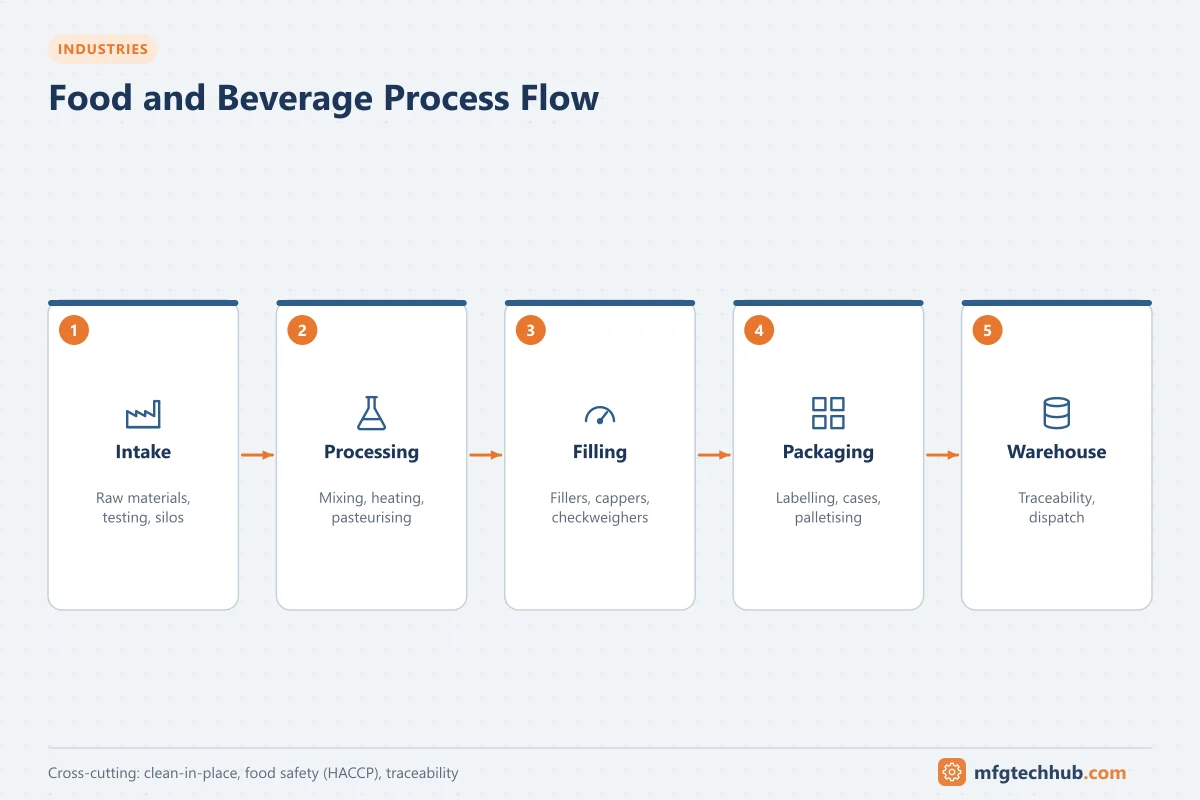
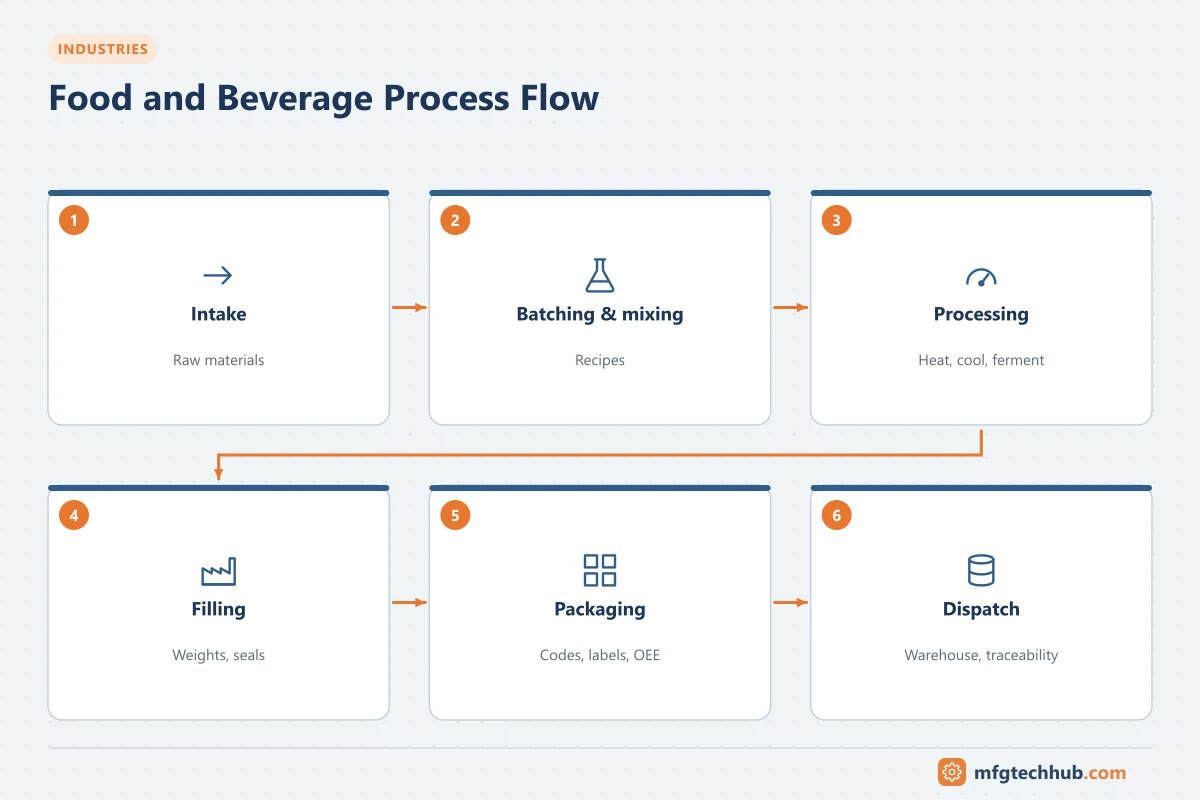
Food and beverage plants turn agricultural raw materials into safe, consistent products at high speed and low margin. Automation priorities are food safety, hygiene, changeover speed, packaging line efficiency and traceability. Many plants combine continuous or batch processing with very fast discrete packaging lines.
See How a Factory Works, which uses a milk pasteuriser as its worked example.
Typical process flow
| Area | What happens | Key automation |
|---|---|---|
| Raw material intake | Receiving milk, grain, fruit, sugar, ingredients; sampling; storage in silos and tanks | Weighbridges, flowmeters, level, temperature; lot registration |
| Batching and mixing | Ingredients dosed by weight or volume into mixers | Load cells, mass flowmeters, recipe control, dosing valves |
| Processing | Cooking, fermentation, pasteurisation, UHT, extrusion, baking, freezing | Temperature and time control, holding tubes, flow diversion, ovens and freezers |
| Filling | Liquids, powders or solids into containers | Fillers, weight control, cap/seal checks |
| Packaging | Labelling, coding, case packing, palletising | Vision inspection, checkweighers, metal detection/X-ray, label and code verification |
| Warehousing and dispatch | Storage and shipping | WMS, pallet labels, temperature monitoring for chilled/frozen products |
Hygiene and clean-in-place
Process equipment is cleaned without dismantling using CIP (clean-in-place). A typical CIP sequence includes:
- Pre-rinse with water
- Caustic (alkaline) wash at controlled temperature, concentration and flow
- Intermediate rinse
- Acid wash (where needed)
- Final rinse and, where required, sanitisation
Automation controls temperature, conductivity (concentration), flow/velocity, time and return verification; the CIP record is part of food safety documentation. CIP also has a large impact on water, energy and chemical use, and on production time.
Hygienic design of equipment and instruments (smooth surfaces, cleanable connections, no dead legs) follows industry guidelines such as EHEDG and 3-A. Instrument selection must consider hygienic process connections. See Pressure Transmitters and How to Select a Flowmeter.
Food safety and quality
- HACCP (hazard analysis and critical control points): critical control points such as pasteurisation temperature, metal detection and chilling are monitored and recorded, often automatically.
- Food safety certification schemes (for example FSSC 22000, BRCGS, SQF) and national regulations define requirements for records and traceability.
- Allergen management: controlled changeovers, cleaning verification, line clearance and correct labelling.
- Label and code verification: vision systems check that the correct label, allergen information, date and lot code are applied.
- Foreign body detection: metal detectors and X-ray systems with verified reject mechanisms.
Packaging lines and OEE
Packaging lines often limit plant output. Key topics:
- Line control and balancing: accumulation between machines, speed control, blockage and starvation detection.
- Machine states and OEE: standard state models (for example based on PackML, ISA-TR88.00.02) make data from different machines comparable. See the OEE calculator.
- Changeovers: recipe download to fillers, labellers and printers; format parts; SMED techniques.
- Reject verification: confirming that rejected products actually leave the line. See PLC Application Examples.
Automation architecture
| Level | Typical systems |
|---|---|
| Field | Hygienic instruments, load cells, flowmeters, valves, drives, vision, checkweighers, metal detectors |
| Control | PLCs for process areas, CIP and each packaging machine |
| Supervisory | SCADA for process and CIP; line management systems for packaging |
| Operations | MES for orders, recipes, genealogy, quality checks, OEE; LIMS for laboratory tests |
| Business | ERP for planning, procurement, inventory and costing; WMS |
Traceability
A recall must identify quickly which raw material lots went into which finished product lots and where they were shipped. Traceability requires:
- Lot registration at intake
- Recording which lots were used in each batch (weighing, dosing, tank transfers)
- Linking batches to packaging lots and pallets
- Shipping records
Continuous processes with tanks and silos make genealogy harder: material from several lots mixes. Plants typically use time-based or tank-based tracking rules. See MES Benefits.
Typical challenges
| Challenge | Good practice |
|---|---|
| Frequent changeovers | Recipe management, standardised procedures, changeover time tracking |
| Many machine vendors on packaging lines | Standard interfaces (state models, OPC UA), line-level data collection |
| Water and energy use | Optimise CIP, heat recovery, monitoring per area. See Energy Management with PLCs |
| Paper-based HACCP records | Automatic recording of critical control points with alarms and reviews |
| Washdown environments | Suitable enclosure ratings and hygienic designs |
Frequently asked questions
What is CIP in food processing?
Clean-in-place is an automated method of cleaning pipes, tanks and process equipment without dismantling them, using controlled sequences of rinses, detergents, temperatures and flows, with records for food safety.
How is OEE used on packaging lines?
OEE measures availability, performance and quality of a line or machine. Collected automatically from machine states and counts, it shows where capacity is lost (stops, slow running, rejects) and guides improvement.
What makes traceability difficult in food plants?
Mixing of lots in silos, tanks and continuous processes, and many manual transfers. Automated recording of transfers and consumption, with clear tracking rules, makes it manageable.
Key takeaways
- Food and beverage plants combine processing, CIP and high-speed packaging, with food safety at the centre.
- HACCP critical control points, allergen control and label verification rely heavily on automation and records.
- OEE, changeovers and traceability are where MES and data collection add most value.
Related tutorials
Before you apply this in a plant: this article is for education. Always check the current edition of the relevant standards, the manufacturer's documentation for your exact product and version, and your site's procedures. Safety-related work needs qualified personnel. See our editorial policy.