
Semiconductor Fab Automation: Wafer Processing, SECS/GEM, AMHS, MES, APC and Facilities
On this page
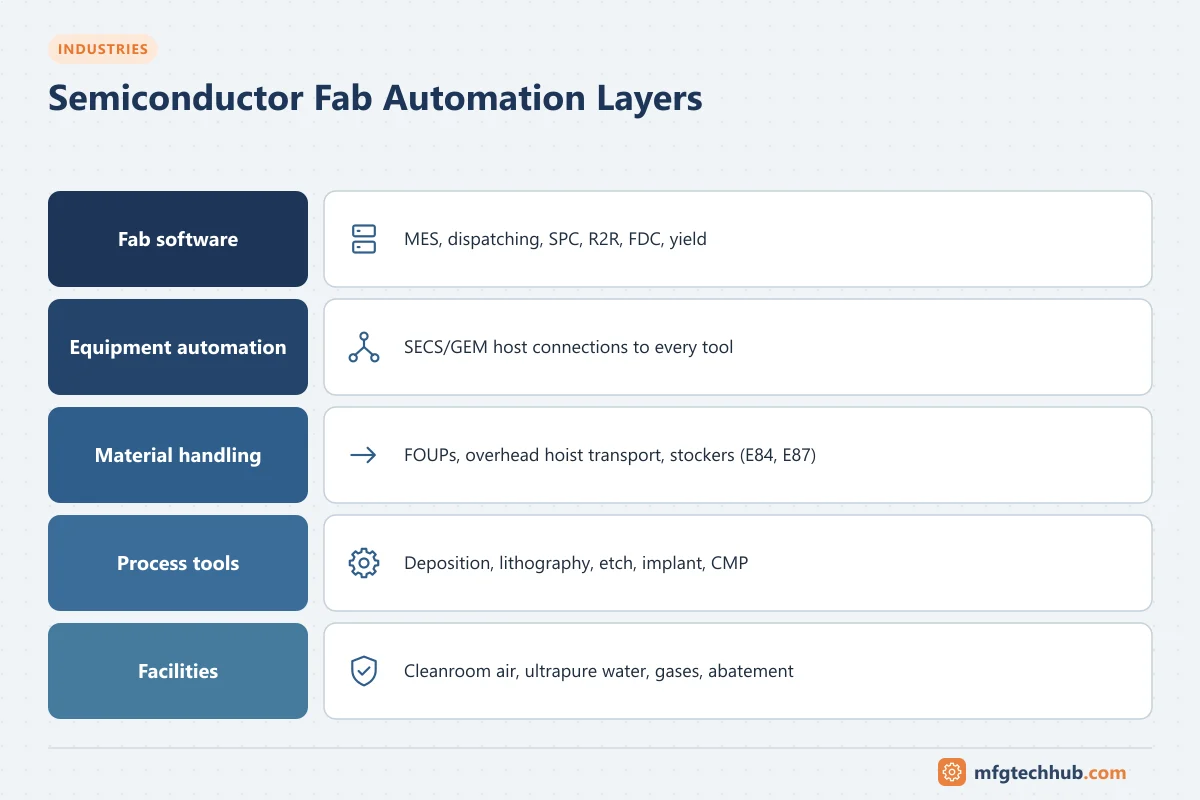
A semiconductor fab is one of the most automated factories in existence. Wafers pass through hundreds of process steps (deposition, lithography, etch, implant, polishing, cleaning) on tools that cost millions each, moved between tools by overhead transport systems, and controlled by software that decides which lot runs on which tool next. Automation here is built around SEMI standards for equipment communication and material handling, rather than the PLC and DCS architectures of other industries.
Front end and back end
| Stage | What happens | Typical units |
|---|---|---|
| Front end (wafer fab) | Circuits are built on wafers through repeated deposition, lithography, etch, implant, CMP and cleaning steps | Lots of wafers carried in FOUPs (front-opening unified pods), commonly 25 wafers of 300 mm |
| Wafer test (probe) | Each die is tested electrically on the wafer | Wafer maps |
| Back end (assembly and test) | Wafers are diced, dies are packaged, packages are tested | Strips, trays, reels |
Equipment integration: SEMI standards
| Standard | Purpose |
|---|---|
| SEMI E5 (SECS-II) | Message format for equipment communication |
| SEMI E37 (HSMS) | Transport of SECS messages over TCP/IP |
| SEMI E30 (GEM) | Generic equipment model: states, events, alarms, remote commands, recipe handling |
| SEMI E84 | Parallel I/O handshake for carrier handoff between transport and tool load ports |
| SEMI E87 | Carrier management at load ports |
| SEMI E40 / E94 | Process jobs and control jobs |
| SEMI E90 | Substrate (wafer) tracking inside the tool |
| Interface A (EDA) | High-volume equipment data collection for analysis |
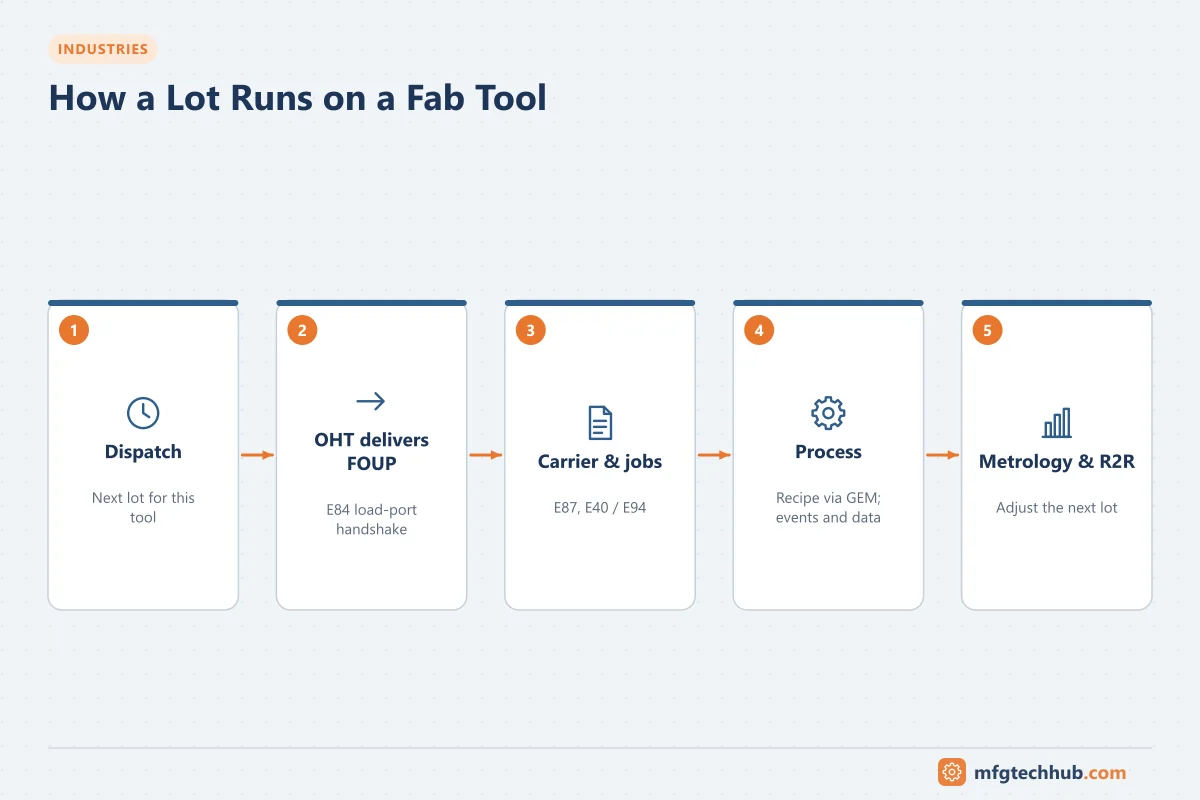
The host software communicates with every tool through GEM: it downloads or selects recipes, starts jobs, receives events and alarms, and collects data. Integrating a new tool is largely a matter of GEM compliance and testing.
Automated material handling (AMHS)
- FOUPs protect wafers and are the unit of transport.
- Overhead hoist transport (OHT) vehicles run on ceiling rails and lower FOUPs directly onto tool load ports.
- Stockers buffer lots between process steps.
- A material control system decides where each carrier goes; SEMI E84 handshakes make handoffs safe.
Fab software
| System | Role |
|---|---|
| MES | Lot tracking, routes and operations, holds, recipes, equipment states; see MES for Discrete Manufacturing |
| Real-time dispatching | Decides which lot runs next on each tool based on priorities, due dates, tool qualification and setups |
| Recipe management | Controls recipe versions on tools |
| Equipment automation / station controllers | Connect tools to MES through GEM |
| Statistical process control (SPC) | Monitors metrology results |
| Run-to-run (R2R) control | Adjusts recipe parameters lot by lot from metrology feedback (advanced process control) |
| Fault detection and classification (FDC) | Monitors tool sensor data to detect abnormal runs quickly |
| Yield management | Links test results, defects and process data to find yield loss |
Data volumes are very high, and analytics are central to yield improvement. See Data Analytics and AI in Manufacturing.
Cleanrooms and facilities
The process depends on a precisely controlled environment:
| Facility system | Control focus |
|---|---|
| Cleanroom air | Particle counts (cleanliness classes per ISO 14644-1), temperature, humidity, pressure cascades |
| Ultrapure water | Resistivity, particles, total organic carbon |
| Process gases and chemicals | Supply, purity, leak detection, toxic gas monitoring |
| Exhaust and abatement | Treatment of process exhausts |
| Vibration and electrical power | Stable conditions for lithography; power quality |
Facilities are typically monitored by a facility monitoring system and controlled with PLCs and building management systems. Safety systems for toxic and flammable gases are critical. See Functional Safety.
Back-end automation
Assembly and test lines (die attach, wire bonding or flip-chip, moulding, marking, test handlers) also use SEMI communication standards, and increasingly electronics-assembly standards such as IPC-CFX for connectivity. Traceability links packaged units to wafers and lots.
Typical challenges
| Challenge | Approach |
|---|---|
| Hundreds of steps and re-entrant flows | Dispatching and scheduling software, capacity models |
| Tool variability | FDC, R2R control, chamber matching |
| Contamination | Cleanroom control, AMHS, minimal human handling |
| Data volume | Interface A, big-data platforms, analytics |
| Uptime of expensive tools | Predictive maintenance, fast recovery |
Frequently asked questions
What is SECS/GEM?
A family of SEMI standards for communication between semiconductor equipment and host software. SECS-II defines messages, HSMS carries them over TCP/IP and GEM defines standard equipment behaviour such as states, events, alarms and remote commands.
What is a FOUP?
A front-opening unified pod: a sealed carrier that protects wafers (commonly 25 wafers of 300 mm) and is moved automatically between tools and stockers.
What is run-to-run control?
An advanced process control method that adjusts recipe parameters for each lot based on metrology results from previous lots, to compensate for tool drift.
Key takeaways
- Fabs are automated around SEMI standards rather than conventional PLC/DCS architectures.
- GEM connects each tool to the host; E84 and E87 manage carriers at load ports.
- MES, dispatching, R2R control and FDC run the fab; data analytics drive yield.
- Cleanroom and facility systems are as critical as the process tools.
Related tutorials
Before you apply this in a plant: this article is for education. Always check the current edition of the relevant standards, the manufacturer's documentation for your exact product and version, and your site's procedures. Safety-related work needs qualified personnel. See our editorial policy.