
How an Oil Refinery Works: Process Units, DCS, Safety Systems, Analysers and Refinery IT
On this page
A refinery converts crude oil into fuels and feedstocks through a chain of continuous process units that run for years between shutdowns. It is a demanding automation environment: thousands of control loops, hazardous materials at high temperatures and pressures, tight product specifications and large economic value in small efficiency gains.
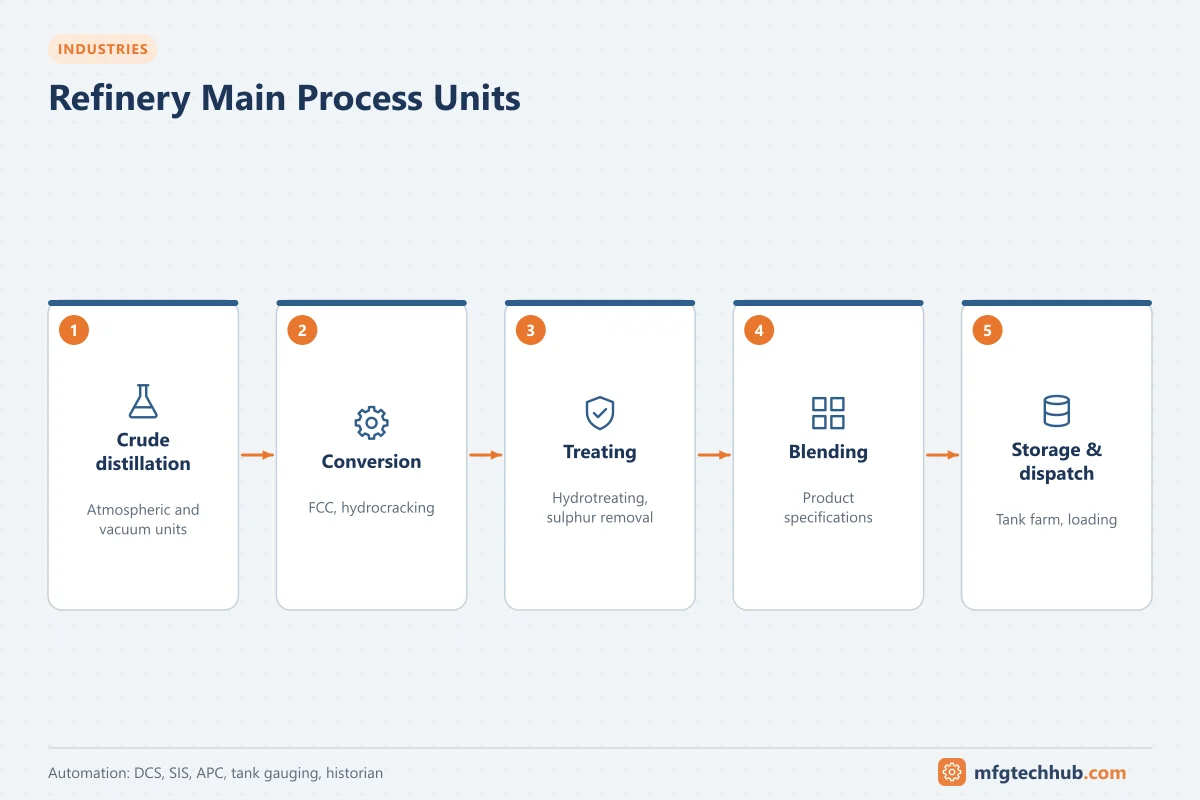
Main process units
| Unit | Purpose | Automation highlights |
|---|---|---|
| Desalter | Removes salt and water from crude | Temperature, interface level, electrical grid control |
| Crude distillation unit (CDU) | Separates crude into fractions by boiling range at near-atmospheric pressure | Furnace control, column pressure and temperature profile, pumparounds, side-draw control |
| Vacuum distillation unit (VDU) | Further separates heavy residue under vacuum | Vacuum systems, furnace control |
| Hydrotreaters | Remove sulfur and other contaminants with hydrogen over catalyst | Reactor temperature control, hydrogen partial pressure, safety systems for high-pressure hydrogen |
| Catalytic reformer | Raises octane of naphtha, producing hydrogen | Multiple reactors and heaters, catalyst regeneration |
| Fluid catalytic cracker (FCC) | Cracks heavy oils into lighter products | Complex reactor–regenerator control, pressure balance, advanced control |
| Hydrocracker / coker | Converts heavy fractions | High-pressure and high-temperature control, batch-like cycles in delayed cokers |
| Blending | Blends components into finished products meeting specifications | Online analysers, blend ratio control and optimisation |
| Tank farm and terminals | Stores crude, intermediates and products; loading | Tank gauging, custody transfer metering, overfill protection |
Utilities include steam and power generation, cooling water, fuel gas, nitrogen, hydrogen, flare systems and wastewater treatment.
Instrumentation
- Large numbers of pressure, temperature, flow and level instruments, many with HART diagnostics. See HART Protocol.
- DP flow (orifices) is still common; Coriolis and ultrasonic meters for custody and critical services. See How to Select a Flowmeter.
- Level measurement in columns, drums and separators using DP, guided wave radar and displacers, including interface levels. See How to Select a Level Transmitter.
- Online analysers: gas chromatographs, NIR, sulfur, octane/cetane-related analysers, oxygen analysers on furnaces, with sample conditioning systems that need careful maintenance.
- Control valves in severe services (high pressure drop, cavitation, erosion). See Control Valves.
Automation and safety architecture
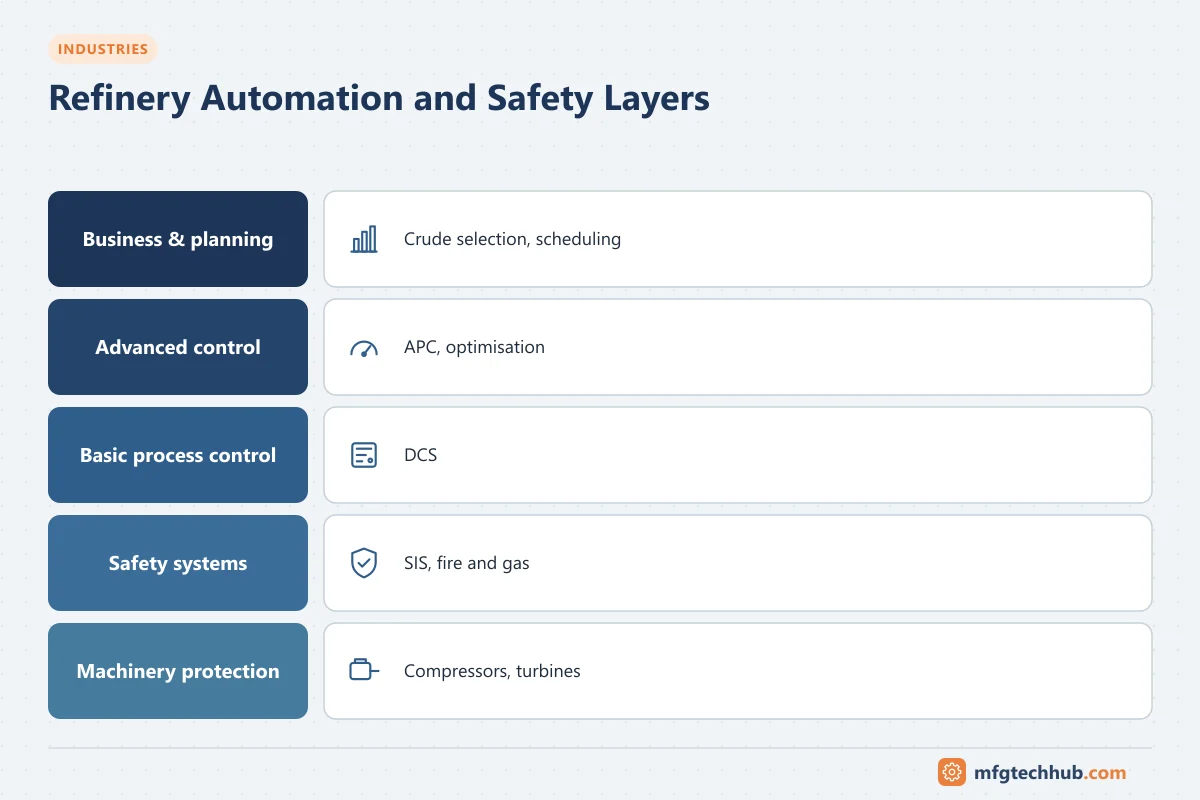
| Layer | Typical systems |
|---|---|
| Basic process control | DCS with redundant controllers and networks. See Why Process Plants Use a DCS |
| Advanced control | Advanced process control (APC), typically model predictive control on major units, and real-time optimisation in some sites |
| Safety instrumented systems | SIS / emergency shutdown (ESD) designed to IEC 61511, burner management for furnaces. See Functional Safety |
| Fire and gas | Gas detection, flame detection and fire protection systems with their own logic |
| Machinery protection | Vibration and machinery protection for compressors and pumps. See Vibration Analysis |
| Supervisory and data | Operator consoles, alarm management, historian, operator training simulators |
| Operations and business | LIMS, tank and movement management, yield accounting, maintenance (CMMS/EAM), refinery planning and scheduling tools, ERP |
Process safety
Refineries handle flammable and toxic materials, so process safety management is central:
- Hazard studies (HAZOP, LOPA) define safety functions and protection layers.
- SIS and relief systems protect against overpressure and other hazards.
- Alarm management (ISA-18.2 / IEC 62682) prevents operator overload during upsets.
- Management of change covers control and safety system changes.
- Regulatory frameworks (for example process safety management regulations in the US or the Seveso directive in the EU) apply depending on location.
Data and optimisation
Margins depend on yields, energy and product quality. Data-driven improvements include:
- APC keeping units close to constraints
- Energy management of furnaces, steam systems and compressors
- Blend optimisation reducing quality give-away
- Yield accounting and mass balances reconciling measurements across the refinery
- Predictive maintenance of rotating equipment and heat exchangers
These depend on reliable instruments, a well-maintained historian and good data context. See Industrial Historians.
Typical challenges
| Challenge | Good practice |
|---|---|
| Long run lengths with limited shutdown windows | Online maintenance capabilities, careful turnaround planning. See Plant Shutdown and Startup Checklist |
| Ageing control systems | Phased DCS migration. See Traditional vs Modern DCS Architecture |
| Analyser reliability | Sample system design and maintenance programmes |
| Alarm floods during upsets | Alarm rationalisation and state-based alarming |
| Cybersecurity | Segmentation, secure remote access, IEC 62443 |
Frequently asked questions
What control system does a refinery use?
Refineries typically use a DCS for process control, separate safety instrumented systems for emergency shutdown and burner management, fire and gas systems, machinery protection systems, and advanced process control on major units, supported by historians and laboratory and planning systems.
What is APC in a refinery?
Advanced process control, usually model predictive control, adjusts multiple setpoints of the basic control loops to keep a unit close to its economic optimum within constraints such as temperatures, pressures and product specifications.
Why are online analysers important?
They measure product quality in near real time, allowing control of specifications, blending and APC without waiting for laboratory results.
Key takeaways
- A refinery is a chain of continuous units (distillation, treating, conversion, blending) with extensive utilities and tank farms.
- DCS, SIS, fire and gas, APC and analysers form the core automation.
- Process safety, alarm management and data-driven optimisation are central to operations.
Related tutorials
Before you apply this in a plant: this article is for education. Always check the current edition of the relevant standards, the manufacturer's documentation for your exact product and version, and your site's procedures. Safety-related work needs qualified personnel. See our editorial policy.