
How to Select a Flowmeter: Comparing Magnetic, Coriolis, Vortex, Ultrasonic, DP, Thermal and More
On this page
No flowmeter technology is best for every application. A magnetic flowmeter that works perfectly on water will not measure oil at all; a vortex meter that is ideal for steam fails at low flows; a Coriolis meter that gives excellent mass flow and density may be impractical on a large water main. This guide gives a structured way to choose.
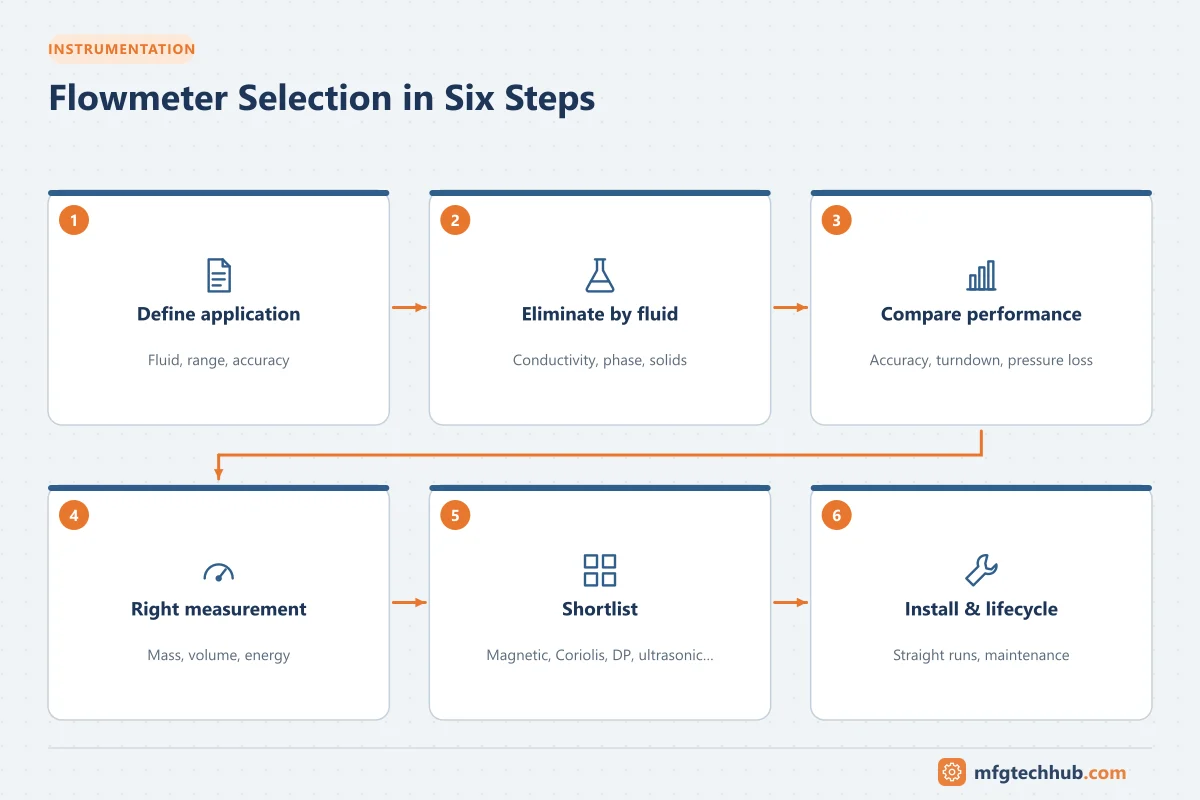
For the working principles of individual technologies, see DP Flowmeters, Electromagnetic and Ultrasonic Flowmeters and Coriolis and Thermal Mass Flowmeters.
Step 1: Define the application
Collect this data before looking at technologies:
| Data | Why it matters |
|---|---|
| Fluid and phase (liquid, gas, steam, slurry, multiphase) | Eliminates technologies immediately |
| Conductivity (liquids) | Magnetic meters need conductive liquids |
| Viscosity, density, cleanliness, solids, bubbles | Affects vortex, turbine, ultrasonic and PD meters |
| Minimum, normal and maximum flow | Determines turndown needed |
| Pressure and temperature (normal and design) | Materials, ratings, compensation |
| Pipe size and material, available straight run | Installation feasibility and accuracy |
| Allowed pressure loss | Energy cost and process constraints |
| Required measurement: volume or mass? | Coriolis and thermal measure mass directly |
| Accuracy and repeatability needed; is it custody transfer? | Custody transfer needs approved meters and systems |
| Hygienic, hazardous area, safety function requirements | Certifications and design |
| Maintenance and budget constraints | Total cost of ownership |
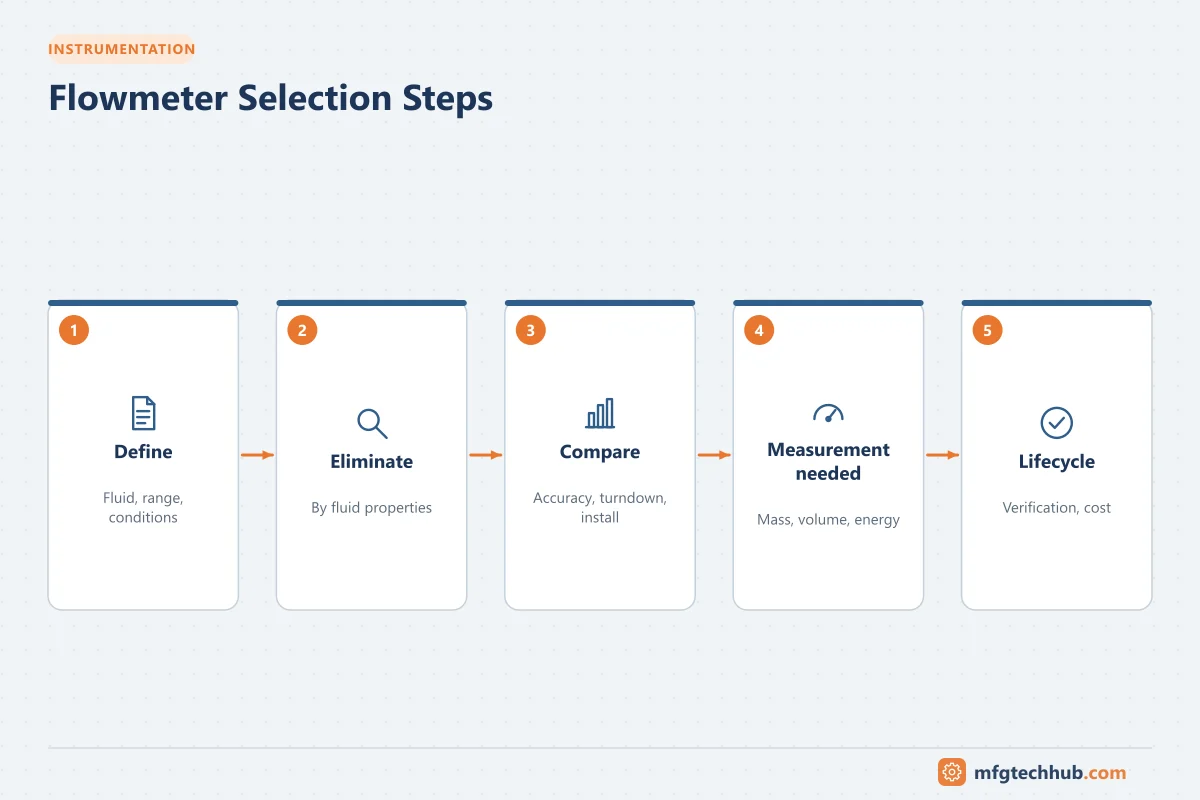
Step 2: Eliminate by fluid
| Technology | Clean liquids | Dirty liquids / slurries | Gases | Steam | Key limitation |
|---|---|---|---|---|---|
| Electromagnetic | Yes (conductive) | Yes | No | No | Liquid must be conductive (non-conductive liquids such as oils and hydrocarbons cannot be measured); full pipe needed |
| Coriolis | Yes | Many | Yes | Limited | Cost and weight at large sizes; pressure drop; entrained gas can affect performance |
| Vortex | Yes | Limited | Yes | Yes | Minimum Reynolds number, so poor at low flows and high viscosity; sensitive to vibration and piping disturbances |
| Ultrasonic transit time | Yes | Limited | Yes (dedicated designs) | Specialised | Needs acoustic path; bubbles and solids can interfere |
| Ultrasonic Doppler | No (needs reflectors) | Yes | No | No | Lower accuracy; depends on particles or bubbles |
| Differential pressure (orifice, venturi, cone) | Yes | Some designs | Yes | Yes | Limited turndown; permanent pressure loss (orifice); straight runs |
| Thermal mass | Limited | No | Yes | No | Gas composition must be known; mainly gases |
| Turbine | Yes (clean) | No | Yes | No | Moving parts wear; viscosity sensitivity |
| Positive displacement | Yes, including viscous | No | Some types | No | Moving parts, pressure drop, can block the line if seized |
| Variable area (rotameter) | Yes | No | Yes | No | Mainly local indication; vertical mounting |
Step 3: Compare performance and installation
| Technology | Typical accuracy class | Turndown | Pressure loss | Straight run needed | Relative cost |
|---|---|---|---|---|---|
| Electromagnetic | High (fraction of a percent of rate) | Wide | None (full-bore) | Low | Moderate |
| Coriolis | Very high (mass); also density | Wide | Moderate to high | Very low | High |
| Vortex | Good | Moderate (limited at low flow) | Moderate | High | Moderate |
| Ultrasonic transit time (inline, multipath) | High | Wide | None | Moderate to high | Moderate to high |
| Ultrasonic clamp-on | Moderate (installation dependent) | Wide | None | High | Low to moderate; no pipe cutting |
| DP (orifice) | Moderate; depends on the whole installation | Limited (square-root relationship) | High (orifice), low (venturi) | High | Low for the element; installation adds cost |
| Thermal mass | Moderate | Wide | Low | Moderate | Moderate |
| Turbine | High on clean fluids | Moderate | Moderate | Moderate | Moderate |
| Positive displacement | High | Moderate to wide | High | Low | Moderate |
| Variable area | Low to moderate | Limited | Moderate | Low | Low |
These are general classes; actual performance depends on the specific product, size, calibration and installation. Always compare manufacturers’ specifications at your operating conditions.
Note on straight runs: many meters need a certain length of straight pipe upstream and downstream of bends, valves and reducers so that the flow profile is fully developed. Requirements vary from almost none (Coriolis, most magnetic meters) to many pipe diameters (vortex, DP, ultrasonic). Flow conditioners can reduce the required length. For orifice plates, ISO 5167 defines installation requirements.
Step 4: Consider the measurement you actually need
- Mass flow (for reactions, batching, custody transfer by mass, gas flow): Coriolis or thermal mass directly, or volumetric flow with pressure and temperature compensation (multivariable DP, vortex with compensation).
- Energy (steam, heating and cooling): steam flow with pressure and temperature, or heat meters combining flow and temperature difference.
- Totalised volume (billing, inventory): meters and totalisers with suitable approvals for custody transfer.
- Density or concentration: Coriolis meters also measure density, which can indicate concentration.
Step 5: Practical decision shortcuts
| Application | Common first choice | Alternatives |
|---|---|---|
| Water, wastewater, slurries, chemicals (conductive) | Electromagnetic | Ultrasonic |
| Hydrocarbon liquids, oils | Coriolis (small/medium sizes), turbine or ultrasonic (large) | PD for viscous liquids |
| Steam | Vortex or DP (orifice, venturi, cone) | Multivariable DP for compensated flow |
| Compressed air and industrial gases | Thermal mass or vortex | DP, ultrasonic |
| Natural gas (custody) | Ultrasonic or turbine meters in approved metering systems | Coriolis |
| Batching and dosing | Coriolis (mass) or magnetic | PD |
| Hygienic food and pharmaceutical | Magnetic or Coriolis with hygienic designs | Ultrasonic |
| Existing pipe, no shutdown possible | Clamp-on ultrasonic | Insertion meters |
| Large water mains | Electromagnetic or ultrasonic | Insertion meters |
Step 6: Installation and lifecycle checks
- Full pipe: most meters must run full; install in vertical upward flow or at low points for liquids.
- Grounding: magnetic meters need correct grounding (rings or electrodes) for accurate measurement, especially in plastic or lined pipes.
- Vibration: vortex and Coriolis meters need attention to pipe vibration and support.
- Bypass and isolation for maintenance where the process cannot stop.
- Verification: many modern meters offer in-situ verification of the electronics and sensor, which can support longer calibration intervals where justified.
- Diagnostics and communication: HART or digital protocols provide diagnostics such as empty pipe, coating or gas entrainment. See HART Protocol Explained.
- Total cost of ownership: purchase, installation (straight runs, flanges, supports), pressure-loss energy cost, maintenance and calibration.
Common selection mistakes
- Choosing by habit rather than by fluid properties (for example a magnetic meter on a non-conductive liquid).
- Oversizing the meter so normal flow sits at the bottom of its range, where accuracy is poor (particularly vortex).
- Ignoring the pressure-loss energy cost of orifice plates on large, continuously running lines.
- Not providing the straight runs the chosen technology needs.
- Specifying custody-transfer accuracy where process-control repeatability would be enough, or the reverse.
Frequently asked questions
Which flowmeter is the most accurate?
Coriolis meters generally offer the highest accuracy for mass flow of liquids, and well-installed magnetic and multipath ultrasonic meters are also very accurate. However, the best meter is the one that suits the fluid and installation; an accurate meter installed badly performs poorly.
Can a magnetic flowmeter measure oil?
No. Magnetic flowmeters require an electrically conductive liquid. Oils and most hydrocarbons are not conductive enough.
What flowmeter is best for steam?
Vortex and differential pressure meters are the most common choices for steam, often with pressure and temperature compensation to calculate mass flow.
Key takeaways
- Start with the fluid and the measurement you need, then narrow down by range, accuracy, pressure loss, installation and cost.
- Magnetic for conductive liquids, Coriolis for mass and density, vortex or DP for steam, thermal or vortex for gases, clamp-on ultrasonic for retrofits.
- Installation (full pipe, straight runs, grounding, vibration) determines real performance.
Related tutorials
Before you apply this in a plant: this article is for education. Always check the current edition of the relevant standards, the manufacturer's documentation for your exact product and version, and your site's procedures. Safety-related work needs qualified personnel. See our editorial policy.