
Industrial Generators and Emergency Backup Power Systems
On this page
When the utility supply fails, standby generators keep critical processes, safety systems, lighting and essential services running for hours or days. Combined with UPS systems for the few seconds before a generator starts, they form the backbone of a plant’s emergency power system. A generator that fails to start or cannot accept the load when needed is worse than useless, so design, testing and maintenance matter.
Main components
| Component | Function |
|---|---|
| Engine | Usually diesel, sometimes gas or dual-fuel |
| Alternator | Converts mechanical energy to electrical power |
| Governor | Controls engine speed and therefore frequency |
| Automatic voltage regulator (AVR) | Controls alternator excitation and output voltage |
| Generator controller | Starting, stopping, protection, metering and communication |
| Fuel system | Day tank, bulk storage, transfer pumps |
| Cooling and exhaust systems | Radiators, ventilation, silencers |
| Starting system | Batteries and chargers (or air start on large units) |
Generator ratings (ISO 8528-1)
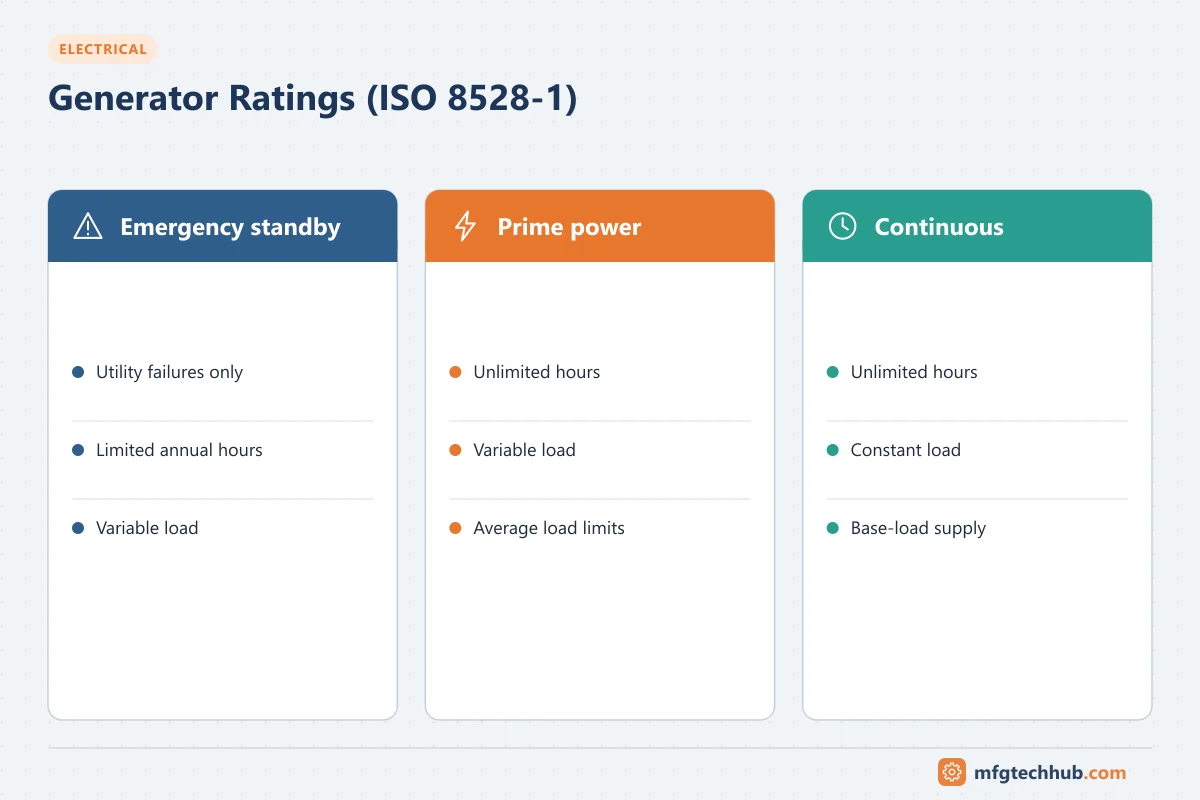
| Rating | Meaning |
|---|---|
| Emergency standby power (ESP) | Maximum power during utility outages, with limited annual running hours; no overload capability |
| Prime power (PRP) | Unlimited hours at variable load, with an average load limit |
| Continuous operating power (COP) | Constant load for unlimited hours |
Selecting a generator on its standby rating and then running it as a prime power source shortens its life and may void the warranty.
Automatic transfer switches (ATS)
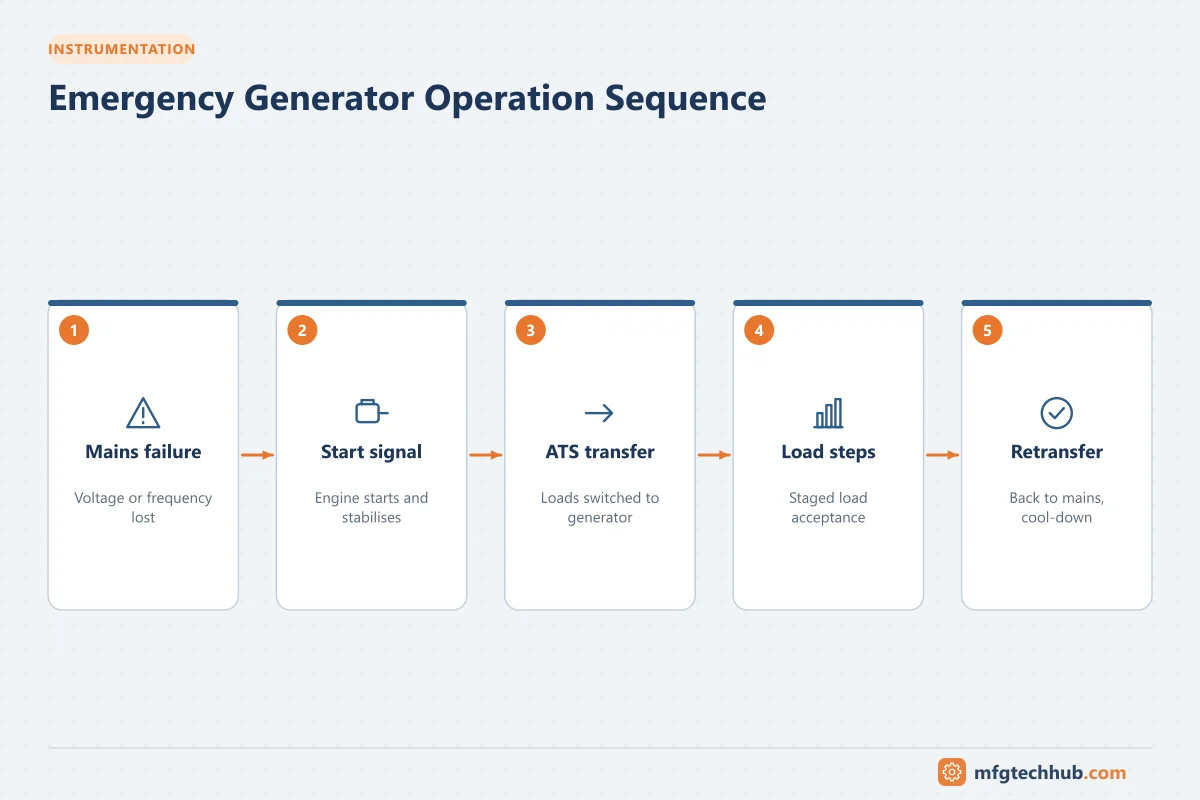
An ATS monitors the normal supply and transfers loads to the generator:
- Utility failure is detected (voltage or frequency out of limits).
- After a short delay to ignore brief dips, the ATS signals the generator to start.
- When the generator reaches stable voltage and frequency, the ATS transfers the load.
- When the utility returns and remains stable for a set time, the ATS transfers back and the generator runs unloaded to cool down before stopping.
Transfer types include open transition (break before make, a short interruption), closed transition (brief parallel with the utility, no interruption, subject to utility approval), and soft loading for larger systems.
A typical diesel standby generator can start and accept load within about 10-15 seconds. Loads that cannot tolerate this interruption need a UPS. See Industrial UPS and Battery Backup.
Load acceptance and load steps
A generator cannot accept its full rated load instantly. Large motor starts cause voltage and frequency dips. Good practice:
- Sequence loads in steps, starting critical loads first and large motors later
- Use soft starters or VFDs on large motors to reduce starting current
- Size the generator for the largest motor starting step as well as the running load
- Consider nonlinear loads (VFDs, UPS) which can interact with generator voltage regulation
Paralleling and synchronization
Larger sites often use several generators in parallel for capacity and redundancy (N+1). Paralleling requires:
- Synchronization of voltage, frequency and phase angle before closing the breaker
- Load sharing of active power (governors) and reactive power (AVRs)
- Protection such as reverse power, loss of excitation and overcurrent
Paralleling switchgear and controllers manage this automatically and can add or remove generators based on load.
Protection and monitoring
Generator controllers protect against low oil pressure, high coolant temperature, overspeed, overcurrent, over/under voltage and frequency, and earth faults. Status and alarms should be sent to the SCADA or building management system so problems are noticed before an emergency.
Testing and maintenance
Many standby generator failures are caused by lack of testing and maintenance. Common practice includes:
| Task | Typical frequency (check local codes and manufacturer guidance) |
|---|---|
| Visual inspection, fluid levels, battery condition | Weekly |
| Run test under load | Monthly |
| Full load or load bank test | Annually, or when monthly tests are at light load |
| Fuel quality testing and polishing | Periodically for stored diesel |
| Transfer switch operation test | Monthly |
| Engine and alternator servicing | Per running hours and manufacturer schedule |
In the United States, NFPA 110 sets requirements for emergency and standby power systems, including monthly testing. Other countries have similar requirements for life safety systems.
Wet stacking
Diesel engines run repeatedly at light load can suffer wet stacking: unburned fuel and carbon accumulate in the exhaust system. Periodic operation at a substantial load (using the plant load or a load bank) prevents it.
Battery failures
Starting battery failure is one of the most common reasons generators fail to start. Maintain chargers, monitor battery voltage and replace batteries on schedule.
Fuel planning
- Determine required runtime (for example 24, 48 or 72 hours) based on risk and fuel delivery reliability.
- Consider fuel consumption at expected load, not only full load.
- Manage fuel quality: water and microbial contamination can block filters.
Key takeaways
- Generators provide long-duration backup; UPS systems cover the seconds before generators take the load.
- Rate generators correctly (standby, prime or continuous) for how they will be used.
- ATS logic, load sequencing and motor starting methods determine whether the generator can accept the load.
- Regular load testing, battery care and fuel management prevent failures when power is needed most.
Related tutorials
Before you apply this in a plant: this article is for education. Always check the current edition of the relevant standards, the manufacturer's documentation for your exact product and version, and your site's procedures. Safety-related work needs qualified personnel. See our editorial policy.