
How to Select a Level Transmitter: Radar, Guided Wave Radar, Ultrasonic, DP, Displacer and More
On this page
Level measurement looks simple (how full is the tank?), but vessel conditions make it one of the most application-dependent measurements in a plant. Foam, vapour, agitators, internal structures, dust, sticky materials, high pressure and changing density can each defeat a technology that works perfectly elsewhere. This guide gives a structured selection method.
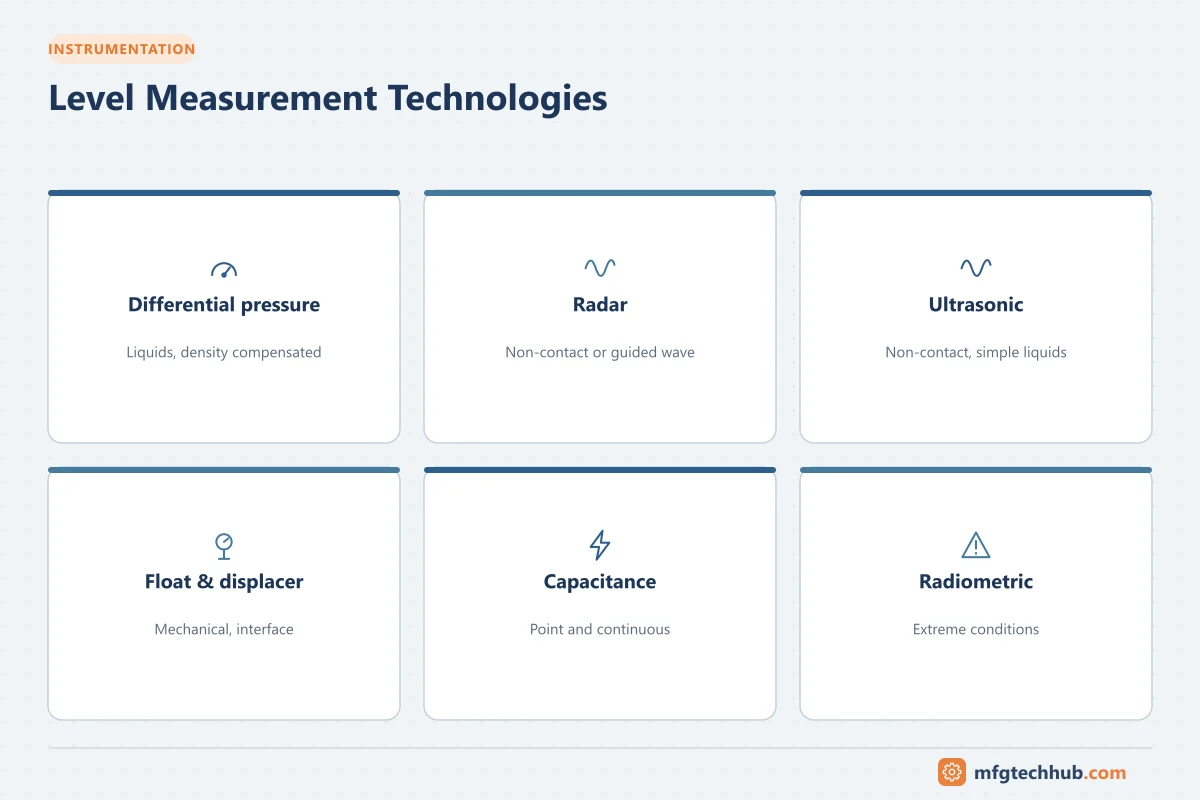
For working principles, see Radar vs Ultrasonic Level Sensors and Float, Displacer and DP Level Measurement.
Step 1: Define the application
| Question | Why it matters |
|---|---|
| Liquid, slurry, powder or bulk solid? | Solids need technologies that handle dust, angles of repose and build-up |
| Continuous level or point level (high/low switch)? | Switches are simpler and often used for alarms and protection |
| Total level or interface (for example oil/water)? | Interface needs guided wave radar, displacer, DP (with densities) or specialised methods |
| Vessel pressure and temperature | Rules out some technologies; drives materials and seals |
| Foam, vapour, condensation, turbulence, agitators | Affect non-contact technologies |
| Coating, sticky or corrosive media | Affect contact technologies |
| Vessel geometry, nozzles, internals | Mounting options and false echoes |
| Required accuracy (inventory, custody, process control, overfill protection) | Tank gauging for inventory needs high accuracy; process control usually needs repeatability |
| Hazardous area, hygienic, safety function | Certifications and design |
Step 2: Compare technologies
| Technology | Contact? | Strengths | Limitations | Typical applications |
|---|---|---|---|---|
| Non-contact radar (FMCW, high frequency) | No | Unaffected by density, temperature and most vapours; narrow beams avoid internals; wide range | Heavy foam, very low dielectric media and some coatings can weaken signals | Storage and process tanks, reactors, solids silos |
| Guided wave radar (GWR) | Yes (probe) | Works with foam, vapour, low dielectrics, turbulence; can measure interface | Probe can be affected by heavy build-up; probe length and mechanical loads | Process vessels, separators, interfaces, chambers (replacing displacers) |
| Ultrasonic | No | Economical, simple; good for water, wastewater, open channels | Affected by foam, vapour, temperature gradients, dust; limited in pressurised vessels | Water tanks, sumps, open channels, simple solids |
| Differential / hydrostatic pressure | Yes | Robust, well understood, works with foam and agitation | Depends on density; seals needed for difficult media; not for solids | Most liquid tanks, pressurised vessels with remote seals |
| Displacer | Yes | Proven, interface capability, high pressure and temperature | Density dependent, moving parts, limited range | Separators, boiler drums, chambers |
| Float / magnetic level gauge | Yes | Simple local indication, switches, transmitters on gauges | Moving parts, clean liquids | Local indication, auxiliary tanks |
| Capacitance / RF admittance | Yes | Simple, point and continuous, some coating tolerance with admittance designs | Depends on dielectric; calibration sensitive | Point level, simple continuous level |
| Vibrating fork / rod switches | Yes | Reliable point level for liquids and solids, little calibration | Point level only | High/low alarms, pump protection, overfill switches |
| Radiometric (nuclear) | No (external) | Measures through vessel walls in extreme conditions | Licensing, handling rules for radioactive sources, cost | Extreme temperature, pressure, toxic or abrasive processes where nothing else works |
| Weighing (load cells) | No | Measures mass directly, independent of density and foam | Vessel mounting, piping forces, cost | Batching vessels, silos. See Load Cells |
Step 3: Match conditions to technology
| Condition | Usually works well | Be careful with |
|---|---|---|
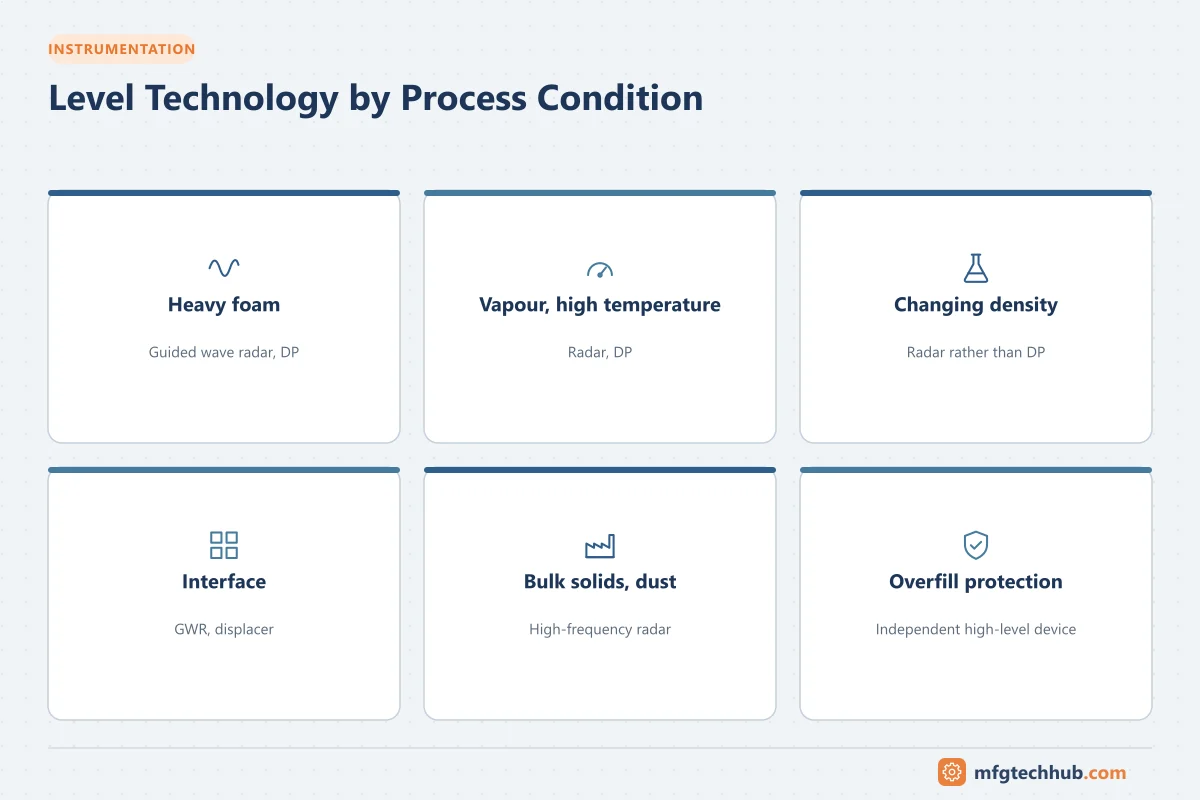
| Heavy foam | GWR, DP, weighing | Ultrasonic; some non-contact radar |
| Vapour, high temperature | Radar, GWR, DP with seals | Ultrasonic |
| Agitated, turbulent surface | GWR (with still pipe or chamber), DP, radar with signal processing | Ultrasonic |
| Changing density | Radar, GWR, ultrasonic, weighing | DP, displacer (need density compensation) |
| Sticky, coating media | Non-contact radar, radiometric | Probes, floats, displacers |
| Interface (two liquids) | GWR, displacer, DP (with known densities) | Non-contact radar, ultrasonic |
| Bulk solids and dust | High-frequency radar, weighing, radiometric | Ultrasonic in dusty conditions |
| Open channel or outdoor water tanks | Ultrasonic, radar | — |
| Hygienic applications | Hygienic radar, hydrostatic with hygienic seals | Devices without hygienic certification |
Step 4: Overfill protection and safety
High-level protection must not rely on the same instrument used for control. Use an independent level switch or transmitter, and where the hazard requires it, design the function as a safety instrumented function with the appropriate integrity. For storage tanks of flammable liquids, industry practices such as API 2350 describe overfill prevention programmes. See Functional Safety.
Step 5: Installation checks
- Radar and ultrasonic: mount away from inlets and internals, observe nozzle guidelines, map false echoes during commissioning, consider still pipes for turbulent surfaces.
- GWR: ensure the probe can be installed and removed; use chambers or bridles where appropriate; consider probe type (single rod, coaxial) for the medium.
- DP: correct tap positions, wet or dry legs, remote seals, density data. Use the DP level calculator.
- Blocking distances (dead zones) near the sensor for non-contact technologies must be respected.
- Verification: compare with a sight glass, manual dip or known volumes during commissioning.
Common selection mistakes
- Using ultrasonic in pressurised, vapour-filled or foaming vessels.
- Using DP without accounting for density changes between products or temperatures.
- Using the control transmitter as the only overfill protection.
- Ignoring build-up on probes in sticky services.
- Not considering maintenance access for probe or seal replacement.
Frequently asked questions
Is radar better than ultrasonic for level measurement?
For most industrial process vessels, yes: radar is not affected by vapour, temperature and pressure the way ultrasonic is. Ultrasonic remains cost-effective for water, wastewater, open channels and simple storage.
Which technology measures interface level?
Guided wave radar and displacers are common choices; DP can infer interface if both densities are known and stable. Specialised capacitance or radiometric solutions exist for difficult interfaces.
When is radiometric level measurement used?
When process conditions (very high temperature or pressure, toxic or highly abrasive media, no suitable openings) rule out other technologies. It measures through the vessel wall but requires licensing and handling of radioactive sources.
Key takeaways
- Define medium, vessel conditions, measurement type and accuracy before choosing a technology.
- Radar and GWR cover most process applications; DP remains robust for liquids with known density; ultrasonic suits water and simple tanks.
- Use independent instruments for overfill protection.
Related tutorials
Before you apply this in a plant: this article is for education. Always check the current edition of the relevant standards, the manufacturer's documentation for your exact product and version, and your site's procedures. Safety-related work needs qualified personnel. See our editorial policy.