
What Is a PLC? Programmable Logic Controllers Explained with a Worked Example
On this page
A programmable logic controller (PLC) is an industrial computer that controls machines and processes. It reads inputs from sensors, switches and push buttons, runs a program written by an engineer, and switches outputs such as motor starters, valves, lamps and drives. It repeats this cycle continuously, typically every few milliseconds, and is built to keep doing so for years in dust, heat, vibration and electrical noise.
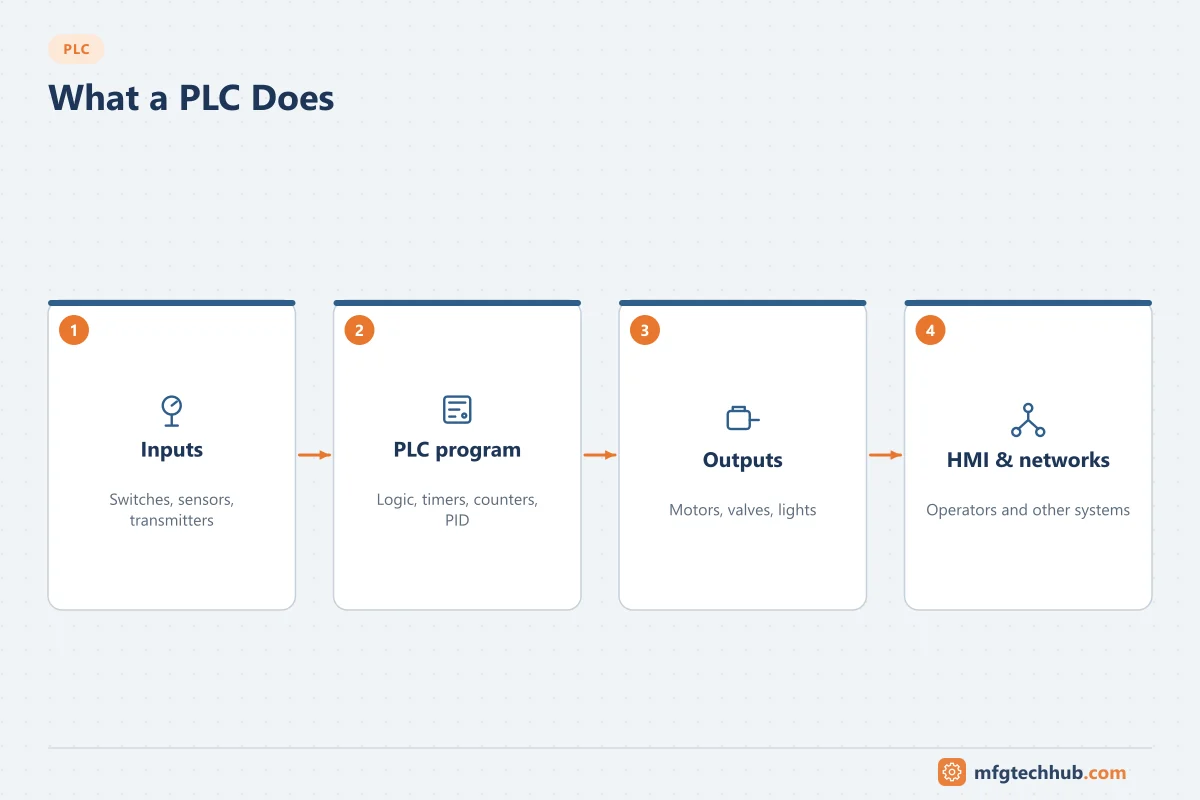
The international standard for PLCs is IEC 61131. Part 3 of it defines the programming languages that most PLCs use today. See PLC Programming Languages.
Inputs, program, outputs
| Part | Examples | What the PLC does with it |
|---|---|---|
| Digital inputs | Push buttons, limit switches, proximity sensors, photo-eyes, motor running contacts | Reads on/off states |
| Analog inputs | 4–20 mA or 0–10 V from pressure, level, temperature and flow transmitters | Converts to numbers and scales to engineering units |
| Program | Ladder logic, function blocks, structured text, sequential function charts | Decides what the outputs should be |
| Digital outputs | Motor contactors, solenoid valves, lamps, horns | Switches them on or off |
| Analog outputs | Speed reference to a drive, position to a control valve | Sends a proportional signal |
| Communication | HMI panels, drives, robots, SCADA, other PLCs | Exchanges data over industrial networks |
The PLC reads all inputs, runs the program, then writes all outputs, and repeats. This is the scan cycle; see How PLCs Work.
A worked example: starting a conveyor
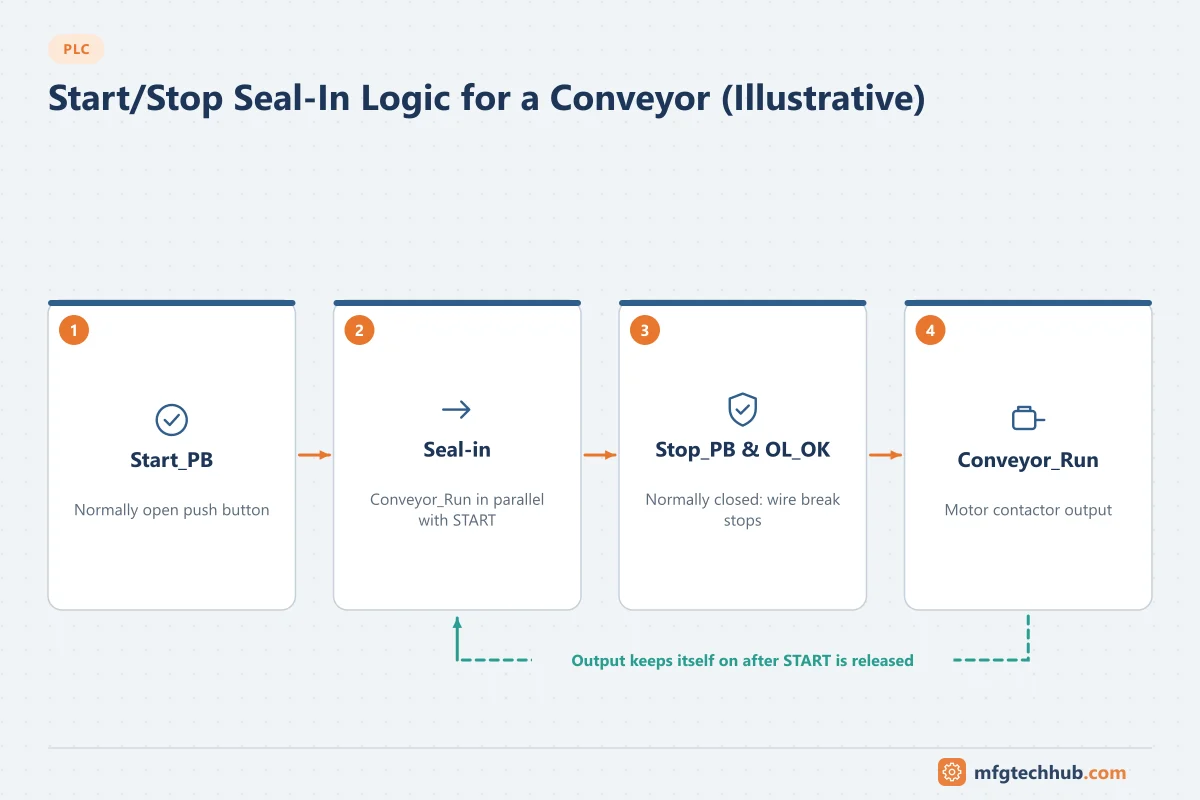
A conveyor motor must start when the operator presses START, keep running after the button is released, and stop when STOP is pressed or the motor overload trips. The inputs and outputs (illustrative addresses):
| Signal | Type | Tag |
|---|---|---|
| Start push button (normally open) | Input | Start_PB |
| Stop push button (normally closed) | Input | Stop_PB |
| Motor overload contact (normally closed) | Input | OL_OK |
| Motor contactor | Output | Conveyor_Run |
In ladder logic, this is the classic start/stop “seal-in” circuit:
|  Start_PB      Stop_PB     OL_OK          Conveyor_Run |
|----] [----+----] [--------] [-------------------( )----|
|           |                                            |
|  Conveyor_Run                                          |
|----] [----+                                            |
The same logic in structured text:
Conveyor_Run := (Start_PB OR Conveyor_Run) AND Stop_PB AND OL_OK;Two design points show why PLC programs are written this way:
- The stop button and overload are normally closed contacts, so a broken wire stops the motor instead of preventing a stop. This is fail-safe wiring.
- The seal-in contact (
Conveyor_Runin parallel with START) keeps the motor running after START is released.
An emergency stop must not rely on this logic alone: it is implemented with safety-rated devices or a safety PLC according to machine safety standards. See PLC Industry Standards.
The parts of a PLC system
| Part | Role | Detail page |
|---|---|---|
| CPU | Runs the program and communication | PLC Components |
| I/O modules | Connect field signals | PLC Components |
| Power supply | Usually 24 V DC for the PLC and I/O | PLC Components |
| Programming software | Writing, downloading and testing programs | PLC Programming Software |
| HMI | Operator screens and controls | SCADA HMI Display Design |
| Networks | PROFINET, EtherNet/IP, Modbus TCP, OPC UA | Industrial Communication Protocols |
PLCs come as compact units with built-in I/O, modular systems with separate modules, and larger rack-based or high-availability systems. See Types of PLCs.
PLC compared with other control options
| Option | Strengths | Typical use |
|---|---|---|
| Relay logic | Simple, easy to understand for small circuits | Very small or safety-related hard-wired circuits |
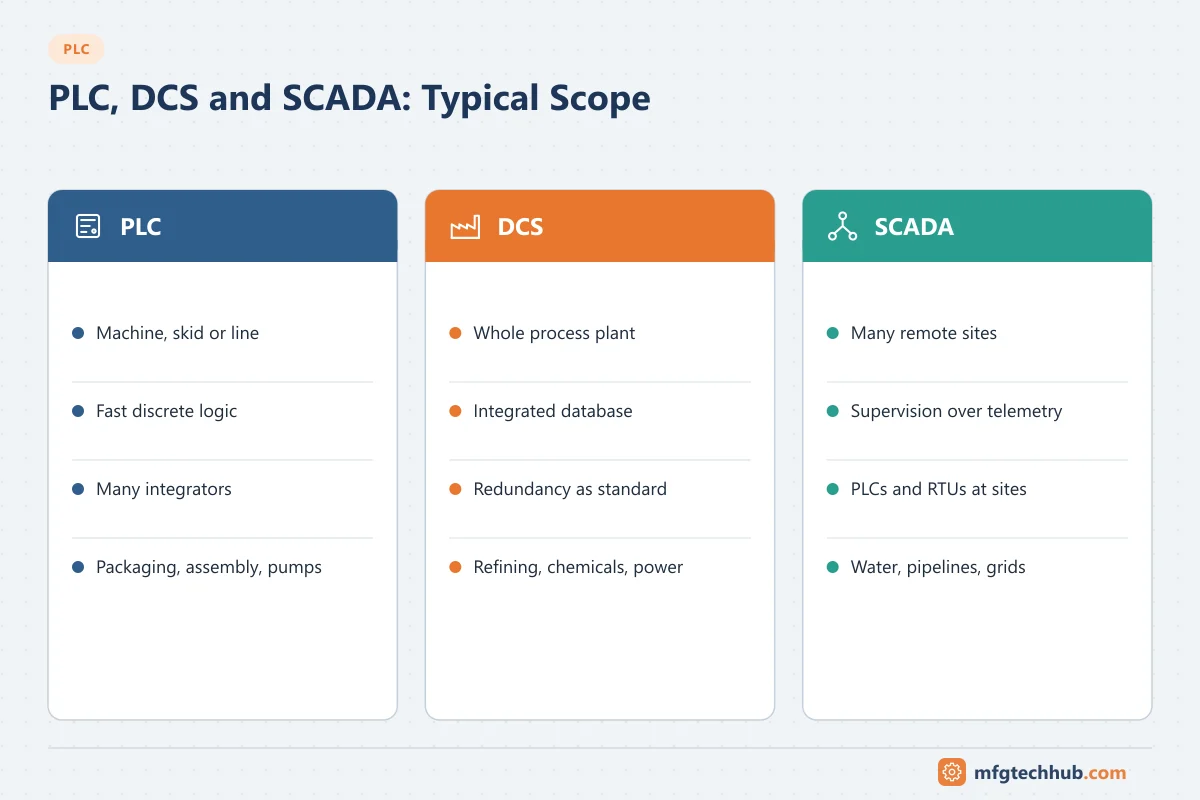
| PLC | Rugged, deterministic, easy to change, strong diagnostics | Machines, lines, skids, pump stations |
| Industrial PC | Computing power, data handling, vision | Complex applications, often alongside a PLC |
| DCS | Integrated plant-wide process control | Refineries, chemical and power plants; see DCS vs PLC |
| SCADA | Supervision of many remote sites | Uses PLCs and RTUs at each site; see What Is SCADA? |
For why PLCs replaced relay panels and their limitations, see Why PLCs Matter.
Where PLCs are used
- Manufacturing: assembly, packaging, material handling, machine tools. See PLC Applications in Manufacturing.
- Process and utilities: pumps, dosing, boilers, compressors, water treatment. See PLC Applications in Process Control.
- Buildings and infrastructure: HVAC, lifts, tunnels, transport. See PLC Building Automation and PLC Applications in Transportation.
- Motion: servo axes, packaging machines, robotics cells. See Servo and Motion Control.
Key terms
| Term | Meaning |
|---|---|
| Scan cycle | Read inputs, execute program, write outputs, repeat |
| Tag | A named variable, such as Conveyor_Run |
| Rung | One line of ladder logic |
| Normally open / normally closed | Contact state when not actuated |
| Seal-in (latch) | Logic that keeps an output on after the start signal ends |
| Download / upload | Transferring the program to or from the PLC |
| Online edit | Changing the program while the PLC runs |
| Force | Overriding an input or output for testing; dangerous if left in place |
How to start learning
- Learn digital and analog I/O and basic electrical wiring.
- Practise ladder logic with start/stop, timers and counters, then structured text.
- Use a vendor’s free or trial software with its simulator, or an IEC 61131-3 environment such as CODESYS.
- Study the scan cycle, troubleshooting and safety basics.
See the Automation Engineer Roadmap and PLC Interview Questions.
Frequently asked questions
What does PLC stand for?
Programmable logic controller: an industrial computer that controls machines and processes by reading inputs, executing a program and switching outputs.
What is the difference between a PLC and a normal computer?
A PLC is built for the plant floor: it tolerates harsh conditions, executes its program deterministically in a fixed cycle, connects directly to industrial I/O and runs for years without an operating system that needs frequent updates. A normal computer is general purpose.
Which PLC programming language should I learn first?
Ladder logic is still the most common for machine control and maintenance, and structured text is increasingly important for complex logic. Learning both covers most jobs.
Key takeaways
- A PLC reads inputs, runs a program and writes outputs in a continuous scan cycle.
- Programs are written in IEC 61131-3 languages such as ladder logic and structured text.
- Fail-safe wiring (normally closed stops) and separate safety systems are part of good design.
- PLCs control machines, lines, utilities and infrastructure; DCS and SCADA serve larger or distributed systems.
Related tutorials
Before you apply this in a plant: this article is for education. Always check the current edition of the relevant standards, the manufacturer's documentation for your exact product and version, and your site's procedures. Safety-related work needs qualified personnel. See our editorial policy.