
Why PLCs Are Used: Advantages, Limitations and When to Choose One
On this page
A Programmable Logic Controller (PLC) is an industrial computer built for one job: reading inputs, executing control logic and driving outputs, reliably, for years, in an electrically noisy and physically harsh environment. PLCs replaced hard-wired relay panels in the late 1960s, and they remain the default controller for machines, conveyors, packaging lines, utilities and many process skids.
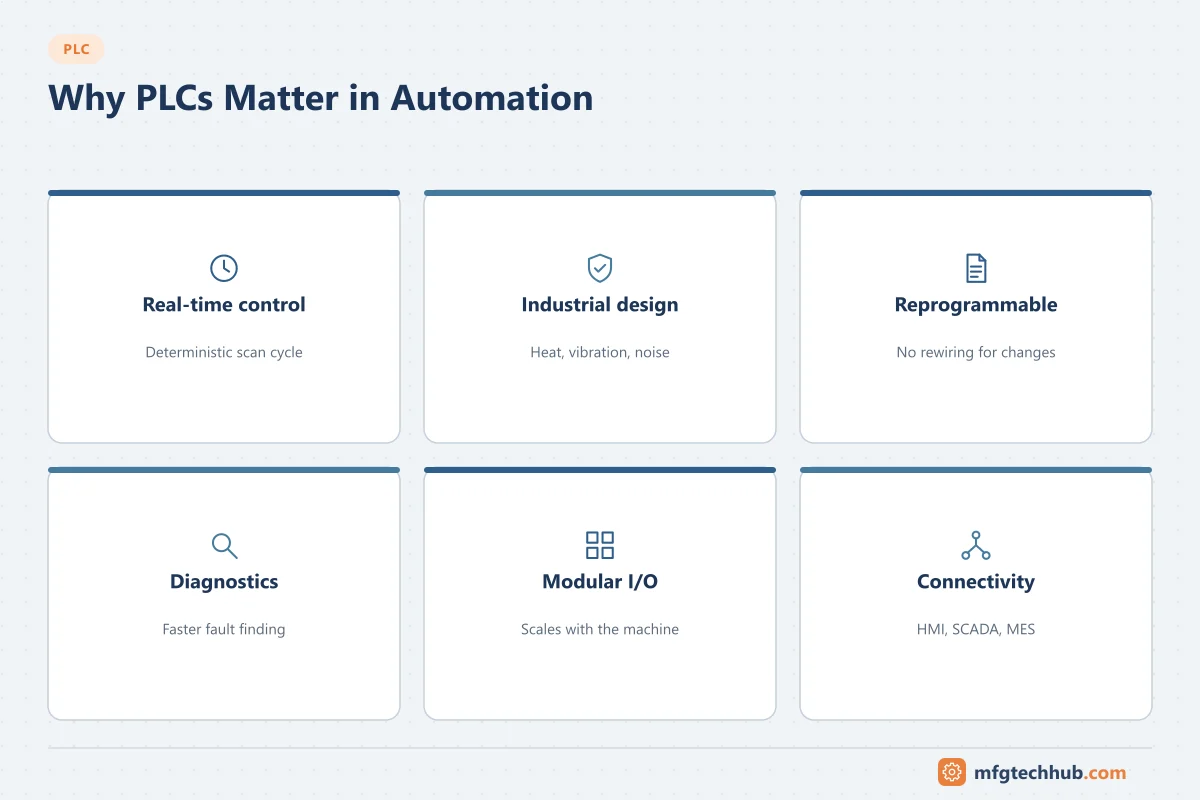
This article explains why engineers choose PLCs, where their advantages come from technically, what their limitations are, and how to decide between a PLC, a relay panel, an industrial PC or a DCS.
The problem PLCs solve
Before PLCs, machine logic was built from relays, timers and wiring. Changing a sequence meant rewiring panels, documentation was often out of date, and fault finding meant tracing wires with a meter. The original PLC requirements, written for the automotive industry, asked for a controller that was reprogrammable, rugged, easy to maintain by plant electricians and competitive in cost with relay panels. Those requirements still explain most of a PLC’s design today.
If you are new to the topic, start with What Is a PLC? and How PLCs Work.
Advantage 1: Deterministic, real-time control
A PLC runs its program in a repeating scan cycle: read inputs → execute logic → write outputs → housekeeping and communication. Because the program and the I/O image are handled in a fixed sequence, the controller’s response time is predictable.
| Characteristic | Typical value or behaviour | Why it matters |
|---|---|---|
| Scan time | Often 1–50 ms depending on program size and CPU | Worst-case response ≈ 2 × scan time + input filter + output delay |
| Cyclic/timed tasks | Many PLCs run interrupt or periodic tasks (for example every 10 ms) | Time-critical logic such as PID or motion runs at a fixed rate |
| Watchdog | CPU faults to a safe state if a scan exceeds a limit | A stuck program does not leave outputs in an unknown state |
Practical check: when a fast event (a product edge at a sensor, a pulse) must never be missed, compare the event duration with the scan time. If the pulse can be shorter than the scan, use a high-speed counter, an interrupt input or a hardware-latched input rather than normal scanned logic.
Advantage 2: Built for the plant environment
PLC hardware is designed and tested to industrial requirements (IEC 61131-2 covers equipment requirements and tests for programmable controllers). In practice this means:
- Wide temperature ranges (commonly 0–55 °C for standard modules, with extended-temperature variants available)
- Electrical noise immunity tested against surges, fast transients and electrostatic discharge
- Vibration and shock resistance for DIN-rail and rack mounting in machine panels
- Isolated I/O so that field wiring faults do not damage the CPU
- Solid-state electronics with no rotating disks and, often, no fans
Hardware lifetimes of 15–20 years are common in the field. The limiting factor is usually spare-part availability and software support, not failure of the electronics, which is why lifecycle status matters when selecting and upgrading PLCs.
Advantage 3: Reprogramming instead of rewiring
Logic lives in software, so changing a sequence, adding an interlock or adjusting a timer is a program change, not a wiring change.
- IEC 61131-3 languages (Ladder Diagram, Function Block Diagram, Structured Text, Sequential Function Chart) let each task use a suitable language. See PLC Programming Languages.
- Online edits: most platforms allow tested changes to be downloaded while the machine runs. This is powerful and must be controlled by change management.
- Reusable code: function blocks for motors, valves and analog inputs make large projects consistent.
- Simulation: many engineering tools include a software PLC, so logic can be tested before commissioning.
Example: a bottling line changes from 500 ml to 1 L bottles. With a PLC, the recipe changes timer presets, conveyor speeds and reject limits. With relay logic the same change could require new timers and wiring.
Advantage 4: Diagnostics and faster fault finding
- The PLC shows the live state of every input and output in the engineering software and often on module LEDs.
- Online monitoring of the program shows which condition is stopping a sequence, instead of tracing wires.
- Module and channel diagnostics report wire break, short circuit, over-range and power loss.
- Fault logs and time stamps help identify intermittent problems.
This is one of the most practical reasons plants standardise on PLCs: mean time to repair drops sharply when technicians can see the logic. See the PLC Troubleshooting Guide.
Advantage 5: Modular, scalable I/O
A small machine may need a compact PLC with 20 I/O points; a production line may need several thousand points spread across remote I/O stations.
- Compact PLCs have fixed I/O with a few expansion modules.
- Modular PLCs use racks or DIN-rail backplanes; I/O, communication and special modules (high-speed counters, motion, weighing) are added as needed.
- Remote I/O over PROFINET, EtherNet/IP, EtherCAT or other fieldbuses reduces cabling by placing I/O close to the equipment.
See Types of PLCs for how compact, modular and rack systems differ.
Advantage 6: Integration with the rest of the plant
Modern PLCs have Ethernet ports and support protocols such as Modbus TCP, PROFINET, EtherNet/IP and, increasingly, OPC UA. That makes it straightforward to:
- display data on an HMI and in SCADA
- log values to a historian
- exchange production data with an MES
- coordinate with drives, robots and other controllers
Protocol details are covered in Industrial Communication Protocols.
The real limitations of PLCs
A fair comparison has to include the downsides:
| Limitation | What it means in practice | Mitigation |
|---|---|---|
| Vendor ecosystems | Hardware, software and often protocols are tied to one vendor | Standardise per site; use open protocols at the integration layer |
| Software licences and versions | Engineering tools are licensed; projects may need a specific version | Archive tool versions with project backups |
| Limited computing and storage | Not designed for heavy data analytics, databases or large file handling | Move analytics to an edge PC, historian or server |
| Legacy cybersecurity | Many installed PLCs lack authentication or encrypted protocols | Network segmentation, access control and newer firmware. See PLC Security Concerns |
| Skills and documentation | Poorly structured code becomes hard to maintain | Coding standards and reviews. See PLC Programming Best Practices |
| Obsolescence | Older product families reach end of sale and end of support | Lifecycle planning and phased migration |
PLC vs relay logic vs industrial PC vs DCS
| Criterion | Relay logic | PLC | Industrial PC / soft PLC | DCS |
|---|---|---|---|---|
| Typical use | Very simple, fixed interlocks | Machines, lines, utilities, skids | Complex motion, vision, data-heavy machines | Large continuous or batch process plants |
| Changing logic | Rewiring | Software change | Software change | Software change with system-wide engineering |
| Determinism | Inherent (hard-wired) | High | Depends on real-time OS/runtime | High |
| Redundancy | Hard-wired duplication | Available on higher-end models | Possible, platform dependent | Standard design feature |
| Diagnostics | Minimal | Good | Good to very good | Very good, system-wide |
| Scale | Small | Small to large | Small to large | Large, plant-wide |
| Integrated HMI/historian/alarm database | No | Separate products | Often integrated | Integrated |
- Choose relays only for very small, fixed logic or where a hard-wired safety function is specified.
- Choose a PLC for discrete and hybrid machine control, utilities and process skids, especially where fast logic and wide technician familiarity matter.
- Consider an industrial PC or soft PLC when the application combines control with heavy computation, vision or complex motion.
- Consider a DCS for large process plants with many interacting loops, where a single integrated database, plant-wide redundancy and operator environment are priorities. See DCS vs PLC.
Safety functions are a separate decision: they require safety-rated controllers (safety PLCs) engineered to IEC 61508/IEC 61511 or ISO 13849/IEC 62061, not a standard PLC.
Where PLCs are used
| Industry | Typical PLC applications |
|---|---|
| Discrete manufacturing | Assembly machines, conveyors, packaging, palletising, robot cells |
| Food and beverage | Filling, mixing, CIP (clean-in-place), pasteurisation skids |
| Water and wastewater | Pump stations, filtration, dosing, remote sites linked to SCADA |
| Power and utilities | Boiler auxiliaries, compressors, substation automation support |
| Pharmaceuticals | Process skids and packaging lines, often integrated with batch and MES systems |
| Buildings and infrastructure | HVAC plant rooms, tunnels, baggage handling. See PLCs in Building Automation |
Frequently asked questions
Why are PLCs used instead of normal computers?
PLCs are designed for deterministic control, industrial temperature and noise conditions, and many years of continuous operation. They have isolated I/O, watchdogs and simple, visible logic that plant technicians can troubleshoot. General-purpose computers are better at data processing but need extra measures to achieve the same reliability and determinism.
Is a PLC always better than relay logic?
No. For a few fixed interlocks, a relay circuit can be simpler and cheaper. Once a machine has sequences, timers, analog values or needs diagnostics and future changes, a PLC is usually more economical over its lifecycle.
Can a PLC control a process plant?
Yes. Many process skids and smaller plants run on PLCs with a SCADA system. For large plants with thousands of interacting loops, a DCS usually provides better integrated engineering, redundancy and operator environments.
Key takeaways
- PLCs are chosen for deterministic control, rugged hardware, easy reprogramming, strong diagnostics and modular I/O.
- Their limitations are vendor lock-in, licensing, limited computing power, legacy cybersecurity and obsolescence; all can be managed.
- Choose between relays, PLCs, industrial PCs and DCS based on scale, determinism, integration and lifecycle requirements, not habit.
Related tutorials
Before you apply this in a plant: this article is for education. Always check the current edition of the relevant standards, the manufacturer's documentation for your exact product and version, and your site's procedures. Safety-related work needs qualified personnel. See our editorial policy.