
PLC Vendors Compared: Siemens, Rockwell, Mitsubishi, Schneider, Omron, Beckhoff, B&R, CODESYS-Based and Open Controllers
On this page
Most plants and machine builders standardise on one or two PLC platforms, because the choice brings an engineering tool, a network family, a spare-parts strategy and a pool of skills with it. This guide profiles the main platforms, explains what each is known for, and gives objective criteria for choosing.
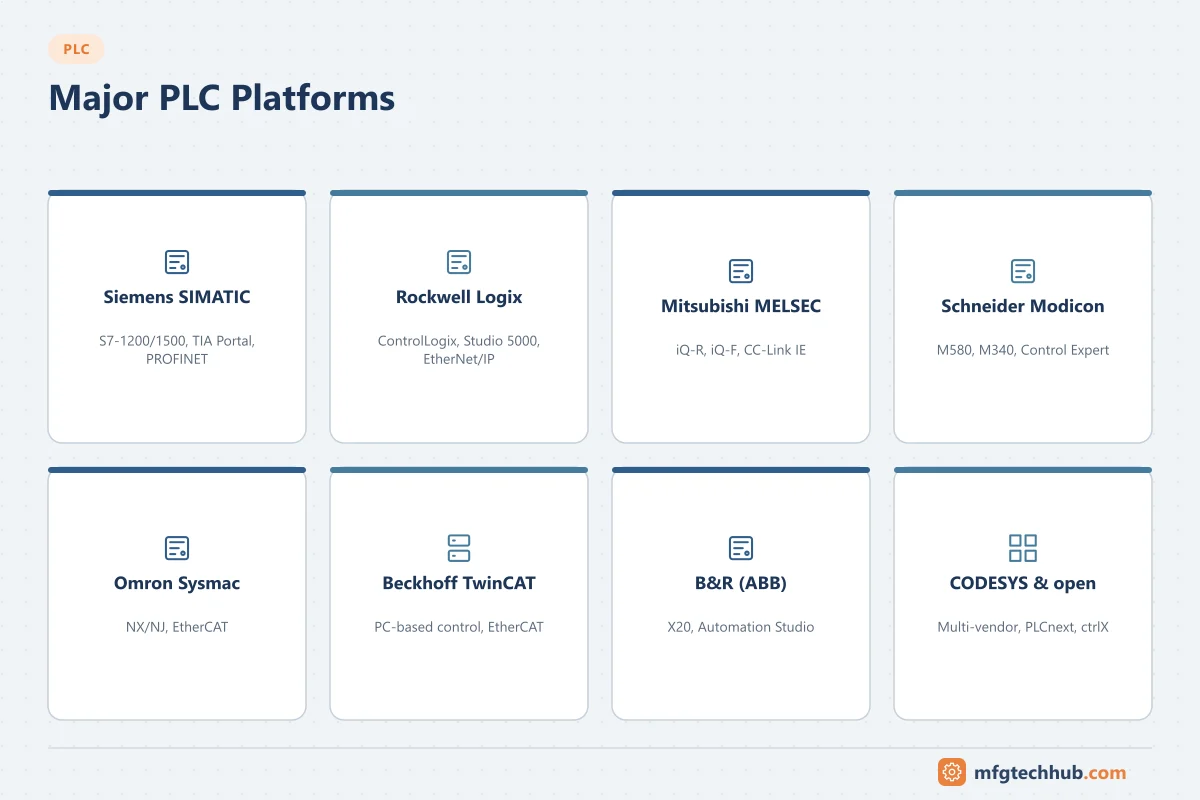
Last technical review: September 2026. Controller families, software versions and lifecycle status change. Check vendor lifecycle notices before designing new systems; for example, Siemens’ SIMATIC S7-300 and ET 200M reached type discontinuation on 1 October 2025, with spare parts available for a limited period.
There is no single best PLC. All major platforms are capable. Differences are in engineering tools, networks, ecosystem, regional support, lifecycle policies and cost.
How PLC platforms differ
| Aspect | What varies |
|---|---|
| Engineering software | Integrated suite vs separate tools; licensing; version compatibility; simulation and emulation |
| Native network | PROFINET, EtherNet/IP, EtherCAT, CC-Link IE, Modbus TCP, POWERLINK. See Industrial Communication Protocols |
| Programming model | IEC 61131-3 languages, object orientation, tag-based vs address-based memory. See PLC Programming Languages |
| Safety and motion | Integrated safety CPUs, integrated motion vs separate motion controllers. See Servo Motion Control |
| Redundancy | Hot-standby CPU options for process applications |
| Openness | Linux, containers, C/C++ or Python alongside IEC 61131-3; OPC UA and MQTT built in |
Vendor profiles
Siemens SIMATIC
- Controllers: S7-1200 (compact), S7-1500 (standard, with fail-safe F, technology/motion T and redundant R/H variants), ET 200SP distributed controllers, and the S7-1500V virtual PLC running on industrial edge or server hardware (a fail-safe version has also been announced).
- Engineering: TIA Portal (STEP 7) for controllers, HMI (WinCC), drives and safety in one project; PLCSIM for simulation.
- Network: PROFINET (PROFIBUS for legacy), OPC UA server on S7-1500.
- Lifecycle: S7-300 discontinued (2025); plan migrations from S7-300/400 to S7-1500.
- Typical fit: very widely used in Europe and Asia in machines and plants; strong where Siemens drives and HMI are also used.
Rockwell Automation (Allen-Bradley) Logix
- Controllers: ControlLogix (large systems and process with PlantPAx), CompactLogix (mid-range), GuardLogix/Compact GuardLogix (safety), Micro800 (small machines).
- Engineering: Studio 5000 Logix Designer for Logix controllers (tag-based, add-on instructions); Connected Components Workbench for Micro800; emulation with FactoryTalk Logix Echo.
- Network: EtherNet/IP with CIP Safety and CIP Motion. See EtherNet/IP and CIP.
- Typical fit: dominant in North America; discrete, hybrid and process (PlantPAx) applications.
Mitsubishi Electric MELSEC
- Controllers: MELSEC iQ-R (high-end, with safety, process and redundant CPUs), iQ-F (FX5 compact), Q and L series in installed bases.
- Engineering: GX Works3 (iQ-R/iQ-F), GX Works2 for older series.
- Network: CC-Link IE (including CC-Link IE TSN), plus Ethernet protocols.
- Typical fit: strong in Asia, electronics, automotive and machine building; integration with Mitsubishi servo, robots and CNC.
Schneider Electric Modicon
- Controllers: Modicon M580 (Ethernet-backplane “ePAC”, with safety and hot-standby versions), M340 (mid-range), M200-series logic and motion controllers for machines.
- Engineering: EcoStruxure Control Expert (formerly Unity Pro) for M340/M580; EcoStruxure Machine Expert for machine controllers.
- Direction: EcoStruxure Automation Expert for software-defined, IEC 61499-based automation.
- Typical fit: infrastructure, water, mining, energy (M580/M340); OEM machines (Machine Expert).
Omron Sysmac
- Controllers: NX/NJ machine automation controllers combining logic, motion and safety; CP and CJ series in installed bases.
- Engineering: Sysmac Studio (logic, motion, safety, vision and HMI).
- Network: EtherCAT for motion and I/O, EtherNet/IP for plant networks.
- Typical fit: packaging, electronics, food and beverage and other machine-building applications with integrated motion and vision.
Beckhoff TwinCAT
- Controllers: PC-based control on industrial PCs and embedded PCs, with EtherCAT I/O.
- Engineering: TwinCAT 3, integrated in Microsoft Visual Studio, with IEC 61131-3, object orientation, C/C++ and MATLAB/Simulink integration, motion, safety and measurement.
- Network: EtherCAT (developed by Beckhoff, now an open IEC standard managed by the EtherCAT Technology Group).
- Typical fit: high-performance machines, motion-intensive and data-intensive applications, OEMs wanting software flexibility.
B&R (ABB)
- Controllers: X20 system and industrial PCs; part of ABB since 2017.
- Engineering: Automation Studio for logic, motion, safety and HMI.
- Network: POWERLINK and OPC UA over TSN.
- Typical fit: machine builders, especially with complex motion (ACOPOS drives and track systems).
CODESYS-based and other controllers
- CODESYS is a hardware-independent IEC 61131-3 development system and runtime used by hundreds of device manufacturers, including controllers from WAGO, ABB (AC500), Festo, Eaton, Bosch Rexroth and many others; a virtual control runtime is also available.
- Open, Linux-based controllers such as Phoenix Contact PLCnext and Bosch Rexroth ctrlX CORE combine IEC 61131-3 with high-level languages, apps and containers.
- Regional and compact brands (for example Delta, Keyence, Panasonic, LS Electric, Fatek, Unitronics) are widely used in specific markets and machine types.
- Typical fit: OEMs wanting one skill set across hardware brands; projects needing open software stacks.
Virtual and software-defined PLCs
Virtual PLCs run control software on standard server or edge hardware rather than a dedicated controller, with I/O on the network. Examples include the Siemens S7-1500V, CODESYS Virtual Control, and IEC 61499-based approaches such as Schneider’s EcoStruxure Automation Expert. Consider:
- Determinism and cycle time on the chosen hardware and hypervisor.
- Availability: redundancy, failover and behaviour on host failure.
- Safety: only certified fail-safe virtual controllers may run safety functions.
- IT/OT responsibilities for patching, virtualisation and cybersecurity. See PLC Security.
Selection criteria
| Criterion | Questions to ask |
|---|---|
| Plant or company standard | Is there an existing standard, and what would changing it cost in skills and spares? |
| Performance and scale | Scan times, I/O counts, memory, number of connections |
| Networks | Native support for the networks your drives, robots and devices use |
| Safety | Integrated safety CPUs and safety protocols (PROFIsafe, CIP Safety, FSoE) with required certifications |
| Motion | Integrated motion, number of axes, synchronisation, robotics integration |
| Process features | Redundancy, process libraries, HART and analog integration |
| Engineering | Software cost and licensing, version management, simulation, libraries, multi-user work |
| Openness and IT integration | OPC UA server, MQTT, web APIs, Linux/containers, high-level languages |
| Cybersecurity | IEC 62443 certifications, access control, secure communication, patch policy |
| Lifecycle | Product lifecycle status, migration tools, spare parts availability |
| Local support | Distributor, service and integrator availability; training |
| Total cost | Hardware, software, engineering hours, spares and training over the machine or plant life |
Frequently asked questions
Which PLC brand is the most widely used?
Siemens and Rockwell Automation have very large installed bases, with Siemens especially strong in Europe and Asia and Rockwell in North America. Mitsubishi Electric, Schneider Electric and Omron are also widely used, and usage varies by region and industry. Choose on requirements, standards and local support rather than market share alone.
What is CODESYS?
A hardware-independent IEC 61131-3 programming system and runtime used by many controller manufacturers, so the same programming skills can be applied across different hardware brands.
Is the Siemens S7-300 still available?
The S7-300 and ET 200M reached type discontinuation on 1 October 2025, meaning they are no longer produced as new products; spare parts and repairs are available for a limited period. New designs should use current platforms such as the S7-1500, and existing systems should plan migration.
Key takeaways
- PLC platforms differ in engineering software, networks, safety and motion integration, openness, lifecycle and support.
- Standardise deliberately; the platform brings tools, skills and spares with it.
- Consider virtual and open controllers where flexibility matters, with attention to determinism, safety and IT/OT responsibilities.
- Check lifecycle notices and plan migrations from discontinued families.
Related tutorials
Before you apply this in a plant: this article is for education. Always check the current edition of the relevant standards, the manufacturer's documentation for your exact product and version, and your site's procedures. Safety-related work needs qualified personnel. See our editorial policy.