
PLCs and SCADA in Transportation: Baggage Handling, Tunnels, Rail, Ports and Traffic
On this page
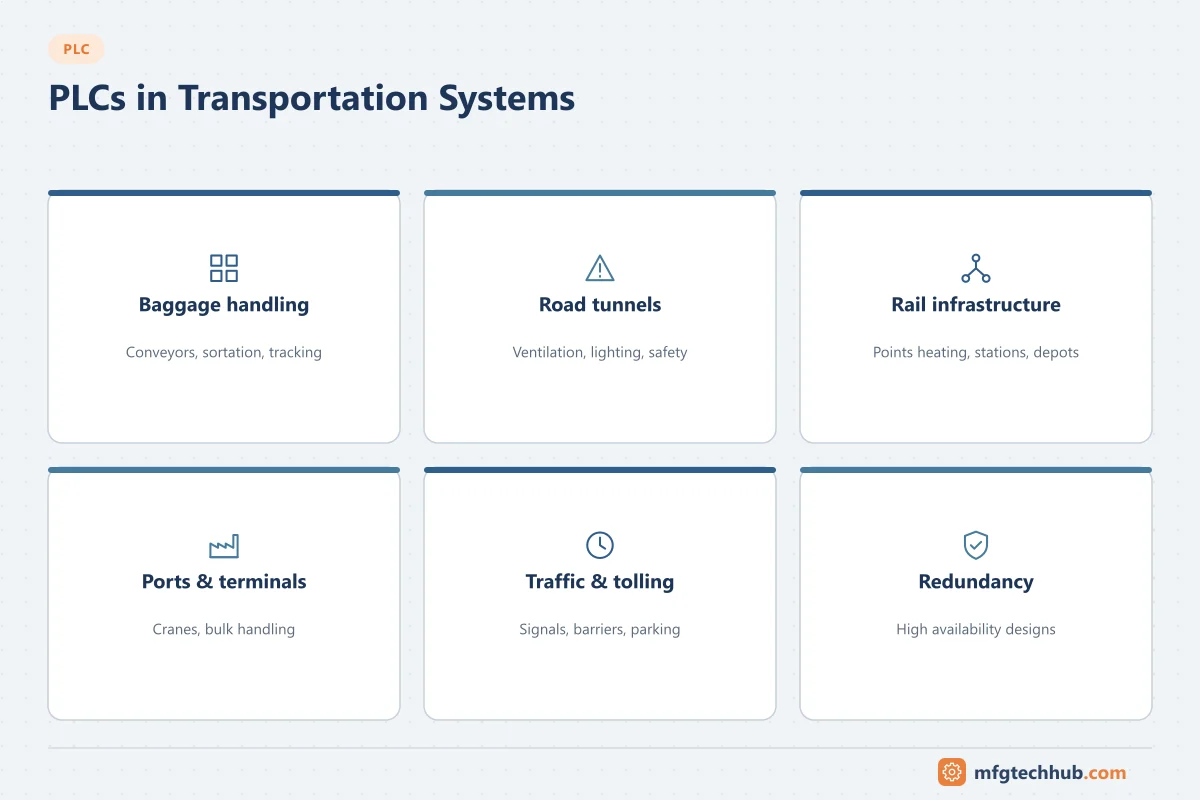
Transportation infrastructure contains a surprising amount of industrial automation. Airports move bags on kilometres of conveyors; road tunnels run ventilation, lighting and fire systems; rail networks power trains, pumps and stations; ports operate cranes and bulk handling equipment. PLCs control much of this equipment, usually supervised by SCADA.
It is equally important to understand where PLCs are not the main controller. Train protection and signalling, for example, use dedicated safety-certified signalling systems. This article covers typical PLC applications, architectures and design concerns.
Overview: where PLCs fit
| Application | Typical PLC role | Usually not the PLC’s job |
|---|---|---|
| Airport baggage handling | Conveyor control, diverters, tracking, screening machine interfaces | Flight and baggage sortation database (higher-level system) |
| Road tunnels | Ventilation, lighting, pumps, fire systems interfaces, barriers and signs | Emergency decisions (made by operators and fire systems per procedures) |
| Rail infrastructure | Traction power (with protection relays), station systems, depot equipment, pumps, ventilation | Train protection, interlocking and signalling (dedicated SIL-rated systems) |
| Ports and terminals | Crane drives and auxiliary control, conveyors, ship loaders, bulk handling | Terminal operating system (logistics planning) |
| Road traffic | Barriers, variable message signs, some traffic signal controllers, car park systems | City-wide traffic optimisation (central software) |
Airport baggage handling systems
A baggage handling system (BHS) moves bags from check-in through security screening to sorting and make-up areas.
- Conveyor zones are controlled by PLCs, often using standard function blocks for each conveyor segment (start/stop, jam detection, gap control).
- Tracking: bags are identified by barcode or RFID readers and then tracked through the conveyors by position (encoders or photo-eye counting), so each bag reaches the correct destination.
- Diverters and sorters (tilt-tray or cross-belt) are controlled by PLCs or dedicated sorter controllers based on sortation instructions from a higher-level system.
- Hold baggage screening machines interface with the PLC for bag handover and results.
- Redundancy: critical PLCs and networks are often redundant because a stoppage affects flights.
Design concerns: high availability, fast fault recovery, maintainability during operations (sections can be bypassed), and consistent tracking after stoppages. See PLC Application Examples for tracking logic.
Road tunnels
Tunnel systems combine continuous monitoring with emergency functions:
- Ventilation: jet fans or ventilation stations controlled by PLCs based on CO, NO₂, visibility (opacity) and air-flow measurements, plus fire-mode ventilation strategies.
- Lighting: entrance zone lighting adjusted to outside luminance so drivers’ eyes can adapt.
- Drainage pumps and hazardous liquid handling.
- Safety interfaces: fire detection, emergency call points, barriers, variable message signs and lane control signals.
Design concerns: high availability (redundant PLCs, power supplies and networks), fire-resistant cabling, defined emergency responses tested regularly with emergency services, and SCADA for the tunnel control room.
Rail infrastructure
- Traction power: substations feeding the overhead line or third rail use protection relays and, often, PLCs or RTUs for switching sequences and SCADA connection.
- Stations: escalators, lifts, ventilation, lighting, pumps and platform screen door systems (which have their own safety controllers).
- Depots: train washing plants, wheel lathes, sanding systems, fuelling and workshop equipment.
- Tunnels and underground sections: ventilation, drainage and fire systems similar to road tunnels.
Signalling and train protection (interlockings, automatic train protection, communications-based train control) are specialised safety systems developed to railway standards such as the EN 50126/50128/50129 series. They are not general-purpose PLC applications.
Ports and bulk terminals
- Cranes (ship-to-shore, gantry) combine drive systems, PLCs for auxiliary functions and interlocks, and safety systems. Crane automation often adds positioning systems and remote operation.
- Bulk handling: conveyors, stackers, reclaimers and ship loaders are classic PLC applications with long conveyor interlocking chains, belt-slip and misalignment protection, and dust suppression.
- Reefer container monitoring and shore power systems.
Road traffic, tolling and parking
- Traffic signal controllers are usually dedicated controllers built to national standards, although PLCs are used in some special installations.
- Barriers, variable message signs and lane control on motorways and bridges are often PLC or RTU controlled and supervised by a traffic control centre.
- Car park systems use PLCs or embedded controllers for barriers, counting and guidance signs.
- Tolling systems are mostly IT systems (readers, cameras, back-office software); PLCs may control barriers and lane equipment.
Common architecture
- Field level: sensors, drives, remote I/O along the route (tunnels and conveyors can be kilometres long).
- Control level: redundant PLCs per section or system, connected by fibre-optic ring networks for resilience.
- Supervisory level: SCADA in a control room, with alarm management, event logging and CCTV integration. SCADA also supervises traction power, station equipment and tunnel ventilation; train separation and braking remain with the signalling system. See SCADA Applications by Industry.
- Interfaces to higher-level systems (baggage sortation, traffic management, maintenance management).
Design requirements that stand out in transportation
| Requirement | Why | Typical measures |
|---|---|---|
| Availability | Stoppages affect the public and schedules | Redundant PLCs, networks and power; hot-swap modules |
| Maintainability during operation | Many systems run 24/7 | Section bypasses, remote diagnostics, standard modules |
| Life safety | Fire and evacuation scenarios | Tested emergency modes, independent safety systems, coordination with fire services |
| Long distances | Tunnels, conveyors, rail lines | Remote I/O, fibre networks, surge protection |
| Cybersecurity | Public infrastructure is a target | Segmentation, secure remote access, IEC 62443. See PLC Security |
Frequently asked questions
Do PLCs control railway signalling?
Generally no. Railway interlocking and train protection use dedicated safety-certified signalling systems developed to railway standards. PLCs are common in traction power, stations, depots and tunnel systems.
Why are baggage handling systems controlled by PLCs?
Baggage handling is essentially a large conveyor and sortation system with many motors, sensors and diverters that must be tracked and interlocked in real time, which suits PLCs well. Higher-level software decides where each bag should go.
What does a tunnel PLC control?
Typically ventilation, lighting, drainage pumps, signs, barriers and interfaces with fire detection and emergency systems, supervised from a tunnel control room through SCADA.
Key takeaways
- PLCs control much of the equipment in airports, tunnels, rail infrastructure, ports and road systems.
- Safety-critical train signalling and protection use dedicated certified systems, not general-purpose PLCs.
- Transportation designs emphasise availability, maintainability, life safety, long distances and cybersecurity.
Related tutorials
Before you apply this in a plant: this article is for education. Always check the current edition of the relevant standards, the manufacturer's documentation for your exact product and version, and your site's procedures. Safety-related work needs qualified personnel. See our editorial policy.