
Building Automation Explained: BMS, PLCs, SCADA and BACnet for HVAC, Lighting and Energy
On this page
Commercial buildings, hospitals, data centres, airports and factory utilities all rely on automation to control heating, ventilation, air conditioning (HVAC), lighting and energy use. In buildings this is usually called a building management system (BMS) or building automation and control system (BACS). PLCs and SCADA are used too, especially in critical and industrial facilities.
This article explains the architecture, the protocols, typical control strategies, and how to decide between BMS controllers, PLCs and SCADA.
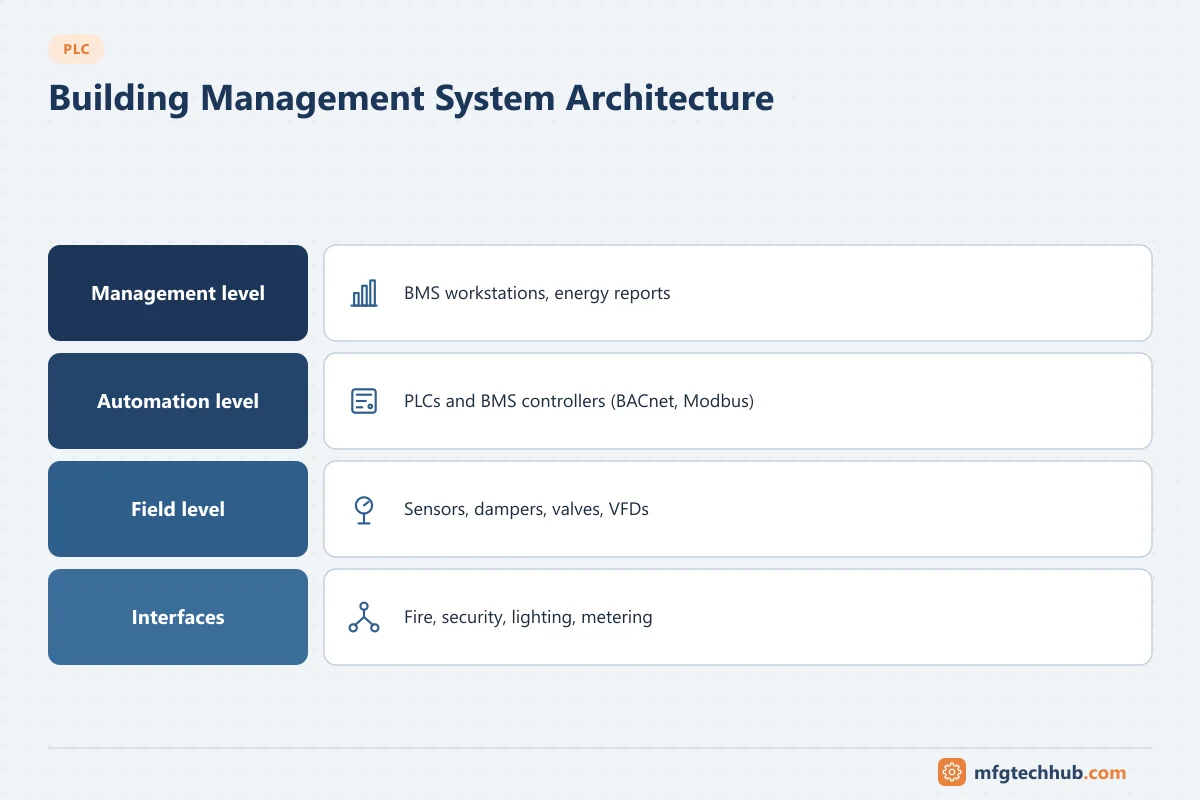
BMS architecture
| Level | Components | Typical protocols |
|---|---|---|
| Management level | BMS server and workstations, web clients, energy dashboards, alarm notification, historical data | BACnet/IP, OPC UA, web APIs |
| Automation level | DDC (direct digital control) controllers, PLCs for plant rooms, chiller and boiler plant controllers | BACnet/IP, BACnet MS/TP, Modbus TCP, vendor protocols |
| Field level | Sensors (temperature, humidity, CO₂, pressure), actuators (valves, dampers), VFDs, room controllers, lighting devices, meters | BACnet MS/TP, Modbus RTU, KNX, DALI, M-Bus, LonWorks (legacy) |
The architecture is similar to industrial automation: field devices, controllers and a supervisory layer. The main difference is the protocols and the standard control sequences.
Protocols you will meet
| Protocol | Where it is used | Notes |
|---|---|---|
| BACnet (ASHRAE 135 / ISO 16484-5) | The main open protocol for BMS; controllers, servers, integration | BACnet/IP over Ethernet; BACnet MS/TP over RS-485; BACnet/SC adds secure connections |
| Modbus RTU/TCP | Meters, VFDs, chillers and packaged equipment | Simple and widely supported |
| KNX | Room control, lighting and blinds, common in Europe | Decentralised bus system |
| DALI | Digital addressable lighting control | Individual control and status of luminaires |
| M-Bus | Heat, water and gas meters | Common in Europe for utility metering |
| LonWorks | Older installations | Many sites are migrating to BACnet |
See Industrial Communication Protocols for the industrial protocols that often meet BMS in factories.
Typical HVAC control strategies
Air handling unit (AHU)
- Supply air temperature control: PID loops modulate heating and cooling valves in sequence, with economiser (free cooling) using outside air when conditions allow.
- Supply duct static pressure control: a VFD on the supply fan maintains duct pressure; static pressure reset lowers the setpoint when VAV boxes are satisfied, saving fan energy.
- Minimum outdoor air / demand-controlled ventilation using CO₂ sensors.
- Safeties: frost protection (low-temperature thermostat), smoke detection shutting down the unit, filter differential pressure alarms.
ASHRAE Guideline 36 publishes standardised high-performance sequences of operation for HVAC systems, which many designers use as a reference.
Chilled water plant
- Chiller staging based on load and efficiency, with minimum run and off times.
- Variable primary flow or primary/secondary pumping with differential pressure control.
- Cooling tower fan control and condenser water temperature reset.
- Integration with chiller controllers over BACnet or Modbus for status, setpoints and alarms.
Zone control
- VAV boxes or fan coil units control room temperature, often with occupancy schedules and sensors.
- Setback and optimum start/stop reduce energy outside occupied hours.
See PID Control Explained for loop tuning.
Lighting control
- Time schedules, occupancy sensors and daylight harvesting (dimming based on daylight).
- DALI or KNX for individually addressable luminaires; emergency lighting monitoring.
- Integration with the BMS for schedules and energy reporting.
Fire, life safety and security interfaces
Fire alarm systems, smoke control and access control are usually separate, certified systems, designed to local codes and product standards. The BMS typically:
- Monitors their status and alarms.
- Receives signals (for example, fire alarm → shut down AHUs, open smoke dampers according to the fire strategy).
- Does not replace the certified system or its logic.
Smoke control sequences must follow the fire engineering design and be tested with the authorities having jurisdiction.
Energy metering and management
- Electricity, heat, gas and water meters connected via Modbus, M-Bus or BACnet.
- Energy dashboards, consumption per area or system, and comparison with weather and occupancy.
- Building energy performance: ISO 52120-1 (which replaced EN 15232) defines classes of building automation functions and their impact on energy performance.
See Energy Management with PLCs and Real-Time Power Monitoring.
BMS controllers vs PLCs vs SCADA
| Option | Best suited for | Considerations |
|---|---|---|
| DDC / BMS controllers | Standard commercial HVAC, lighting and zones | Pre-built HVAC function libraries, native BACnet, building-services skill base |
| PLCs | Central plants (chillers, boilers), critical facilities (data centres, pharmaceutical cleanrooms), industrial utilities, redundancy requirements | Higher robustness and redundancy options; need BACnet gateways or native support to integrate with BMS |
| SCADA | Large campuses, airports, tunnels, factory utilities, multi-site monitoring | Industrial-grade historian, alarming and redundancy; integrates BMS, PLCs and electrical systems |
In practice, large facilities combine them: DDC controllers in the building zones, PLCs in the central plant, and a BMS or SCADA supervisory layer on top.
Critical and regulated facilities
- Data centres: cooling redundancy, fast failover, integration with electrical power monitoring (EPMS) and UPS systems.
- Pharmaceutical and hospital cleanrooms: room pressure cascades, temperature and humidity limits; GMP environments often use a validated environmental monitoring system (EMS) separate from the BMS for regulated records.
- Laboratories: fume hood and room pressurisation control for safety.
Cybersecurity
Building systems are increasingly connected to IT networks and the internet for remote monitoring. Apply the same principles as for industrial systems: network segmentation, no direct internet exposure of controllers, secure remote access, changed default passwords and patching. BACnet Secure Connect (BACnet/SC) adds TLS-based security to BACnet. See ISA/IEC 62443.
Frequently asked questions
What is the difference between a BMS and SCADA?
Both supervise distributed controllers. A BMS is specialised for building services, with HVAC libraries and BACnet at its core. SCADA is used for industrial processes, utilities and infrastructure, with stronger historian, alarming and redundancy features. Large facilities sometimes use SCADA to supervise building systems.
Can a PLC be used for building automation?
Yes, especially for central plants, critical facilities and industrial sites. PLCs offer robustness and redundancy, but standard BMS controllers are usually more economical for routine zone and air handling control.
What is BACnet?
BACnet is an open data communication protocol for building automation and control networks, standardised as ASHRAE 135 and ISO 16484-5. It lets controllers and systems from different manufacturers exchange data.
Key takeaways
- A BMS has management, automation and field levels, similar to industrial automation.
- BACnet is the main open protocol; Modbus, KNX, DALI and M-Bus are common alongside it.
- Fire and security systems remain separate certified systems; the BMS monitors and interfaces with them.
- Choose DDC controllers, PLCs or SCADA based on criticality, scale and integration needs.
Related tutorials
Before you apply this in a plant: this article is for education. Always check the current edition of the relevant standards, the manufacturer's documentation for your exact product and version, and your site's procedures. Safety-related work needs qualified personnel. See our editorial policy.