
PLC Learning Resources: Books, Standards, Organisations and Practice Tools
On this page
There is a lot of low-quality PLC material online. This page lists resources that are established and widely used: textbooks, the standards that define PLC programming and hardware, organisations that publish specifications, and practical ways to practise. It is organised by what you want to achieve rather than by resource type.
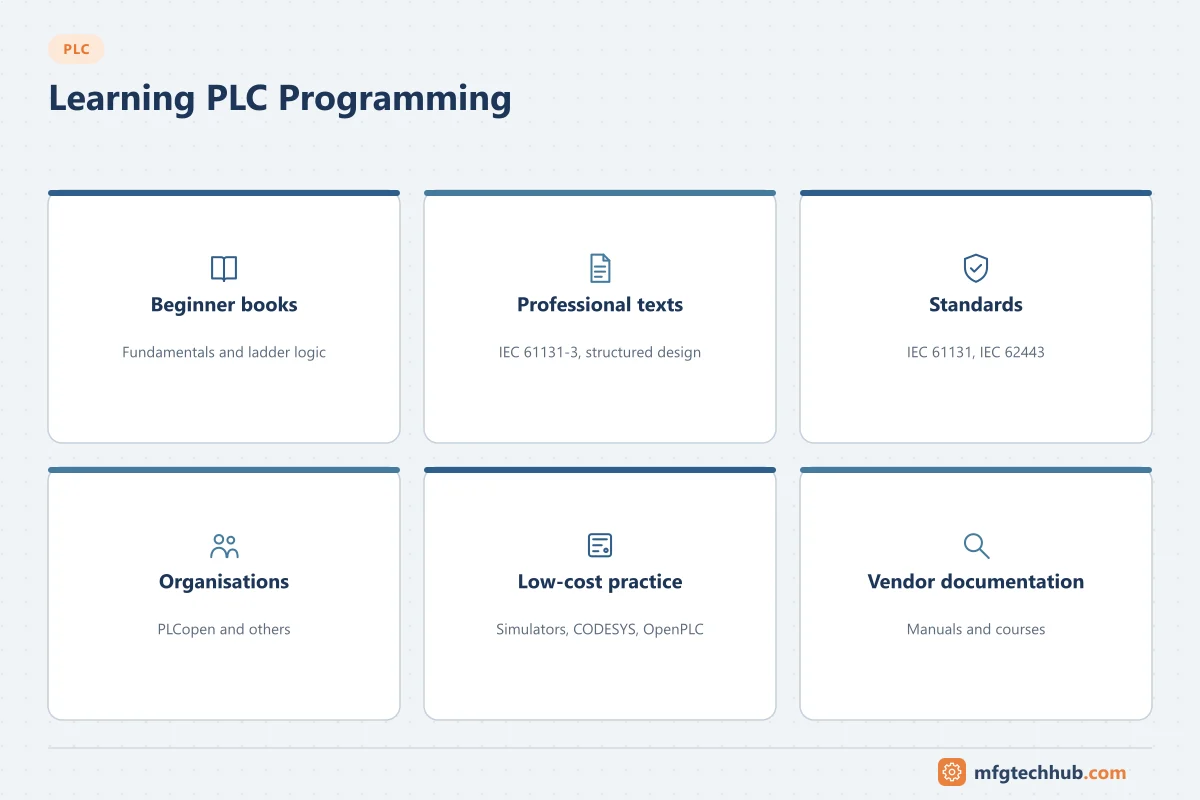
Book editions change over time; check the publisher for the latest edition before buying.
If you are starting out
| Book | Author(s) | Why it is useful |
|---|---|---|
| Programmable Logic Controllers | Frank D. Petruzella (McGraw-Hill) | Widely used introductory textbook: hardware, ladder logic, timers, counters and troubleshooting |
| Automating Manufacturing Systems with PLCs | Hugh Jack | Comprehensive text that the author has made freely available online; good on logic design and sequencing |
| Programmable Logic Controllers | W. Bolton (Newnes/Elsevier) | Concise introduction with clear examples of each programming language |
| Industrial Automation: Hands On | Frank Lamb (McGraw-Hill) | Practical, experience-based guide to sensors, motion, PLCs and machine design |
If you program PLCs professionally
| Book | Author(s) | Why it is useful |
|---|---|---|
| IEC 61131-3: Programming Industrial Automation Systems | Karl-Heinz John and Michael Tiegelkamp (Springer) | Detailed explanation of the IEC 61131-3 languages, data types and program organisation units |
| Programmable Logic Controllers: An Emphasis on Design and Application | Kelvin T. Erickson | Structured design methods for sequential logic, with examples on several platforms |
| Programmable Logic Controllers: Programming Methods and Applications | John R. Hackworth and Frederick D. Hackworth Jr. (Prentice Hall) | Methods for designing logic systematically rather than by trial and error |
Topics on this site that complement these books: PLC Programming Languages, PLC Programming Best Practices and PLC Application Examples.
Standards to know
| Standard | What it covers |
|---|---|
| IEC 61131-1 | General information and definitions for programmable controllers |
| IEC 61131-2 | Equipment requirements and tests (environmental, electrical) |
| IEC 61131-3 | Programming languages (LD, FBD, ST, SFC; IL was deprecated in the third edition) and software model |
| IEC 61131-5 / -6 / -8 | Communications, functional safety for programmable controllers, and guidelines for applying the languages |
| IEC 61499 | Distributed, event-driven function block architecture |
| IEC 62443 series | Security for industrial automation and control systems. See ISA/IEC 62443 |
| IEC 61508 / IEC 61511 / ISO 13849 / IEC 62061 | Functional safety; relevant when PLCs perform safety functions (safety PLCs) |
| NFPA 79 / IEC 60204-1 | Electrical equipment of industrial machines, including control circuits |
Standards are sold by IEC, ISO, ISA and national standards bodies. Many universities and employers provide access. See also PLC Industry Standards and Guidelines.
Organisations and specifications
- PLCopen – vendor-neutral organisation that promotes IEC 61131-3; publishes motion control function blocks, safety function blocks, the PLCopen XML exchange format and coding guidelines.
- OPC Foundation – OPC UA specifications and companion specifications.
- PROFIBUS & PROFINET International (PI) – PROFINET and PROFIBUS specifications and guidelines, including installation guidelines.
- ODVA – EtherNet/IP and CIP specifications.
- EtherCAT Technology Group – EtherCAT specifications.
- Modbus Organization – Modbus protocol specifications (freely downloadable).
- International Society of Automation (ISA) – standards, training and certifications (for example Certified Automation Professional).
- CISA (US Cybersecurity and Infrastructure Security Agency) – public ICS security advisories covering PLC vulnerabilities.
Practice without a large budget
- Vendor starter or free software editions: several PLC manufacturers offer free or low-cost engineering software for their smaller controllers, often with a built-in simulator. Check the vendor’s current offer and licence terms.
- Controller simulators included in engineering tools let you test logic without hardware.
- IEC 61131-3 development environments that support many hardware platforms (for example CODESYS-based tools) are a good way to learn standard languages.
- Machine simulation software (virtual conveyors, sensors and actuators) lets you practise sequences and troubleshooting against a realistic model.
- Small hardware kits: a compact PLC, a few switches, lamps and a small motor or relay teach wiring and diagnostics that software cannot.
Vendor documentation
Vendor manuals are the authoritative source for instruction behaviour, hardware limits, wiring and diagnostics on a specific platform. When books and manuals disagree about a specific product, the current vendor manual wins. Make a habit of reading:
- The CPU and I/O module manuals (specifications, wiring, diagnostics)
- The instruction set or programming reference
- Security and hardening guides
- Release notes when updating firmware or software
Frequently asked questions
What is the best book to learn PLC programming?
For beginners, Frank Petruzella’s Programmable Logic Controllers is widely used in technical education, and Hugh Jack’s Automating Manufacturing Systems with PLCs is freely available. For IEC 61131-3 in depth, John and Tiegelkamp’s book is a standard reference.
Can I learn PLC programming without buying hardware?
Yes, to a large extent. Most engineering tools include simulators, and machine simulation software provides realistic practice. Real hardware still helps for wiring, I/O and diagnostics skills.
Where can I find PLC security advisories?
CISA publishes ICS advisories, and PLC vendors publish product security advisories on their websites. Subscribe to those for the platforms you use.
Related tutorials
Before you apply this in a plant: this article is for education. Always check the current edition of the relevant standards, the manufacturer's documentation for your exact product and version, and your site's procedures. Safety-related work needs qualified personnel. See our editorial policy.