
History of the PLC: From GM's 1968 Relay Replacement to Safety, Motion and Virtual PLCs
On this page
The PLC was invented to solve a very practical problem in car factories: every model change meant rewiring large relay panels, which took weeks and was error-prone. A controller that could be reprogrammed instead of rewired, while still being understood by electricians, changed industrial automation. Almost every later development, from networking to safety and motion, built on that idea.
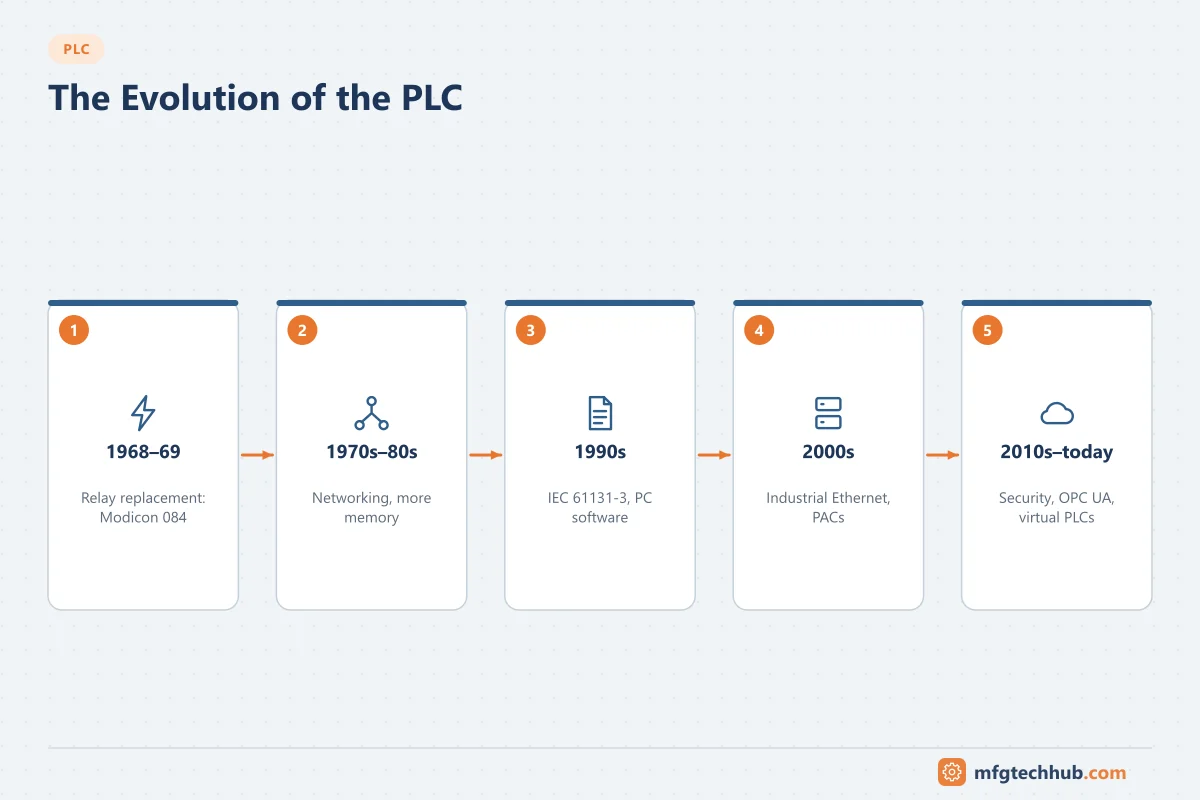
Before the PLC: relay logic
Machines and lines were controlled by relays, timers and drum sequencers wired in panels. Relay logic is easy to understand for small circuits, but large panels had thousands of relays and wires. Changing a sequence meant redesigning drawings and rewiring, relays wore out, and fault finding was slow. The ladder diagram, still used in PLCs, comes from the drawings of these relay circuits.
1968: General Motors and the Modicon 084
In 1968, General Motors’ Hydra-Matic division asked for an electronic replacement for relay control that could be reprogrammed easily, survive the factory environment and be maintained by plant electricians. Bedford Associates, with Dick Morley as a key engineer, developed a solution named MODICON (modular digital controller); the company soon took the same name. The resulting Modicon 084, named after the firm’s 84th project, is widely regarded as the first commercial PLC.
Around the same time, Allen-Bradley entered the market and is generally credited with popularising the term “programmable logic controller” (PLC) in the early 1970s.
1970s–1980s: microprocessors and ladder logic
- Microprocessor-based PLCs replaced early hard-wired logic processors, adding arithmetic, timers, counters and data handling.
- Ladder logic became the standard programming language because it looked like the relay drawings electricians already knew.
- Programming terminals gave way to PC-based software in the 1980s.
- Proprietary networks connected PLCs, remote I/O and operator panels.
- PLCs spread from automotive to packaging, material handling, food and process utilities.
1990s: standards and open networks
- IEC 61131-3 (first published in 1993) standardised PLC programming languages: ladder diagram, function block diagram, structured text, instruction list and sequential function chart. PLCopen (founded in 1992) promotes its use and later defined motion control and safety function blocks.
- Fieldbuses such as PROFIBUS, DeviceNet and Modbus Plus connected distributed I/O and drives.
- Windows-based programming and HMI software became common.
2000s: Ethernet, PACs, safety and motion
- Industrial Ethernet protocols (PROFINET, EtherNet/IP, Modbus TCP, EtherCAT) replaced many fieldbuses.
- Programmable automation controllers (PACs) combined PLC reliability with PC-like capability: tag-based programming, multiple tasks, integrated motion and process control. The line between PLC and PAC has since blurred.
- Integrated safety: safety PLCs and safety I/O certified to IEC 61508, ISO 13849 and IEC 62061 allowed safety functions on the same networks as standard control.
- Integrated motion in the PLC programming environment. See Servo and Motion Control.
2010s: security and connectivity
- Stuxnet, discovered in 2010, targeted Siemens PLCs controlling centrifuges and showed that PLCs could be deliberately attacked. Password protection, signed firmware, secure communication and IEC 62443 certification followed. See PLC Security.
- OPC UA servers built into PLCs and MQTT connectivity made PLC data available to MES, analytics and cloud platforms.
- New controller generations with web servers, integrated diagnostics and much larger memory; for example, Siemens introduced the S7-1500 family in the early 2010s as the successor to the S7-300 and S7-400.
2020s: software-defined control
- Virtual PLCs run control software on industrial server hardware; Siemens’ S7-1500V is one example. See PLC Technology: Future Outlook.
- IEC 61499 and open automation initiatives aim at portable, hardware-independent control applications.
- Lifecycle pressure: older families reach end of life. Siemens’ S7-300, for example, reached product discontinuation (PM410) on 1 October 2025, meaning new units are no longer sold as regular products and support is time-limited.
Timeline
| Period | Development | What it changed |
|---|---|---|
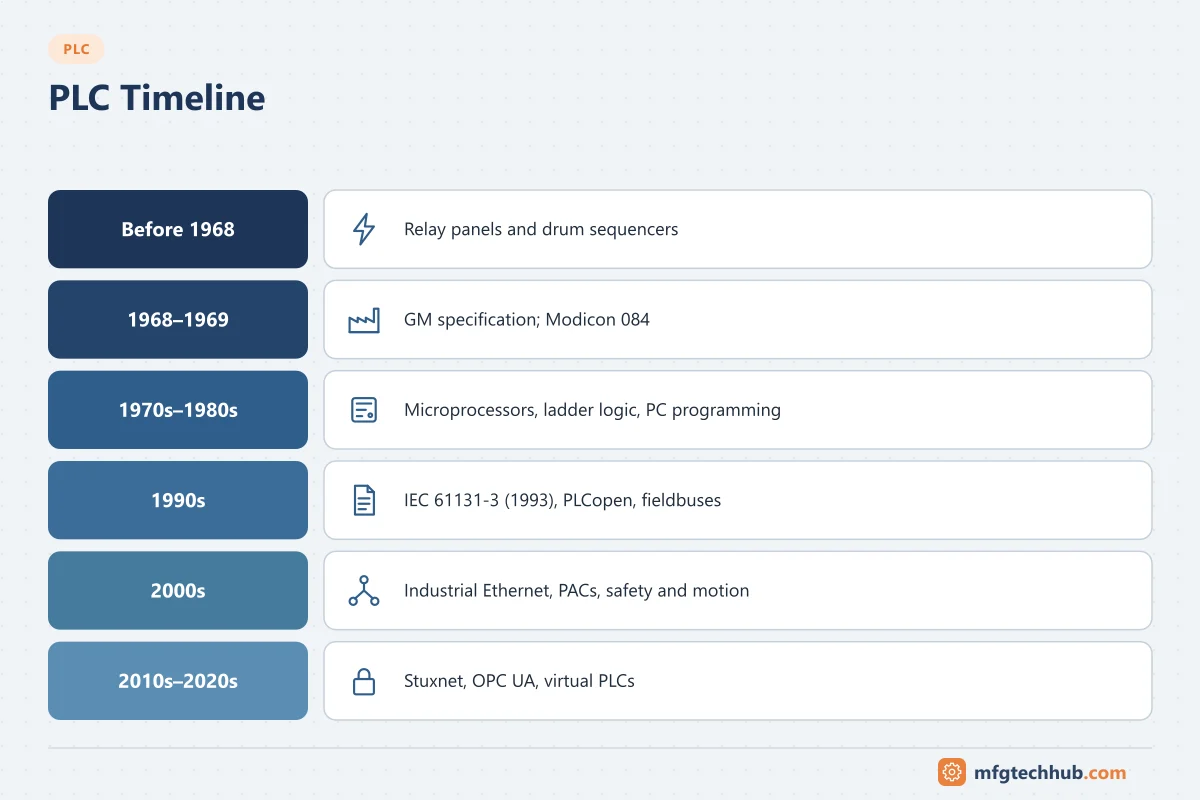
| Before 1968 | Relay panels, drum sequencers | Rewiring for every change |
| 1968–1969 | GM specification; Modicon 084 | Reprogrammable control for factories |
| Early 1970s | Allen-Bradley popularises the term PLC | PLC industry forms |
| 1970s–1980s | Microprocessors, ladder logic, PC programming | Arithmetic, data handling, easier programming |
| 1990s | IEC 61131-3 (1993), PLCopen, fieldbuses | Common languages, distributed I/O |
| 2000s | Industrial Ethernet, PACs, integrated safety and motion | One controller for many functions |
| 2010s | Stuxnet, OPC UA, new controller generations | Security and connectivity requirements |
| 2020s | Virtual PLCs, IEC 61499, lifecycle transitions | Software-defined, hardware-independent control |
What this means for installed systems
Many plants run PLCs from several generations. Older controllers may still work reliably but face spare parts shortages, unsupported programming software, weak security and fewer engineers who know them. Plan migrations before failures force them: inventory, support status, spares and a phased replacement plan. See PLC Upgrading and Integration Challenges.
Frequently asked questions
Who invented the PLC?
The first commercial PLC, the Modicon 084, was developed by Bedford Associates (later Modicon), with Dick Morley as a key engineer, in response to a 1968 General Motors request for a reprogrammable replacement for relay control.
Why is ladder logic used in PLCs?
Because it resembles the relay circuit drawings that electricians and maintenance staff already knew, which made the new controllers easier to accept and maintain.
When was IEC 61131-3 published?
The first edition was published in 1993. It standardised the main PLC programming languages and has been revised since.
Key takeaways
- The PLC was created in 1968–1969 to replace rewiring of relay panels with reprogramming.
- Ladder logic kept the familiar relay-drawing style; IEC 61131-3 standardised the languages in 1993.
- Networks, safety, motion and connectivity turned the PLC into a multi-function controller.
- Security, lifecycle management and software-defined control shape PLCs today.
Related tutorials
Before you apply this in a plant: this article is for education. Always check the current edition of the relevant standards, the manufacturer's documentation for your exact product and version, and your site's procedures. Safety-related work needs qualified personnel. See our editorial policy.