
History of SCADA: From Telemetry Panels to Networked, Web-Based and Secure Systems
On this page
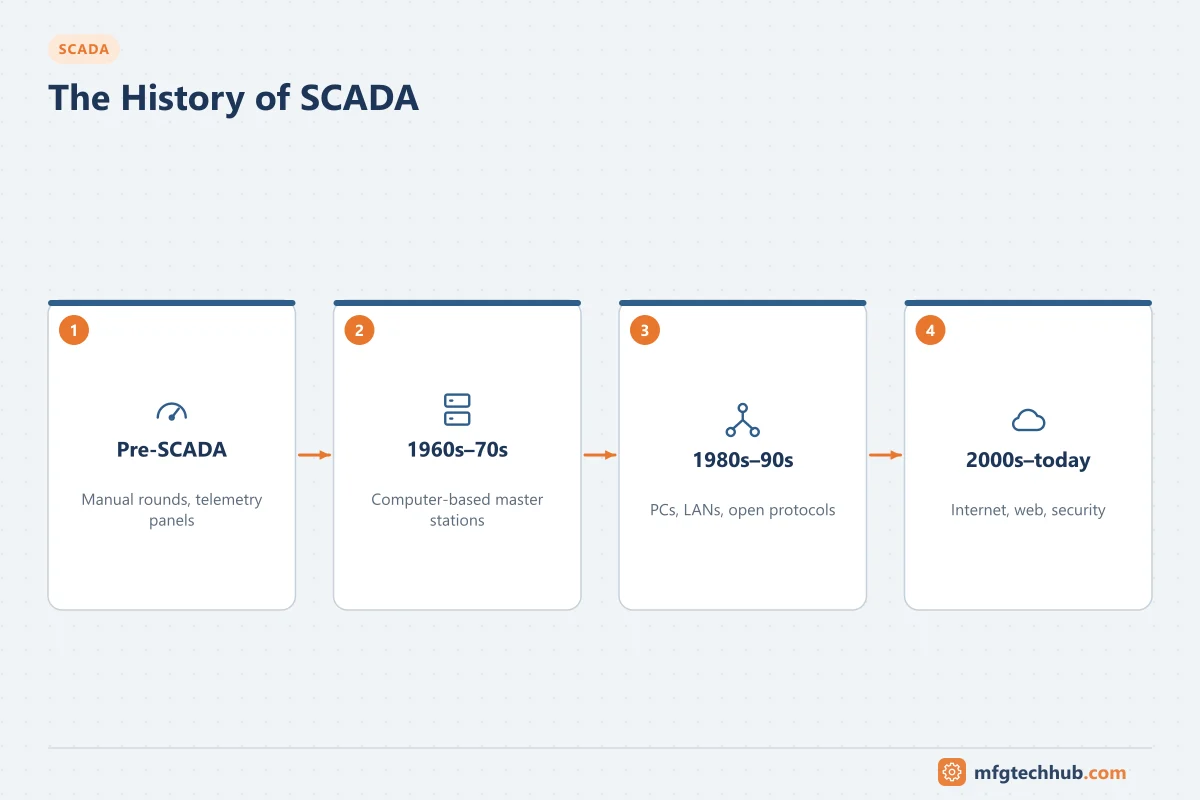
SCADA grew out of a practical need: utilities and pipeline operators had equipment spread over hundreds of kilometres and needed to know what it was doing without sending someone to every site. The answer evolved from hard-wired telemetry and wall panels, through proprietary computer master stations, to today’s networked, software-based platforms. Each step added capability, and the step to open networks also added a problem that now shapes every SCADA design: cybersecurity.
Before SCADA: telemetry and mimic panels
Early remote monitoring used telemetry: signals sent over telephone lines, power-line carrier or dedicated cables to a central room, where they drove indicator lamps, meters and chart recorders on a mimic panel showing the network. Remote control was limited to simple on/off commands through relays. Operators also relied heavily on site visits and telephone calls.
These systems worked, but every point needed dedicated hardware, the panel had to be rebuilt for every change, and there was little history beyond paper charts.
Computer-based master stations (1960s–1970s)
As computers became available, utilities replaced or supplemented mimic panels with computer master stations that polled remote terminal units (RTUs) over communication lines. The term SCADA came into use in this period. Systems were:
- Monolithic: one vendor’s mainframe or minicomputer, often with a duplicate for redundancy.
- Proprietary: vendor-specific RTUs and protocols, so extending the system meant buying from the same supplier.
- Utility-focused: power, water and pipelines were the main users.
PCs, LANs and open protocols (1980s–1990s)
- Distributed SCADA: functions spread over several computers on a local network instead of one central machine.
- PC-based operator stations with graphical displays replaced mimic panels and text terminals.
- Open protocols: Modbus (1979) became a de facto standard for connecting controllers; DNP3 was released as an open protocol in 1993; the IEC 60870-5 series (including -101 for serial links) was standardised in the 1990s, followed by IEC 60870-5-104 for TCP/IP in 2000.
- PLCs increasingly used as outstations alongside RTUs.
- SCADA software packages running on standard PCs made SCADA common in manufacturing plants as well as utilities.
Networked and internet-era SCADA (2000s–2010s)
- Ethernet and IP networks reached remote sites through fibre, cellular and IP radio.
- Web clients and remote access made SCADA visible outside the control room.
- Historians and business integration connected SCADA data to enterprise systems.
- OPC and later OPC UA became the common integration interfaces.
- IEEE 1815 standardised DNP3 in 2010; the 2012 edition added Secure Authentication version 5.
Connectivity exposed SCADA to cyber threats. Stuxnet (discovered 2010) showed that industrial control systems could be targeted deliberately, and the attacks on Ukrainian power distribution companies in December 2015 caused real outages through compromised SCADA. Security frameworks such as ISA/IEC 62443 and sector rules such as NERC CIP for North American power became central to SCADA design. See ISA/IEC 62443.
IIoT and modern SCADA (2010s onwards)
- MQTT, created in 1999 by Andy Stanford-Clark (IBM) and Arlen Nipper to connect oil pipeline sensors to SCADA over costly satellite links, became a mainstream IIoT protocol; Sparkplug B adds a SCADA-oriented payload and state model. See MQTT and Sparkplug B.
- Edge devices buffer data and publish by exception.
- Server-based licensing and web-native HMIs reduce the cost of adding clients.
- Virtualised and cloud-hosted servers for some functions, with control kept local.
- Cellular technologies (LTE, LTE-M, NB-IoT) replacing retired 2G and 3G networks at remote sites.
See Traditional vs Modern SCADA Architecture.
Timeline
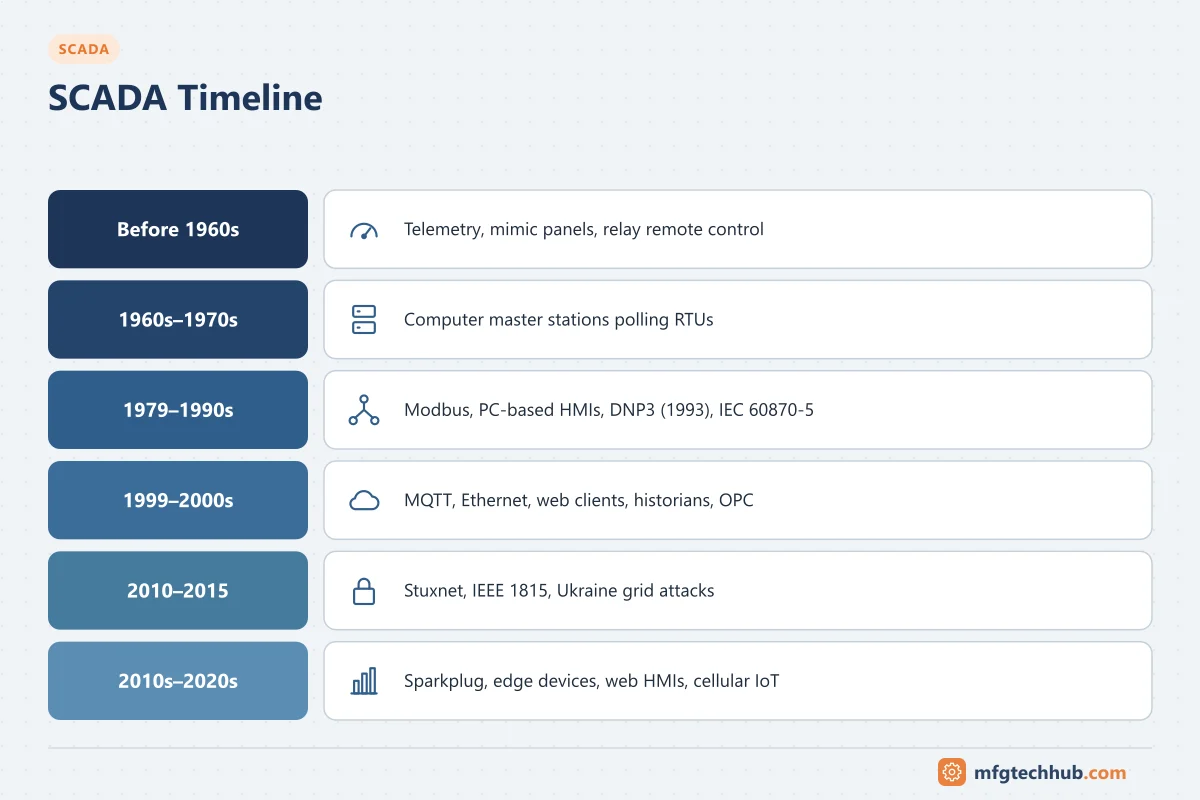
| Period | Development | What it changed |
|---|---|---|
| Before 1960s | Telemetry, mimic panels, relay-based remote control | Central view of remote assets, limited and hard-wired |
| 1960s–1970s | Computer master stations and RTUs | Polling, central database, first “SCADA” systems |
| 1979 | Modbus | Simple, open controller protocol |
| 1980s–1990s | Distributed and PC-based SCADA, graphical HMIs | Lower cost, SCADA spreads to manufacturing |
| 1993 | DNP3 released as an open protocol | Interoperable utility telemetry with events and timestamps |
| 1990s–2000 | IEC 60870-5-101 and -104 | International telecontrol standards |
| 1999 | MQTT | Lightweight publish/subscribe for constrained links |
| 2000s | Ethernet, web clients, historians, OPC | Integration with business systems |
| 2010 | Stuxnet; IEEE 1815 (DNP3) | Cybersecurity becomes a design requirement |
| 2015 | Ukraine grid attacks | First confirmed outages caused by a cyberattack on SCADA |
| 2010s–2020s | MQTT/Sparkplug, edge, web HMIs, cellular IoT | Report-by-exception at scale, flexible architectures |
What this means for systems today
- Many utilities still run RTUs and protocols from the 1990s; migration projects must keep them working while new sites use newer technology.
- Cellular network sunsets force communication upgrades at remote sites.
- Systems designed before modern security practice need segmentation, secure remote access and monitoring added.
- The architecture choice (traditional master station or edge/MQTT-based) depends on the network, the devices and the operator’s skills, not only on fashion.
Frequently asked questions
When was SCADA invented?
There is no single invention date. Telemetry and mimic panels predate computers; computer-based master stations that gave SCADA its name appeared in the 1960s and 1970s.
Why was DNP3 created?
To give North American utilities an open, interoperable protocol for SCADA telemetry, with features such as event reporting and timestamps. It was released as an open protocol in 1993 and standardised as IEEE 1815 in 2010.
Was MQTT designed for SCADA?
Yes. It was created in 1999 to connect oil pipeline equipment to SCADA over satellite links, where bandwidth was expensive and connections unreliable.
Key takeaways
- SCADA evolved from telemetry panels to computer master stations, then to distributed, PC-based and networked systems.
- Open protocols (Modbus, DNP3, IEC 60870-5, OPC, MQTT) made multi-vendor SCADA possible.
- Connectivity made cybersecurity a core design requirement after Stuxnet and the 2015 Ukraine attacks.
- Most real systems mix generations and need planned migration.
Related tutorials
Before you apply this in a plant: this article is for education. Always check the current edition of the relevant standards, the manufacturer's documentation for your exact product and version, and your site's procedures. Safety-related work needs qualified personnel. See our editorial policy.