
Industrial Historian Software Compared: AVEVA PI, Proficy Historian, Aspen InfoPlus.21, Canary, Honeywell PHD, Ignition and More
On this page
A historian is usually the longest-lived piece of software in a plant’s data architecture: many sites keep the same historian for ten to twenty years while SCADA, MES and analytics tools change around it. Choosing one is therefore a significant decision. This guide profiles the main products, explains what each is known for, and gives an objective way to choose.
For how historians work (collection, compression, retrieval, asset models), read Industrial Historians Explained first.
Last technical review: September 2026. Ownership in this market has changed repeatedly: Schneider Electric owns AVEVA (which acquired OSIsoft, the original developer of the PI System), GE Vernova sold its Proficy software business to TPG (completed March 2026), and Emerson completed its acquisition of the remaining shares of AspenTech in March 2025. Always confirm current product names, editions, licensing and support with the vendor.
No single product is “the best”. Each suits different plants, scales, control-system landscapes and budgets. The profiles below describe capabilities and typical fit so you can shortlist objectively.
Types of historian products
| Type | Examples | Typical fit |
|---|---|---|
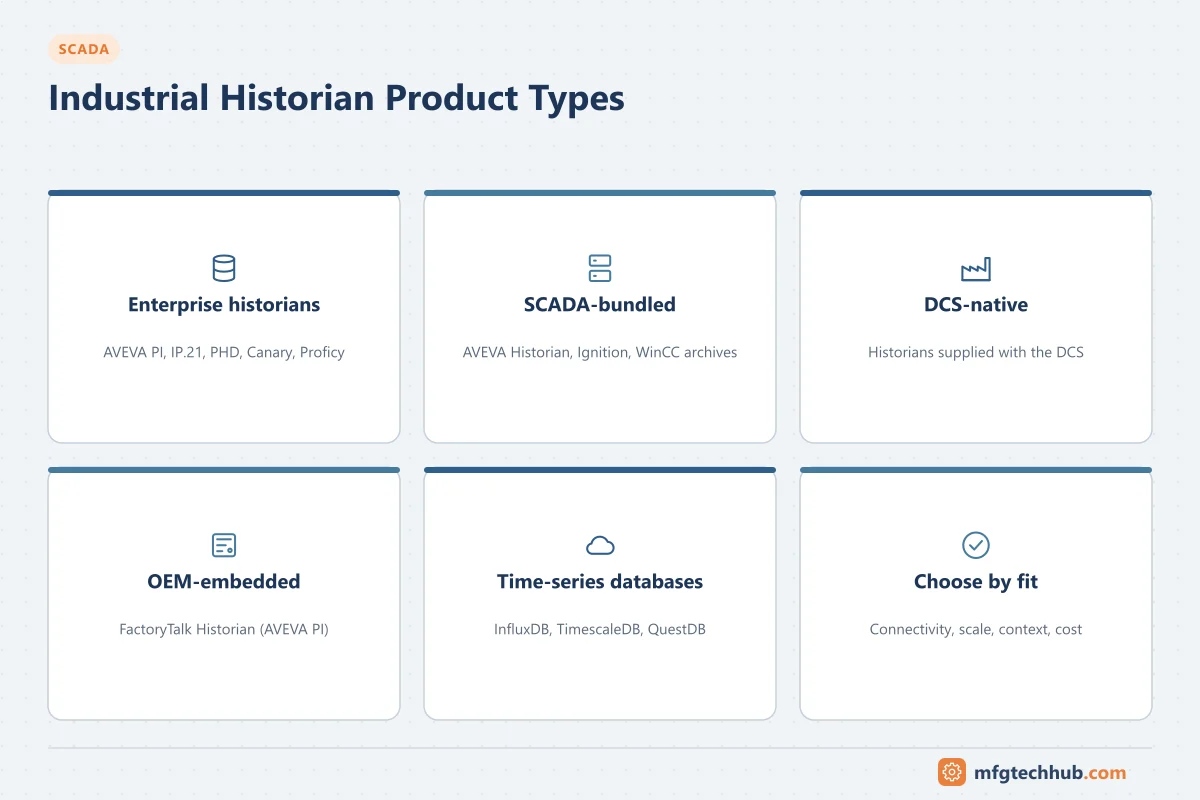
| Enterprise / infrastructure historians | AVEVA PI System, AspenTech InfoPlus.21, Honeywell Uniformance PHD, Canary, Proficy Historian | Large sites and multi-site companies; long retention; many data sources |
| Historians bundled with SCADA or HMI platforms | AVEVA Historian (with AVEVA System Platform), Ignition historian modules, Siemens WinCC archives and SIMATIC Process Historian | Sites standardised on that platform; simpler architectures |
| DCS-native historians | Historians supplied with DCS platforms (for example DeltaV Continuous Historian, ABB 800xA Information Manager) | Data from one DCS; often forwarded to an enterprise historian |
| OEM-embedded historians | FactoryTalk Historian (powered by the AVEVA PI System) | Rockwell-centric sites |
| General time-series databases | InfluxDB, TimescaleDB, QuestDB, cloud time-series services | IIoT projects, custom applications, developer-led teams |
Vendor profiles
AVEVA PI System (Schneider Electric group)
- Core components: the PI Server (the Data Archive for time-series storage and PI Asset Framework (AF) for asset models, calculations and Event Frames), a large family of interfaces, adapters and connectors for data collection, PI Vision for web-based displays, and integrators for exporting data to analytics platforms.
- Cloud: AVEVA’s CONNECT platform provides cloud data services; agents transfer data from PI Servers to CONNECT.
- Known for: a very large installed base in process industries, utilities and pharmaceuticals; a broad ecosystem of connectors, partners and trained engineers; mature asset modelling and event framing.
- Considerations: licensing and total cost need careful evaluation at scale; asset models and interfaces need governance to stay clean across sites.
- Typical fit: enterprise-wide historians in multi-site process and utility companies, and regulated industries needing a widely validated platform.
AVEVA Historian
- Formerly the Wonderware Historian; closely integrated with AVEVA System Platform and InTouch HMI.
- Known for: tight integration with AVEVA’s supervisory products and SQL-based access to data.
- Typical fit: sites standardised on AVEVA System Platform or InTouch, often at site level alongside or feeding an enterprise PI System.
Proficy Historian (Proficy, owned by TPG)
- Part of the Proficy software portfolio (with iFIX, CIMPLICITY, Plant Applications MES and Operations Hub), which GE Vernova sold to TPG; Proficy now operates as a standalone business.
- Known for: integration with Proficy HMI/SCADA and MES products, collectors for common industrial sources, and on-premises and cloud deployment options.
- Considerations: confirm roadmap, support and partner coverage under the new ownership.
- Typical fit: sites using Proficy iFIX, CIMPLICITY or Plant Applications; manufacturers wanting an integrated suite from one vendor.
Aspen InfoPlus.21 (AspenTech, an Emerson company)
- Aspen InfoPlus.21 (IP.21) is a real-time process historian widely used in refining, chemicals and petrochemicals, together with tools such as Aspen Process Explorer and Aspen SQLplus. AspenTech positions IP.21 within its industrial data management offerings alongside AspenTech Inmation for OT/IT data integration.
- Known for: strong use in hydrocarbon processing, integration with AspenTech’s advanced process control, planning and optimisation software.
- Typical fit: refineries and chemical plants using AspenTech APC or planning tools. See Oil Refinery Automation.
Honeywell Uniformance PHD
- Uniformance Process History Database (PHD) collects, stores and replays process data, with Uniformance tools for visualisation and analysis.
- Known for: integration with Honeywell Experion DCS and Honeywell’s operations software; use in refining, chemicals and oil and gas.
- Typical fit: Honeywell-centric process plants.
Canary (Canary Labs)
- An independent historian vendor. The platform combines data collectors (with OPC DA, OPC UA, OPC HDA, MQTT and SQL connectors), store-and-forward, the historian database, the Axiom dashboard tool, virtual views for asset context and a calculation server.
- Known for: lossless compression, ease of deployment and a licensing model the vendor describes as not priced per tag; strong adoption in utilities, oil and gas and manufacturing, and among SCADA integrators.
- Typical fit: sites wanting a stand-alone historian with straightforward deployment and pricing, including MQTT/Sparkplug architectures.
Ignition historian modules (Inductive Automation)
- Ignition 8.3 introduced a Core Historian based on QuestDB, alongside the SQL Historian that stores data in external SQL databases, and a Historian API for custom historian back-ends.
- Known for: integration with Ignition SCADA and MES modules, unlimited-tag licensing of the Ignition platform, and flexible database options.
- Typical fit: plants standardised on Ignition; integrators building IIoT and unified-namespace architectures. See SCADA and HMI Platforms Compared.
Siemens SIMATIC Process Historian and WinCC archives
- SIMATIC Process Historian provides central long-term archiving of process values and alarms from WinCC and PCS 7 systems, with the Information Server for reports.
- Known for: tight integration with Siemens HMI/SCADA and DCS, including alarm archiving.
- Typical fit: Siemens-standardised plants; often forwarded to an enterprise historian for cross-site use.
Rockwell FactoryTalk Historian
- FactoryTalk Historian is powered by the AVEVA PI System and optimised for Rockwell controllers and FactoryTalk software; smaller editions exist for machine- and line-level use.
- Typical fit: Rockwell-centric manufacturing sites; integrates with AVEVA PI enterprise infrastructure.
General-purpose time-series databases
- InfluxDB, TimescaleDB, QuestDB and cloud time-series services are used for IIoT and custom applications.
- Strengths: open interfaces, developer tooling, low entry cost, cloud-native deployment.
- Considerations: you build what industrial historians provide out of the box: OPC collectors, store-and-forward, exception/compression, quality codes, asset models, event frames, validation evidence and long-term support. See the comparison in Industrial Historians Explained.
Capability comparison (qualitative)
| Capability | Enterprise historians | SCADA-bundled historians | Time-series databases |
|---|---|---|---|
| Industrial collectors (OPC, DCS interfaces) | Extensive | Platform drivers | Usually third-party or custom |
| Store-and-forward at the edge | Standard | Varies | Must be built |
| Asset models and event frames | Mature in several products | Varies by platform | Must be built |
| Enterprise scale (many sites, millions of tags) | Designed for it | Varies | Possible with engineering effort |
| Regulated (GMP) validation evidence | Widely available for major products | Varies | Customer responsibility |
| Licensing | Commercial, various models | Often bundled with platform | Open source and commercial options |
Selection criteria
| Criterion | Questions to ask |
|---|---|
| Connectivity | Native collectors for all your DCS, SCADA, PLC and OPC sources? MQTT/Sparkplug? Store-and-forward and backfill? |
| Scale and performance | Tag count now and in five years; write rates; query performance on long ranges |
| Data model and context | Asset models, templates, event frames, batch and alarm/event storage |
| Retrieval and integration | Client tools, Excel add-ins, SQL/ODBC, REST APIs, OPC HDA/UA, connectors to data platforms and cloud |
| Availability | Redundant collectors and servers, replication between site and enterprise |
| Security | Authentication integration, encryption, role-based access, audit trails, vulnerability disclosure and patching |
| Regulated use | Audit trails, electronic records support, supplier validation documentation. See Computerised System Validation |
| Operations | Administration tools, monitoring, backup, upgrade effort, skills available locally |
| Licensing and cost | Per tag, per server, per user, subscription or perpetual; cost of connectors and clients; five-year total cost |
| Vendor and ecosystem | Ownership stability, roadmap, local partners and support, user community |
A practical evaluation plan
- Write requirements from the criteria above, including tag counts, sources, retention and users.
- Shortlist two or three products that fit your control-system landscape and scale.
- Run a proof of concept with your own data sources: connect, simulate network loss, backfill, query a year of data, build an asset model, integrate with one consumer (for example MES or a BI tool).
- Check references from companies of similar size and industry.
- Compare five-year total cost including licences, infrastructure, integration, support and staff.
- Plan migration from any existing historian early. See Historian Migration Runbook.
Frequently asked questions
What is the most widely used industrial historian?
The AVEVA PI System (originally developed by OSIsoft) has one of the largest installed bases, especially in process industries and utilities. Other products such as Aspen InfoPlus.21, Honeywell PHD, Proficy Historian and Canary are also widely used, and many plants run historians bundled with their SCADA or DCS.
Who owns Proficy Historian now?
Proficy, including Proficy Historian, was sold by GE Vernova to TPG; the sale completed in March 2026 and Proficy operates as a standalone business.
Can I use InfluxDB or another time-series database instead of a historian?
Yes, particularly for IIoT and custom applications, but you must provide industrial features yourself: OPC and DCS connectivity, store-and-forward, quality handling, asset context, long-term support and, in regulated industries, validation evidence.
Key takeaways
- Historians range from enterprise platforms to SCADA-bundled and DCS-native products, plus general time-series databases.
- Ownership has changed across the market; confirm current vendor details before selecting.
- Choose by connectivity, scale, context features, integration, security, regulated-use support, operations and five-year cost, validated with a proof of concept on your own data.
Related tutorials
Before you apply this in a plant: this article is for education. Always check the current edition of the relevant standards, the manufacturer's documentation for your exact product and version, and your site's procedures. Safety-related work needs qualified personnel. See our editorial policy.