
SCADA and HMI Platforms Compared: Vendors, Architectures and How to Choose
On this page
There is no single “best” SCADA platform. The right choice depends on your controllers, industry, system size, redundancy needs, IT capabilities, licensing preferences and local support. This page gives a vendor-neutral overview of widely used platforms and, more importantly, a framework for comparing them.
Last technical review: September 2026. Product names and ownership change through acquisitions and new releases. Always confirm current product names, versions, licensing and lifecycle status on the vendor’s official website before making decisions.
Platform categories
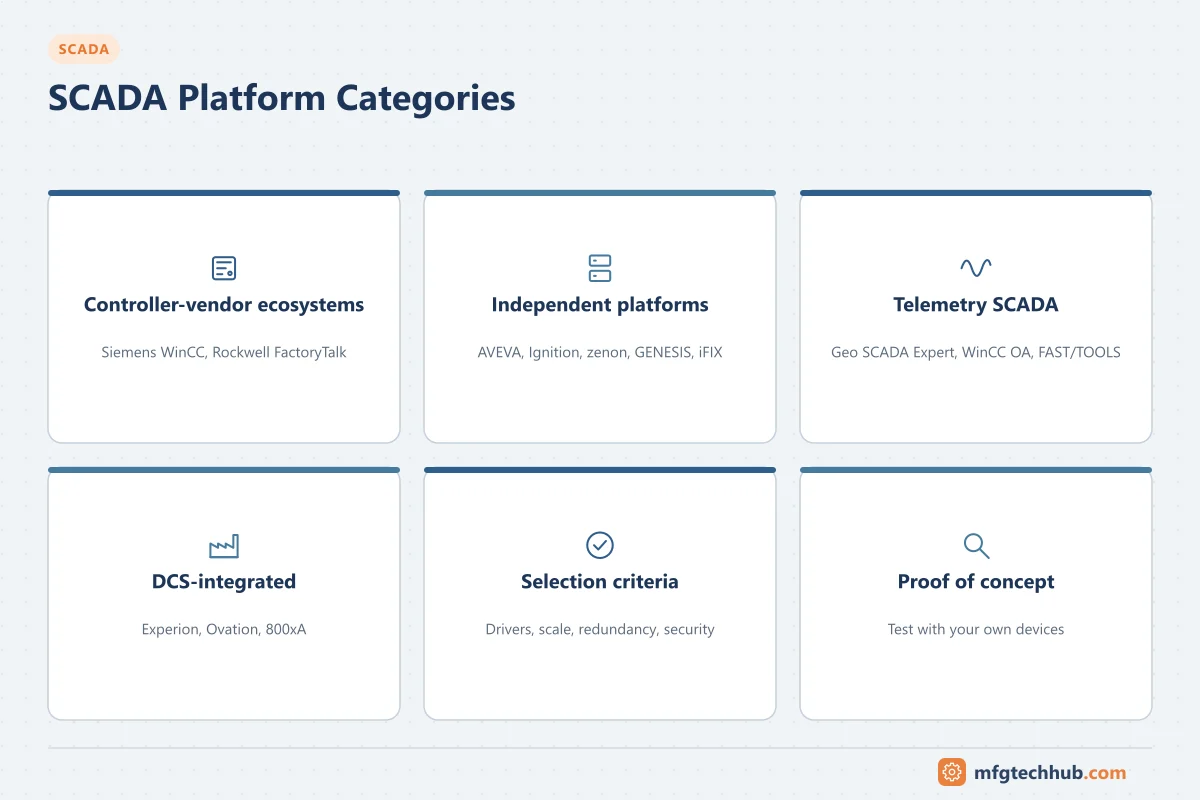
SCADA products fall roughly into four groups:
| Category | Typical strengths | Examples |
|---|---|---|
| Controller-vendor ecosystems | Tight integration with the same vendor’s PLCs, drives and engineering tools | Siemens WinCC family, Rockwell FactoryTalk View and FactoryTalk Optix |
| Independent / multi-vendor SCADA | Broad driver libraries, open architectures, used across many controller brands | AVEVA (System Platform, InTouch, Plant SCADA), Inductive Automation Ignition, Proficy iFIX and CIMPLICITY, Mitsubishi Electric Iconics GENESIS, COPA-DATA zenon |
| Telemetry and utility SCADA | Remote sites, DNP3/IEC 60870-5, low-bandwidth communications | Schneider Electric EcoStruxure Geo SCADA Expert, Siemens WinCC Open Architecture, Yokogawa FAST/TOOLS, ABB SCADA offerings for utilities and oil and gas |
| DCS-integrated supervisory systems | Unified with a DCS for process plants; also used as SCADA in some sectors | Honeywell Experion, Emerson Ovation (power and water), ABB System 800xA, Yokogawa CENTUM with FAST/TOOLS |
The same vendor can appear in several groups, and boundaries between SCADA, HMI, MES and DCS continue to blur.
Overview of widely used platforms
| Vendor | Platform(s) | Notes for evaluation |
|---|---|---|
| Siemens | SIMATIC WinCC (including WinCC Unified), WinCC Open Architecture | WinCC integrates closely with TIA Portal and SIMATIC controllers; WinCC Open Architecture targets large, distributed and customised systems such as infrastructure and utilities |
| Rockwell Automation | FactoryTalk View (ME/SE), FactoryTalk Optix | View SE is widely installed with Logix controllers; FactoryTalk Optix is a newer, web- and OPC UA-oriented HMI platform that can complement View SE |
| AVEVA (part of Schneider Electric) | AVEVA System Platform, AVEVA InTouch HMI, AVEVA Plant SCADA | System Platform uses an object-based, supervisory architecture for large multi-site systems; InTouch (formerly Wonderware) is a long-established HMI; Plant SCADA is the former Citect SCADA |
| Schneider Electric | EcoStruxure Geo SCADA Expert | Formerly ClearSCADA; focused on geographically distributed assets such as water and oil and gas |
| Inductive Automation | Ignition | Server-licensed platform with web-based clients, modular architecture and broad connectivity; licensing model is often cited as a differentiator for large tag and client counts |
| Proficy (independent since 2026, previously GE Vernova / GE Digital) | Proficy iFIX, Proficy CIMPLICITY | Long-established HMI/SCADA products with a large installed base, now in an independent software business owned by TPG |
| Mitsubishi Electric Iconics Digital Solutions | GENESIS (version 11) and GENESIS64 | Visualisation, SCADA, building and energy applications; GENESIS 11 is the successor generation to GENESIS64 |
| COPA-DATA | zenon | Used in manufacturing, energy and infrastructure; strong in regulated and energy applications |
| Honeywell (Honeywell Technologies) | Experion platforms | Supervisory control for process plants and, in some configurations, SCADA for remote assets |
| Yokogawa | FAST/TOOLS | SCADA for distributed assets such as pipelines and utilities |
| Emerson | Ovation | Control and SCADA for power generation and water/wastewater |
| ABB | System 800xA and utility/oil-and-gas SCADA offerings | 800xA is a DCS-based collaborative system; ABB also supplies network-management and SCADA products for utilities |
This is not an exhaustive list. Regional and industry-specific platforms, and open-source projects, are also used.
Vendor capability profiles
The profiles below summarise how each platform is built, what it is known for, what to check, and where it typically fits. They are a starting point for a shortlist, not a ranking.
Siemens: SIMATIC WinCC family and WinCC Open Architecture
- Architecture: WinCC (V7/V8) is a client/server SCADA for Windows; WinCC Unified is the newer generation, engineered in TIA Portal with web-based (HTML5) clients and JavaScript scripting; WinCC Open Architecture (developed by Siemens’ ETM) uses a distributed “manager” architecture for very large, geographically spread systems.
- Strengths: integration with SIMATIC S7 controllers and TIA Portal engineering; long-term archiving options (Process Historian); WinCC OA scales to large distributed and redundant systems.
- Check: migration effort between WinCC generations; licensing by tags and clients; skills for WinCC OA customisation.
- Typical fit: Siemens-standardised machines and plants; WinCC OA for infrastructure, energy, transport and large utilities.
Rockwell Automation: FactoryTalk View and FactoryTalk Optix
- Architecture: FactoryTalk View SE (site/distributed) and ME (machine-level); FactoryTalk Optix is a newer HMI/visualisation platform with an OPC UA-based information model, web clients and cloud-assisted engineering.
- Strengths: tight integration with Logix controllers, tag browsing and faceplates from Rockwell libraries; PlantPAx process libraries; large integrator base in North America.
- Check: licensing structure (servers, clients, activations), mixed View SE and Optix architectures, multi-vendor connectivity.
- Typical fit: Rockwell-centric discrete and hybrid plants; OEM machines using Logix controllers.
AVEVA (Schneider Electric): System Platform, InTouch HMI, Plant SCADA
- Architecture: AVEVA System Platform uses a “Galaxy” of object templates deployed across redundant application servers, with a central repository; InTouch HMI is the long-established HMI (formerly Wonderware); Plant SCADA (formerly Citect SCADA) is a scalable SCADA with strong redundancy.
- Strengths: object-based engineering for large, multi-site systems; broad connectivity through AVEVA communication drivers; integration with AVEVA Historian, PI System and MES products.
- Check: subscription vs perpetual licensing options; required skills for System Platform template design; architecture complexity for small sites.
- Typical fit: multi-site manufacturers, food and beverage, life sciences, water and infrastructure.
Schneider Electric: EcoStruxure Geo SCADA Expert
- Architecture: a server-based telemetry SCADA with a built-in database, historian and web/mobile clients, designed for distributed assets (formerly ClearSCADA).
- Strengths: native telemetry protocols (DNP3 and others), efficient handling of remote outstations and communications, integrated historian.
- Check: fit for high-speed plant-floor HMI versus wide-area telemetry.
- Typical fit: water and wastewater networks, oil and gas production, pipelines. See SCADA Telemetry Communications.
Inductive Automation: Ignition
- Architecture: a Java-based server (“Gateway”) with modules for drivers, historian, alarming, reporting and MES; Perspective web/mobile clients and Vision desktop clients; Gateway Network for multi-site architectures; redundancy.
- Strengths: licensing per server with unlimited tags and clients, rapid development, Python (Jython) scripting, native MQTT/Sparkplug through modules, large integrator community. Ignition 8.3 added the Core Historian based on QuestDB.
- Check: governance of scripting and project standards; module selection; support model through integrators.
- Typical fit: multi-vendor plants, IIoT and unified-namespace architectures, fast-growing manufacturers.
Proficy (TPG): iFIX and CIMPLICITY
- Architecture: iFIX is a Windows SCADA with a process database and VBA scripting; CIMPLICITY is a client/server SCADA with object and web features. Both integrate with Proficy Historian and Proficy Operations Hub.
- Strengths: large installed base in manufacturing, water and infrastructure; integrated Proficy suite (historian, MES).
- Check: roadmap and support under the new ownership (TPG, completed March 2026); migration paths for older versions.
- Typical fit: existing Proficy sites; companies wanting a suite from one vendor.
Mitsubishi Electric Iconics: GENESIS
- Architecture: GENESIS (version 11, successor to GENESIS64) provides HMI/SCADA, historian, analytics and building/energy management with web clients.
- Strengths: visualisation, building and energy applications, integration with Mitsubishi Electric automation.
- Typical fit: facilities, energy management, Mitsubishi-centric plants.
COPA-DATA: zenon
- Architecture: a platform for HMI, SCADA and energy automation with strong object-oriented engineering and many native drivers.
- Strengths: energy and substation automation features, regulated-industry features for pharma and food, device-independent engineering.
- Typical fit: energy, utilities, pharmaceuticals, food and beverage, OEM machines.
Process and telemetry platforms from DCS vendors
- Yokogawa FAST/TOOLS: SCADA for pipelines, oil and gas and utilities, often combined with CENTUM VP.
- Emerson Ovation: control and SCADA for power generation and water/wastewater.
- Honeywell Experion (Honeywell Technologies since the June 2026 Aerospace spin-off): supervisory control for process plants and remote assets.
- ABB: System 800xA for process plants and separate network-management/SCADA products for utilities.
These are usually chosen together with the vendor’s DCS; see DCS Vendors and Platforms Compared.
Quick comparison by requirement
| If your priority is… | Platforms often shortlisted |
|---|---|
| One PLC brand and integrated engineering | Controller-vendor ecosystem for that brand (Siemens WinCC, Rockwell FactoryTalk) |
| Many PLC brands, many sites, object templates | AVEVA System Platform, Ignition, zenon, GENESIS |
| Unlimited tags/clients licensing and web clients | Ignition; compare others’ web and licensing options |
| Remote telemetry (DNP3, IEC 104) | Geo SCADA Expert, WinCC OA, FAST/TOOLS, utility SCADA products |
| Energy and substations (IEC 61850) | zenon, WinCC OA, utility SCADA products from DCS and grid vendors |
| Process plant with a DCS | The DCS vendor’s operator system, with SCADA for remote sites |
Objective selection criteria
| Criterion | Questions to ask |
|---|---|
| Connectivity | Native drivers for your PLCs, RTUs and IEDs? OPC UA client/server? DNP3, IEC 60870-5-104, IEC 61850, Modbus, MQTT? |
| Architecture and scale | Tag, client and server limits? Multi-site and hierarchical architectures? Performance at your expected update rates? |
| Redundancy | Hot-standby servers, redundant communication paths, historian failover, tested switchover times? |
| Engineering efficiency | Object/template model, bulk engineering, version control, multi-user development, deployment tools? |
| Operator interface | Support for high-performance HMI (ISA-101), web and mobile clients, alarm management features (ISA-18.2)? |
| Historian | Built-in or separate? Compression, retention, integration with enterprise historians and analytics? |
| Security | Role-based access, directory integration, encrypted communications, audit trails, IEC 62443 certification of product or development process, patch cadence? |
| Regulated use | Audit trails and electronic signatures for 21 CFR Part 11 / EU Annex 11 environments? Validation support? |
| Integration | APIs, SQL, MQTT, MES/ERP connectivity? |
| Licensing and cost | Per tag, per client, per server, subscription or perpetual? Upgrade and support costs over 10 years? |
| Lifecycle and support | Product roadmap, backward compatibility, local integrators and vendor support, skills availability? |
A practical evaluation process
- Write requirements first: number of tags and clients, protocols, redundancy, historian needs, security and regulatory requirements.
- Shortlist 2–4 platforms that meet the hard requirements (protocols, scale, regulatory features).
- Run a proof of concept with your own controllers, a representative display set, alarms, trends and a failover test.
- Compare total cost of ownership over 10 years, including licences, upgrades, support, hardware, integrator effort and training.
- Check references in your industry and region, and the availability of integrators and staff with the skills.
- Check security and lifecycle commitments: vulnerability disclosure, patch frequency, supported operating systems.
Common mistakes
- Choosing a platform only because it was used on a previous site, without checking current requirements.
- Comparing licence prices without engineering, support and upgrade costs.
- Ignoring redundancy and failover testing until commissioning.
- Copying legacy screens instead of redesigning with high-performance HMI principles.
- Underestimating the skills needed for the IT side: servers, virtualisation, directory services, backups and security.
Frequently asked questions
Which SCADA software is the most widely used?
Several platforms have large installed bases, and usage varies strongly by industry and region. Controller-vendor ecosystems are common where one PLC brand dominates; independent platforms are common in multi-vendor plants; telemetry-focused products dominate utilities. Choose on requirements rather than popularity.
Is Wonderware still available?
The Wonderware brand was replaced by AVEVA names. InTouch HMI and System Platform continue under the AVEVA brand. AVEVA is part of Schneider Electric.
Who owns iFIX and CIMPLICITY now?
They are part of the Proficy software business, which GE Vernova sold to TPG; the sale completed in March 2026. Check the Proficy website for current product information.
Key takeaways
- SCADA platforms fall into controller-vendor, independent, telemetry and DCS-integrated categories.
- Compare them with objective criteria: connectivity, scale, redundancy, engineering, HMI, historian, security, integration, cost and lifecycle.
- Verify current product names, ownership and licensing with vendors; this market changes frequently.
Related tutorials
Before you apply this in a plant: this article is for education. Always check the current edition of the relevant standards, the manufacturer's documentation for your exact product and version, and your site's procedures. Safety-related work needs qualified personnel. See our editorial policy.