
What SCADA Does in Industrial Automation: Functions, Benefits and Limitations
On this page
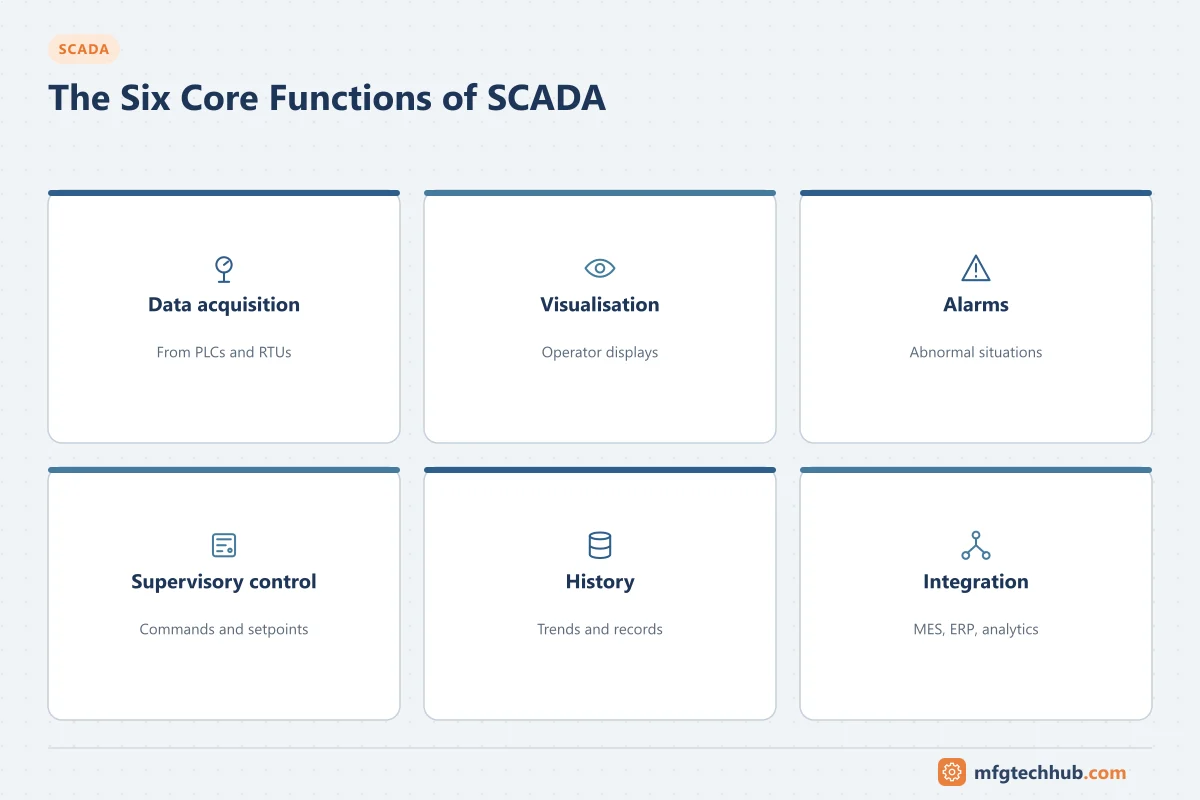
SCADA (Supervisory Control and Data Acquisition) is the layer that lets people see and supervise an automated process. PLCs, RTUs and DCS controllers do the actual control; SCADA gathers their data, shows it to operators, raises alarms, records history and sends supervisory commands such as starting a pump station or changing a setpoint.
This article explains what SCADA does, the benefits it brings, its limitations, and how it fits with other systems. For the basics of components and architecture, start with What Is SCADA?.
Where SCADA sits
| Layer | Does | Examples |
|---|---|---|
| Field devices | Measure and act | Transmitters, valves, motors |
| Controllers | Real-time control, interlocks, sequences | PLCs, RTUs, DCS controllers |
| SCADA / HMI | Supervise: visualise, alarm, command, record | SCADA servers, operator stations, historian |
| MES / ERP | Manage production and business | Orders, quality, inventory, finance |
SCADA is Level 2 in the ISA-95 and Purdue models. See How a Factory Works.
The six core functions
1. Data acquisition
SCADA collects values, states and events from controllers using drivers and protocols such as OPC UA, Modbus, DNP3, IEC 60870-5-104 or vendor protocols. Remote sites often use report-by-exception to save bandwidth. See SCADA Data Acquisition.
2. Visualisation
Operators see the process on displays: overviews, unit displays, equipment faceplates and trends. Good displays show abnormal conditions clearly and support fast decisions. See SCADA Data Presentation and Customising HMI Displays.
3. Alarms and events
SCADA detects abnormal conditions, notifies operators (and on-call staff), and records events with timestamps. An effective alarm system follows an alarm philosophy (ISA-18.2 / IEC 62682) so that operators only receive alarms that require action. See Setting Up SCADA Alarms.
4. Supervisory control
Operators send commands: start and stop equipment, change modes and setpoints, acknowledge alarms. Control logic and protective interlocks remain in the controllers, so the process stays safe if SCADA is unavailable. See SCADA Control and Command Functions.
5. History and reporting
A historian stores time-series data for trends, shift and compliance reports, and investigations. See SCADA Data Processing.
6. Integration
SCADA passes data to MES, maintenance systems, historians and analytics platforms through OPC UA, SQL, APIs or MQTT.
Real benefits
| Benefit | How it comes about | Measure it with |
|---|---|---|
| Visibility | One view of many machines or remote sites | Time to detect abnormal conditions |
| Fewer site visits | Remote monitoring and control of unmanned sites | Travel and call-out hours |
| Faster fault response | Alarms with context, diagnostics, on-call notification | Mean time to respond and repair |
| Consistent operation | Standard displays, procedures and supervisory sequences | Variation between shifts |
| Records and compliance | Automatic history and event logs | Effort for regulatory and quality reports |
| Data for improvement | Trends and history for engineers | Number of improvement actions based on data |
| Energy and resource awareness | Consumption trends and alarms | Energy per unit, leak detection |
The size of these benefits depends on the starting point. A water utility moving from manual site visits to telemetry gains far more than a plant replacing one SCADA with another.
Limitations and risks
- Not a controller: SCADA scripts should not replace PLC or DCS logic for time-critical or safety functions.
- Alarm overload: poorly configured systems overwhelm operators with nuisance alarms.
- Communication dependency: remote sites need local autonomy for when links fail.
- Cybersecurity exposure: SCADA connects to many networks and is a common target; it needs segmentation, secure remote access and patching. See SCADA Challenges and Considerations.
- Lifecycle effort: servers, operating systems and software need regular updates and testing.
- Data without context: tag values alone do not explain production performance; MES and good data models add context.
SCADA vs PLC vs DCS vs MES
| System | Main purpose | Timescale |
|---|---|---|
| PLC | Controls machines and processes | Milliseconds |
| DCS | Integrated control and operation of large process plants | Milliseconds to seconds (control), seconds (operation) |
| SCADA | Supervises distributed controllers, often across wide areas | Seconds to minutes |
| MES | Manages production orders, materials, quality, performance | Minutes to shifts |
In process plants, the DCS usually provides the operator interface itself; SCADA is more common for utilities, infrastructure, multi-vendor PLC systems and geographically distributed assets. See DCS vs PLC.
Frequently asked questions
Does SCADA control the process?
SCADA sends supervisory commands, but the real-time control and protective interlocks run in PLCs, RTUs or DCS controllers. The process should remain safe and controlled if SCADA fails.
What industries use SCADA the most?
Water and wastewater, electricity transmission and distribution, oil and gas pipelines, renewable energy, transportation infrastructure and manufacturing. See SCADA Applications by Industry.
Is HMI the same as SCADA?
An HMI is the operator interface, often for a single machine or unit. SCADA is a larger system that includes data acquisition from many controllers, alarm management, history, supervisory control and integration, and it uses HMIs as its operator interface.
Key takeaways
- SCADA acquires data, visualises it, manages alarms, sends supervisory commands, records history and integrates with other systems.
- Its benefits are visibility, faster response, fewer site visits, consistent operation and data for improvement.
- Control and safety belong in controllers; SCADA needs good alarm management, security and lifecycle support.
Related tutorials
Before you apply this in a plant: this article is for education. Always check the current edition of the relevant standards, the manufacturer's documentation for your exact product and version, and your site's procedures. Safety-related work needs qualified personnel. See our editorial policy.